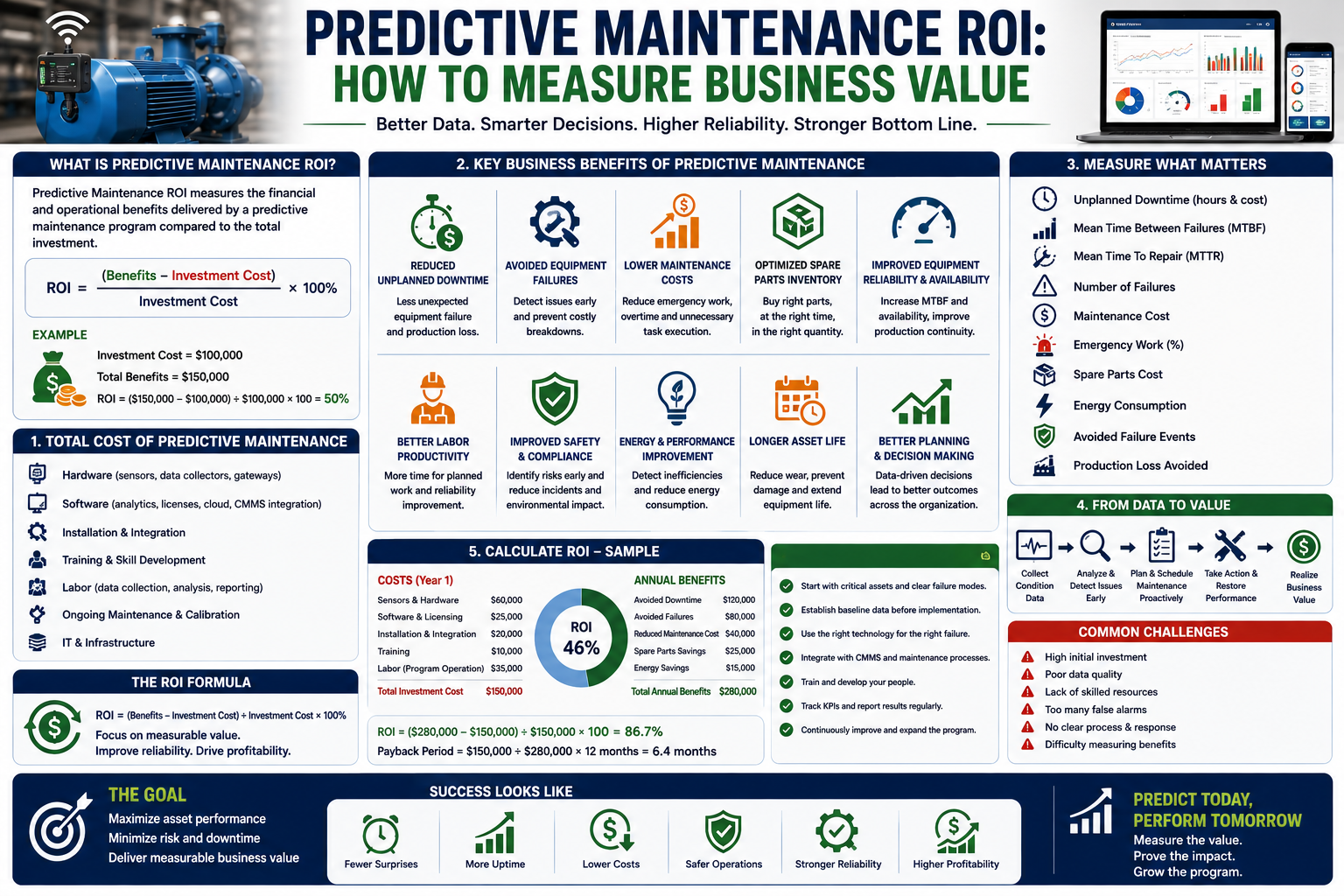
Predictive maintenance is becoming an important part of modern industrial asset management. By using condition-monitoring technologies, sensors, analytics, and equipment data, organizations can identify developing failures before they result in unexpected breakdowns.
However, implementing predictive maintenance requires investment.
Organizations may need to purchase sensors, monitoring equipment, software, data platforms, training, installation services, and specialist expertise. Because of this investment, maintenance managers and business leaders need to answer an important question:
Does predictive maintenance actually create measurable business value?
The answer can be determined by measuring Return on Investment (ROI).
Predictive Maintenance ROI is not simply about calculating how much money was saved on repairs. A successful program can create value through reduced downtime, improved reliability, better maintenance planning, reduced spare-parts consumption, improved safety, increased production, and longer asset life.
This guide explains how organizations can measure the business value of predictive maintenance.
What Is Predictive Maintenance ROI?
Predictive Maintenance ROI measures the financial and operational benefits generated by a predictive maintenance program compared with the cost of implementing and operating that program.
A basic ROI calculation is:
ROI = (Benefits − Investment Cost) ÷ Investment Cost × 100
For example, if a predictive maintenance program costs $100,000 and generates $150,000 in measurable benefits:
ROI = ($150,000 − $100,000) ÷ $100,000 × 100 = 50%
However, calculating predictive maintenance ROI in an industrial environment can be more complicated because many benefits are indirect.
Why Measuring Predictive Maintenance ROI Matters
Without proper measurement, predictive maintenance can become a technology project rather than a business improvement program.
Measuring ROI helps organizations determine:
- Whether the program is financially successful
- Which assets provide the greatest value
- Which monitoring technologies are most effective
- Whether the program should be expanded
- Where resources should be allocated
- Whether maintenance performance is improving
ROI measurement also helps maintenance teams communicate the value of reliability activities to senior management.
1. Calculate the Total Cost of Predictive Maintenance
Before calculating benefits, determine the full cost of the program.
Costs may include:
Hardware Costs
- Sensors
- Data collectors
- Monitoring devices
- Gateways
- Inspection equipment
Software Costs
- Condition-monitoring software
- Analytics platforms
- Cloud services
- CMMS integration
- Data storage
Installation Costs
Installing sensors and communication systems can require engineering and labor resources.
Training Costs
Employees may need training in:
- Vibration analysis
- Thermography
- Oil analysis
- Data analytics
- Sensor technology
Labor Costs
Specialists may be required to collect, analyze, and interpret condition data.
Maintenance Costs
Sensors and monitoring equipment themselves require inspection, calibration, replacement, and maintenance.
The total cost should include both initial investment and ongoing operating costs.
2. Measure Reduced Unplanned Downtime
One of the most important financial benefits of predictive maintenance is reduced unplanned downtime.
Equipment failures can stop production and create significant financial losses.
For example, suppose a production line generates $20,000 of contribution margin per hour.
If predictive maintenance prevents 10 hours of unplanned downtime:
10 × $20,000 = $200,000
The organization may therefore attribute up to $200,000 of avoided production loss to the maintenance improvement, depending on how the financial calculation is structured.
However, organizations should avoid overstating savings.
The calculation should consider whether production could actually have been recovered elsewhere or whether the full production value represents genuine economic benefit.
3. Measure Avoided Equipment Failures
Predictive maintenance can identify equipment deterioration before catastrophic failure.
Suppose vibration monitoring identifies a developing bearing problem.
The bearing is replaced during planned downtime, preventing a larger equipment failure.
The financial benefit may include:
- Avoided emergency repair
- Avoided secondary damage
- Reduced downtime
- Reduced overtime
- Reduced expedited shipping
- Reduced production losses
The value of an avoided failure can therefore be significantly greater than the cost of the component itself.
4. Measure Maintenance Cost Reduction
Predictive maintenance can reduce certain unnecessary maintenance activities.
Instead of replacing components according to fixed schedules, organizations may monitor their condition and replace them when deterioration indicates that intervention is appropriate.
Potential savings include:
- Reduced labor
- Lower spare-parts consumption
- Reduced contractor costs
- Reduced equipment opening and disassembly
- Reduced maintenance-induced failures
However, organizations should not assume that every reduction in scheduled maintenance represents a saving.
Some preventive maintenance activities remain necessary for safety, compliance, lubrication, inspection, and reliability.
5. Measure Spare-Parts Savings
Predictive maintenance can improve spare-parts planning.
When a developing failure is detected early, maintenance teams may have sufficient time to order the required component using normal procurement processes.
This can avoid:
- Emergency purchases
- Expedited shipping
- Premium supplier charges
- Excessive inventory
- Incorrect spare-parts orders
Predictive information can therefore improve both inventory efficiency and maintenance readiness.
6. Measure Improved Equipment Availability
Equipment availability is another important measure.
Availability can be influenced by:
- Equipment reliability
- Downtime
- Repair duration
- Maintenance planning
- Spare-parts availability
Predictive maintenance can improve availability by identifying problems early and allowing repairs to be planned.
For example:
Unexpected failure → Emergency repair
can become:
Condition alert → Planned maintenance → Controlled downtime
The second scenario can significantly reduce disruption to production.
7. Measure MTBF Improvement
Mean Time Between Failures (MTBF) measures the average operating time between equipment failures.
If predictive maintenance successfully identifies and addresses developing failure mechanisms, MTBF may increase.
For example:
Before predictive maintenance: 2,000 operating hours
After improvement: 3,500 operating hours
An increasing MTBF can indicate that equipment reliability is improving.
However, MTBF should be evaluated alongside other metrics rather than used as the only measure of success.
8. Measure MTTR Improvement
Mean Time To Repair (MTTR) measures the average time required to restore equipment after a failure.
Predictive maintenance can sometimes reduce MTTR indirectly by providing maintenance teams with more information about the problem.
Early identification allows teams to:
- Identify required spare parts
- Prepare tools
- Arrange skilled technicians
- Develop repair procedures
- Schedule permits
- Plan equipment isolation
As a result, repair activities may become faster and more organized.
9. Measure Labor Productivity
Predictive maintenance can improve maintenance workforce productivity.
Technicians spend less time responding to emergency breakdowns and more time performing planned work.
Consider a department where technicians previously spent 40% of their time responding to emergencies.
If predictive maintenance reduces emergency work to 20%, the organization may gain additional capacity for:
- Planned maintenance
- Reliability improvement
- Inspections
- Equipment upgrades
- Root Cause Analysis
- Preventive-maintenance optimization
This productivity improvement can have significant business value.
10. Measure Energy and Performance Improvements
Equipment deterioration can sometimes increase energy consumption.
For example, mechanical problems, poor alignment, damaged bearings, blocked filters, or inefficient operating conditions may cause equipment to consume more energy.
Monitoring equipment performance can help identify these conditions.
Potential benefits include:
- Reduced electricity consumption
- Improved motor efficiency
- Reduced process losses
- Better equipment performance
Energy savings can therefore become another component of predictive maintenance ROI.
11. Include Safety and Environmental Benefits
Not every predictive maintenance benefit is easily converted into money.
Early detection of equipment problems can help reduce certain safety and environmental risks.
For example, monitoring may help identify:
- Abnormal temperatures
- Pressure abnormalities
- Equipment degradation
- Leakage
- Electrical problems
- Mechanical deterioration
Avoiding an incident may have enormous value even if no direct financial saving can be assigned.
These benefits should be tracked separately as risk-reduction benefits rather than forcing an uncertain monetary value into the ROI calculation.
12. Establish a Baseline Before Implementation
One of the most important steps in measuring ROI is establishing a baseline.
Before implementing predictive maintenance, record current performance.
Useful baseline metrics include:
- Unplanned downtime
- Equipment failures
- Maintenance costs
- Emergency work
- MTBF
- MTTR
- Spare-parts consumption
- Production losses
- Energy consumption
After implementation, compare the new results with the baseline.
For example:
| KPI | Before | After |
|---|---|---|
| Unplanned downtime | 120 hours | 70 hours |
| MTBF | 1,800 hours | 2,900 hours |
| Emergency work | 35% | 18% |
| Maintenance cost | $500,000 | $430,000 |
This comparison provides evidence of program performance.
13. Calculate Cost Avoidance Carefully
One of the biggest challenges in predictive maintenance ROI is determining whether a failure was actually avoided.
A useful approach is to document verified avoided failure events.
For each event, record:
- Equipment
- Failure mode
- Condition detected
- Recommended action
- Action taken
- Expected failure consequence
- Actual downtime
- Repair cost
- Production impact
This creates an auditable record of predictive-maintenance value.
14. Use a Predictive Maintenance ROI Dashboard
A maintenance department can create a dashboard showing:
Financial KPIs
- Program cost
- Avoided repair cost
- Avoided downtime cost
- Spare-parts savings
- Labor savings
- Energy savings
- Net benefit
- ROI
Reliability KPIs
- MTBF
- MTTR
- Failure frequency
- Equipment availability
- Repeat failures
Predictive KPIs
- Number of assets monitored
- Alerts generated
- Significant alerts
- Verified failures detected
- False alarms
- Response time
- Avoided failures
A dashboard makes it easier for managers to understand the relationship between predictive maintenance activities and business results.
15. Consider Payback Period
ROI is useful, but organizations should also calculate the payback period.
Payback period estimates how long it takes for the benefits of the program to recover the initial investment.
For example:
Initial investment = $120,000
Average monthly benefit = $20,000
Approximate payback:
$120,000 ÷ $20,000 = 6 months
A shorter payback period may make the business case more attractive.
Common Mistakes When Measuring Predictive Maintenance ROI
Several mistakes can make ROI calculations unreliable.
Counting Every Alert as a Saved Failure
An alert is not automatically an avoided failure.
Ignoring Program Costs
Software, sensors, training, labor, installation, and maintenance should all be included.
Using Production Revenue as Guaranteed Savings
Not every hour of downtime necessarily represents lost profit.
Measuring Only Financial Benefits
Safety, reliability, and risk reduction can also be important outcomes.
Failing to Establish a Baseline
Without baseline data, it is difficult to demonstrate improvement.
How to Build a Strong Predictive Maintenance Business Case
A practical business case should follow this structure:
1. Identify the problem
What equipment failures or downtime are occurring?
2. Quantify the current impact
What does downtime, repair, and failure cost the organization?
3. Identify the predictive solution
What condition-monitoring technology can detect the relevant failure modes?
4. Calculate implementation cost
Include hardware, software, training, installation, and ongoing costs.
5. Estimate realistic benefits
Focus on measurable and defensible benefits.
6. Establish KPIs
Define how success will be measured.
7. Start with a pilot
Demonstrate value on a small number of critical assets.
8. Scale based on results
Expand the program where the business case is strongest.