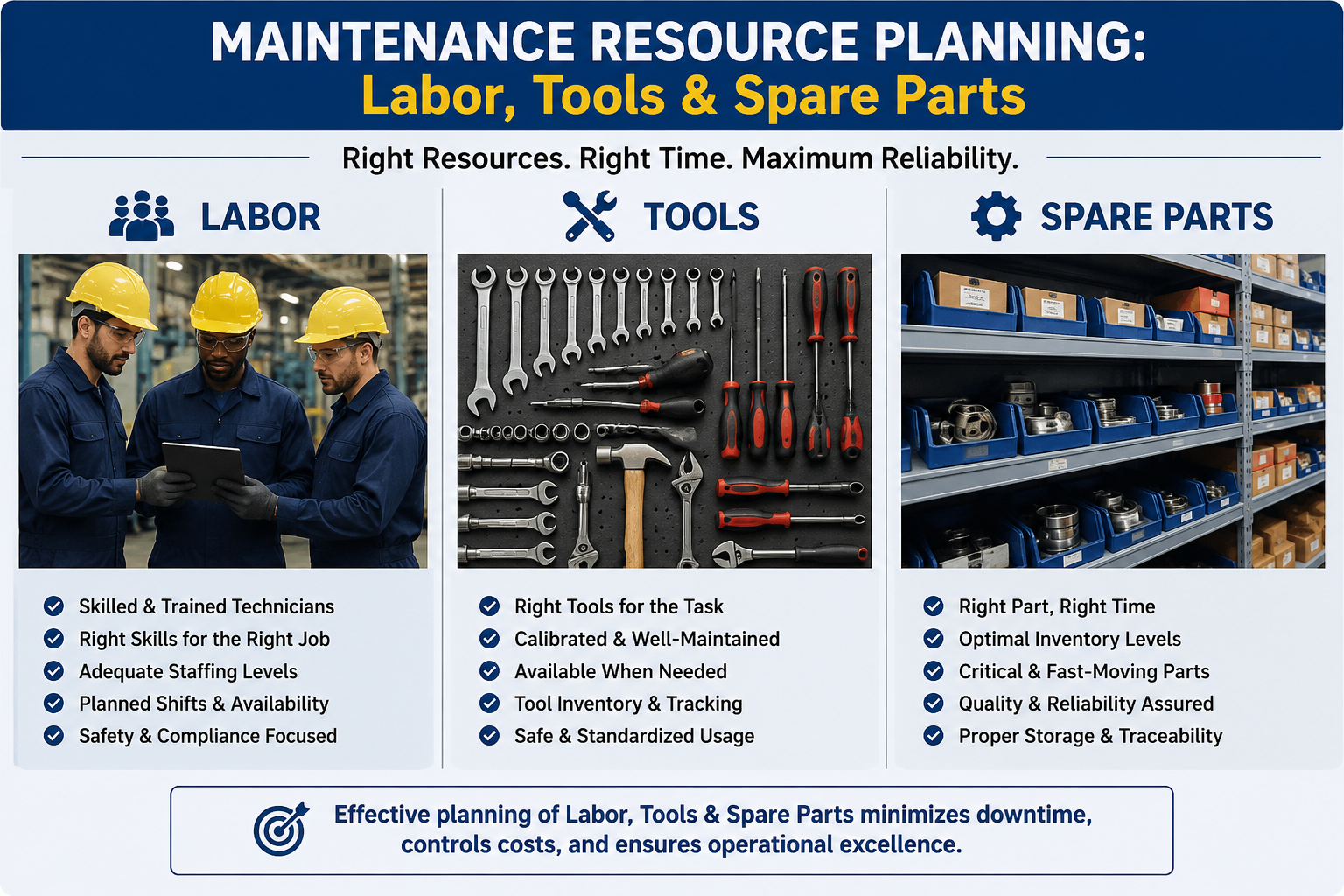
Effective maintenance depends on more than having a good maintenance strategy. Even the best preventive, predictive, or corrective maintenance program can fail if the maintenance team does not have the right people, tools, and spare parts available when the work needs to be performed.
This is why maintenance resource planning is an essential part of modern maintenance management.
Maintenance resource planning involves identifying, preparing, and coordinating the resources required to complete maintenance activities safely, efficiently, and on time. The three most important resource categories are labor, tools, and spare parts.
When these resources are properly planned, technicians spend more time performing productive maintenance and less time waiting for materials, searching for tools, or resolving avoidable problems.
This guide explains how organizations can improve maintenance resource planning and build a more reliable maintenance operation.
What Is Maintenance Resource Planning?
Maintenance resource planning is the process of determining what resources are required to execute planned maintenance work and ensuring those resources are available at the right time.
Resources may include:
- Maintenance personnel
- Specialized skills
- Tools
- Spare parts
- Consumables
- Equipment
- Contractors
- Lifting equipment
- Safety equipment
- Technical documentation
The objective is simple:
Right people + Right tools + Right parts + Right information + Right time
Without this combination, maintenance jobs can experience unnecessary delays.
Why Maintenance Resource Planning Matters
Poor resource planning can lead to:
- Maintenance delays
- Increased equipment downtime
- Low technician productivity
- Emergency purchases
- Higher labor costs
- Excessive inventory
- Poor schedule compliance
- Extended shutdowns
- Increased safety risks
For example, imagine a technician is scheduled to replace a motor bearing. The technician arrives at the machine, but the correct bearing is unavailable.
The technician cannot complete the job.
Labor has been scheduled, equipment may already be offline, and production may be waiting. The result is wasted time and potentially extended downtime.
Good resource planning prevents this type of situation.
1. Labor Resource Planning
Labor is one of the most important maintenance resources.
Maintenance departments require people with different technical skills, including:
- Mechanical technicians
- Electrical technicians
- Instrumentation technicians
- Welders
- Millwrights
- Reliability engineers
- Maintenance planners
- Maintenance supervisors
- Condition-monitoring specialists
The challenge is not simply having enough employees.
The organization needs the right skills at the right time.
Understanding Maintenance Skill Requirements
Different maintenance activities require different skills.
For example:
Pump overhaul: Mechanical skills
Motor testing: Electrical skills
Control-loop calibration: Instrumentation skills
Vibration analysis: Reliability or condition-monitoring expertise
Maintenance planners should identify the skills required for each job before scheduling it.
Estimating Labor Hours
Every planned maintenance activity should have a realistic labor estimate.
For example:
- Technician A: 4 hours
- Technician B: 4 hours
- Specialist: 2 hours
Total estimated labor:
10 labor hours
Accurate estimates help schedulers determine whether the available workforce can complete the planned workload.
Historical maintenance data can improve estimates over time.
If a particular job repeatedly takes six hours rather than the estimated four, the job plan should be updated.
Managing Workforce Capacity
Maintenance managers should understand the difference between total working hours and productive maintenance capacity.
A technician may work an eight-hour shift, but not all eight hours are available for direct maintenance activities.
Time may be consumed by:
- Meetings
- Training
- Travel
- Waiting
- Permit processes
- Material collection
- Administrative activities
- Emergency work
Therefore, schedules should be based on realistic productive capacity rather than theoretical working hours.
Using Contractors and Specialists
Some maintenance activities require external expertise.
Examples include:
- Major equipment overhauls
- NDT inspections
- Specialized alignment
- Crane operations
- Electrical testing
- Instrument calibration
- Welding inspection
Contractors should be planned well in advance, particularly for shutdowns and major maintenance events.
Their scope, manpower, tools, safety requirements, and expected duration should be clearly defined.
2. Tool Resource Planning
Having skilled technicians is not enough if they do not have the correct tools.
Maintenance tools can range from basic hand tools to highly specialized equipment.
Examples include:
- Torque wrenches
- Bearing pullers
- Hydraulic tools
- Laser alignment systems
- Vibration analyzers
- Multimeters
- Insulation-resistance testers
- Calibration equipment
- Lifting equipment
- Specialized disassembly tools
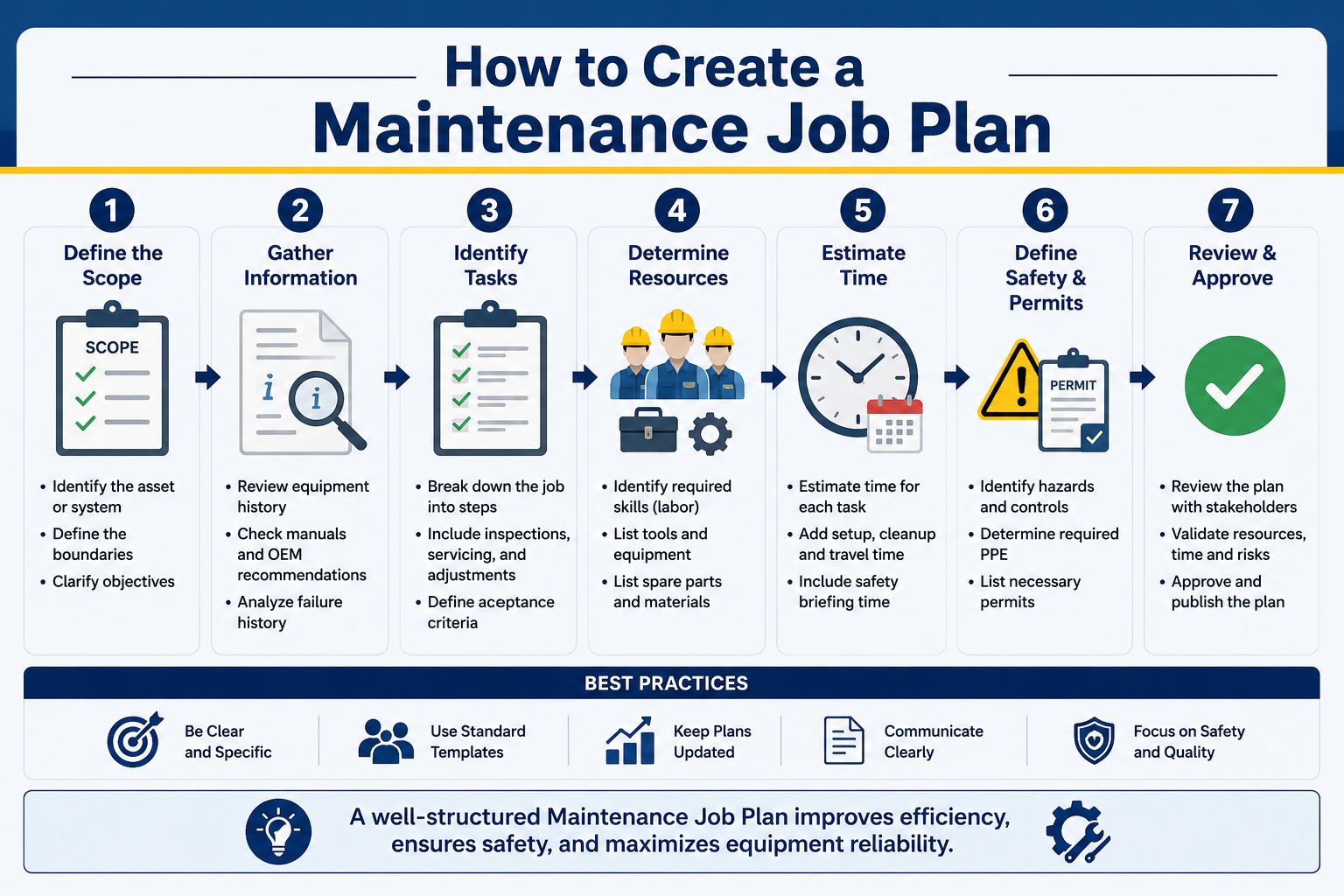
Identify Tools During Planning
Tools should be identified when the maintenance job is planned.
For example, a coupling alignment job may require:
- Laser alignment equipment
- Appropriate measuring devices
- Shims
- Torque tools
- Manufacturer alignment specifications
This prevents technicians from discovering tool requirements after the job has already started.
Tool Availability and Calibration
Critical measuring and testing equipment should be maintained and calibrated where required.
Examples include:
- Torque tools
- Pressure gauges
- Electrical meters
- Temperature instruments
- Calibration equipment
Using inaccurate measuring equipment can result in poor maintenance quality and premature equipment failure.
Tool Management
Organizations can improve tool availability by maintaining:
- Tool inventories
- Tool storage systems
- Calibration records
- Inspection schedules
- Tool reservation systems
A centralized tool management process can be particularly useful for large maintenance organizations.
3. Spare Parts Planning
Spare parts are another major component of maintenance resource planning.
A maintenance team may have sufficient labor and tools, but a missing spare part can prevent the job from being completed.
Common maintenance spares include:
- Bearings
- Mechanical seals
- Motors
- Gaskets
- Valves
- Belts
- Couplings
- Filters
- Sensors
- Electrical components
- Fasteners
Identify Critical Spare Parts
Not every component needs to be stored in large quantities.
Criticality analysis can help identify which spare parts require special attention.
Factors include:
- Equipment criticality
- Failure probability
- Replacement cost
- Supplier lead time
- Availability of alternatives
- Production consequences
- Safety consequences
A low-cost bearing with a two-week lead time may be more operationally important than an expensive component that can be delivered overnight.
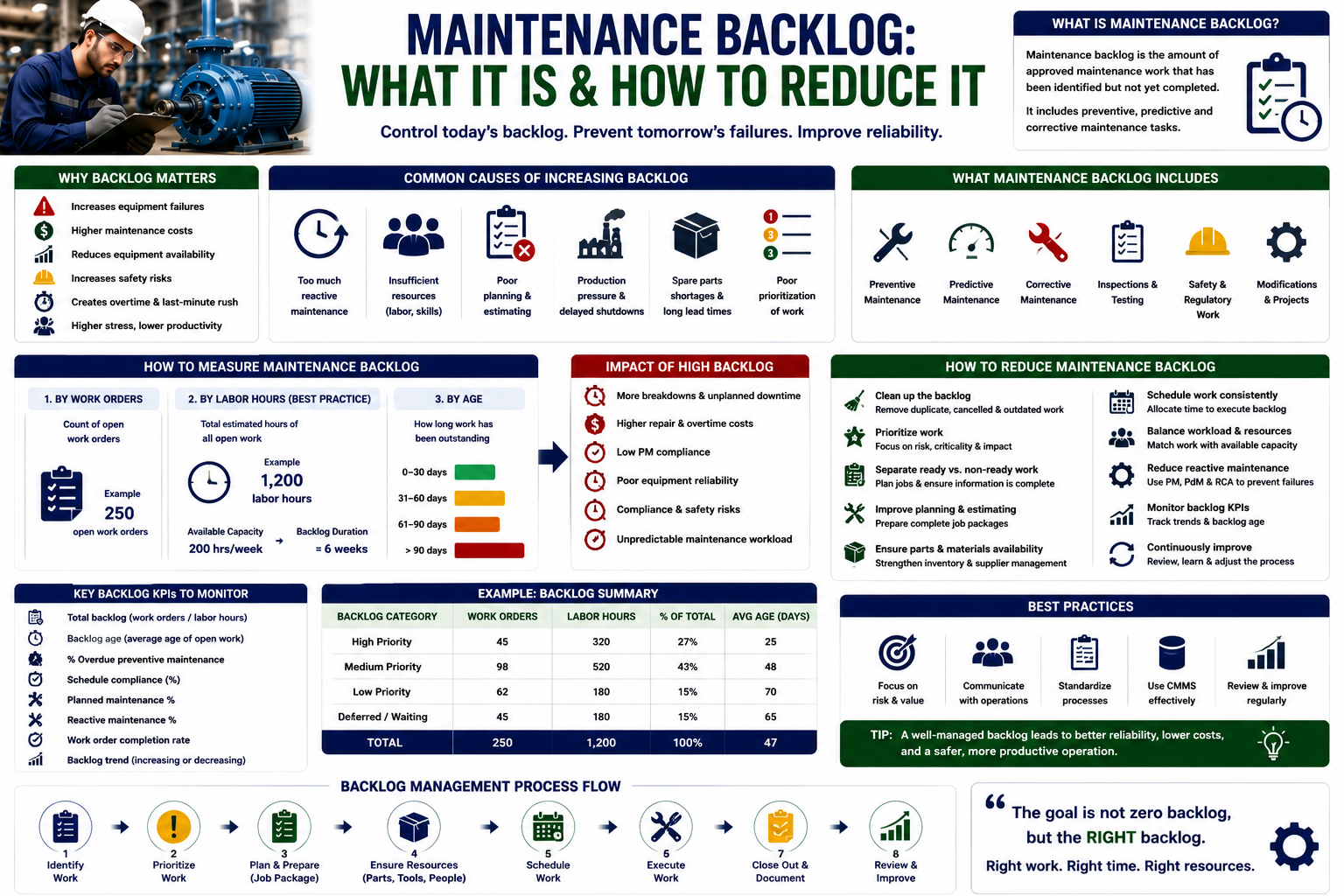
Inventory Levels
Maintenance organizations should establish appropriate inventory levels.
Too little inventory can result in:
- Extended downtime
- Emergency purchases
- Expedited shipping
- Production losses
Too much inventory can result in:
- Excess capital tied up
- Storage costs
- Obsolete parts
- Inventory management problems
The objective is to maintain the right inventory for the organization’s risk profile.
Spare Parts Identification
Incorrect spare-part identification is a common maintenance problem.
A replacement component should be verified for:
- Part number
- Dimensions
- Material
- Rating
- Manufacturer
- Compatibility
- Application
A component that physically fits may not necessarily be suitable for the operating conditions.
4. Integrating Labor, Tools, and Spare Parts
The real value of resource planning comes from integrating all three resource categories.
Consider a planned gearbox overhaul.
The job requires:
Labor: 3 mechanical technicians
Tools: Lifting equipment, torque tools, alignment equipment
Parts: Bearings, seals, gaskets, lubricant
If one of these resources is missing, the job may be delayed.
Therefore, maintenance planners should verify all requirements before a job is marked as ready to schedule.
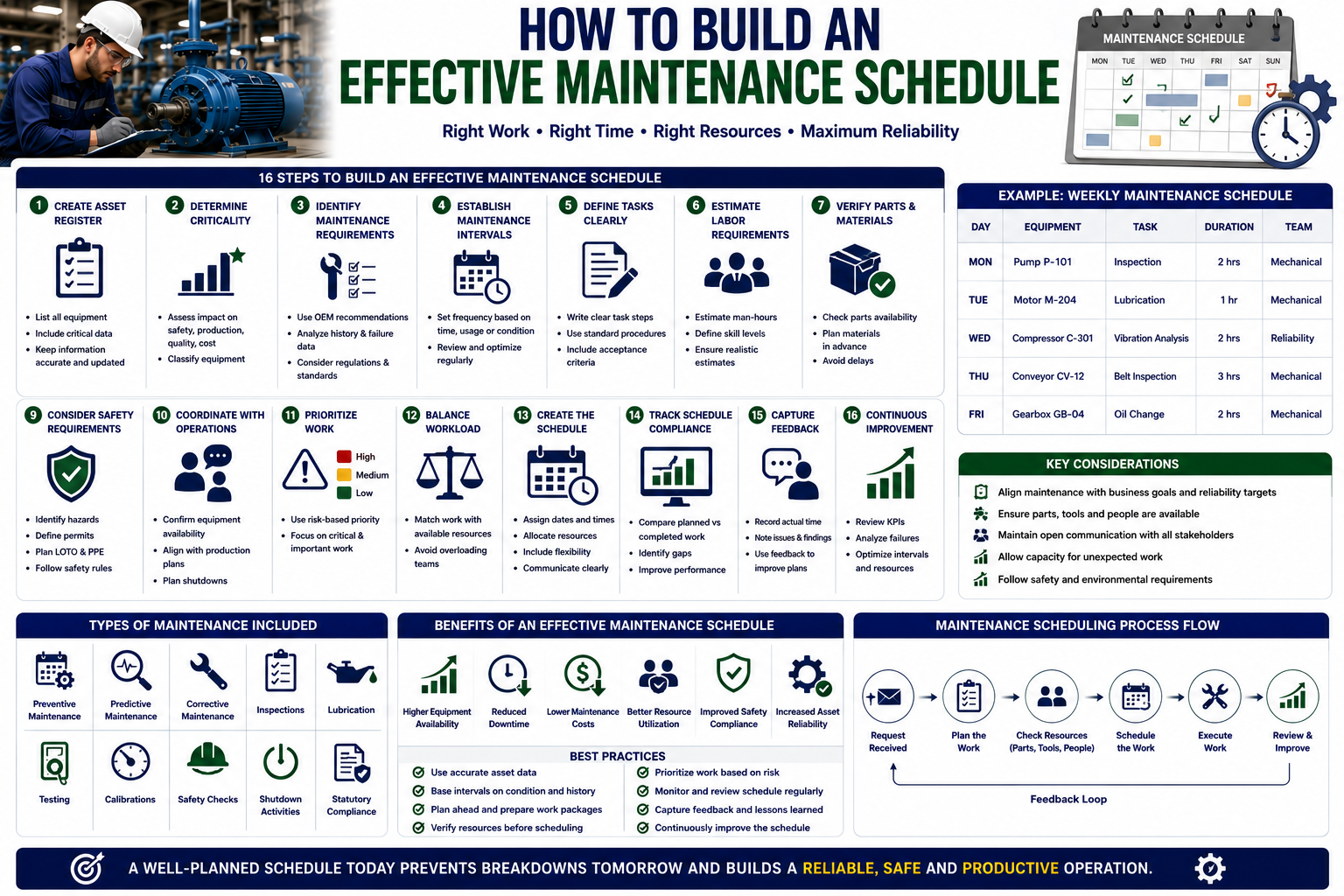
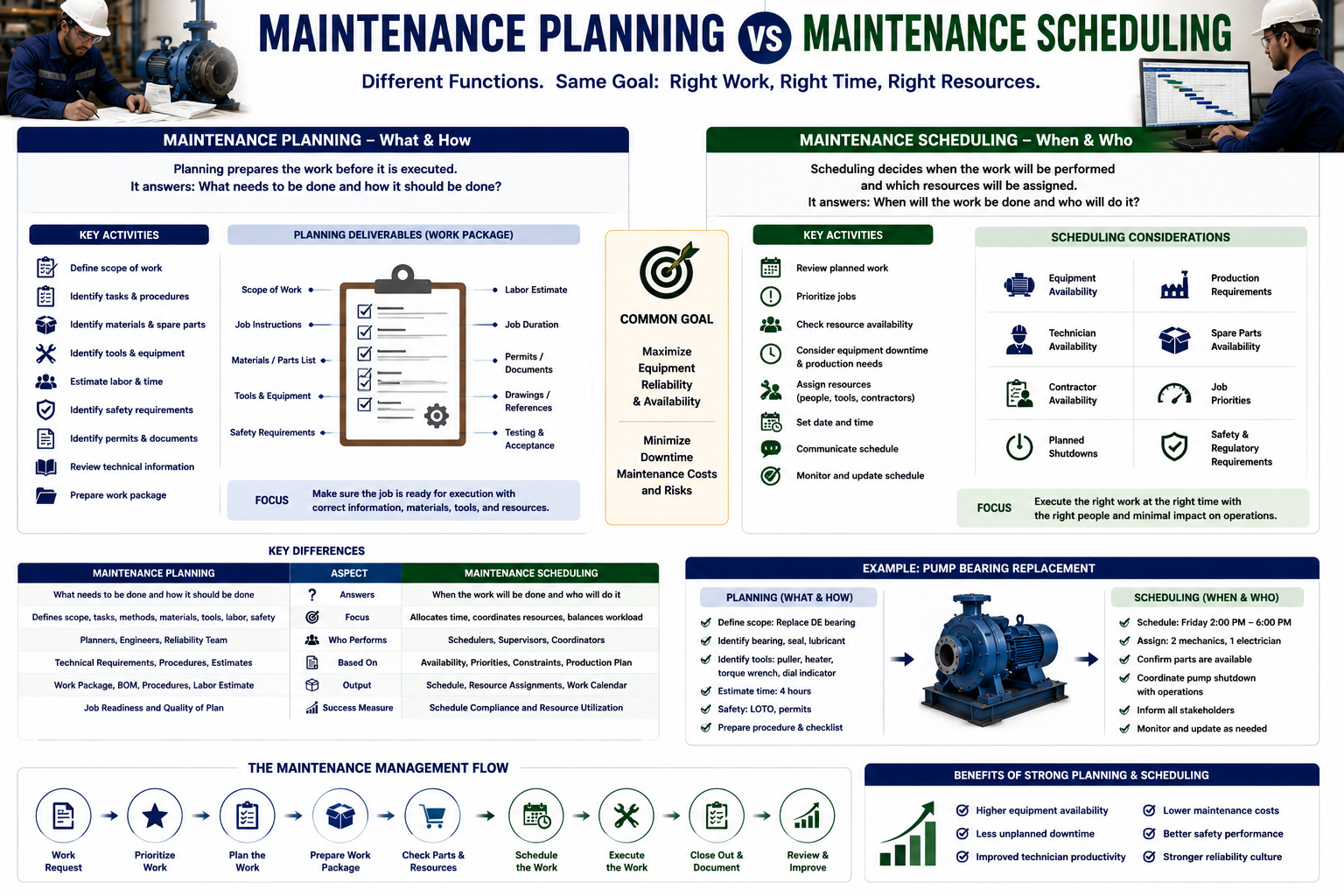
The Maintenance Planning Workflow
A strong resource-planning process can follow this sequence:
Work Request → Scope Definition → Job Planning → Labor Identification → Tool Identification → Spare-Part Identification → Safety Review → Resource Verification → Scheduling → Execution → Feedback
This workflow creates a structured connection between maintenance planning and execution.
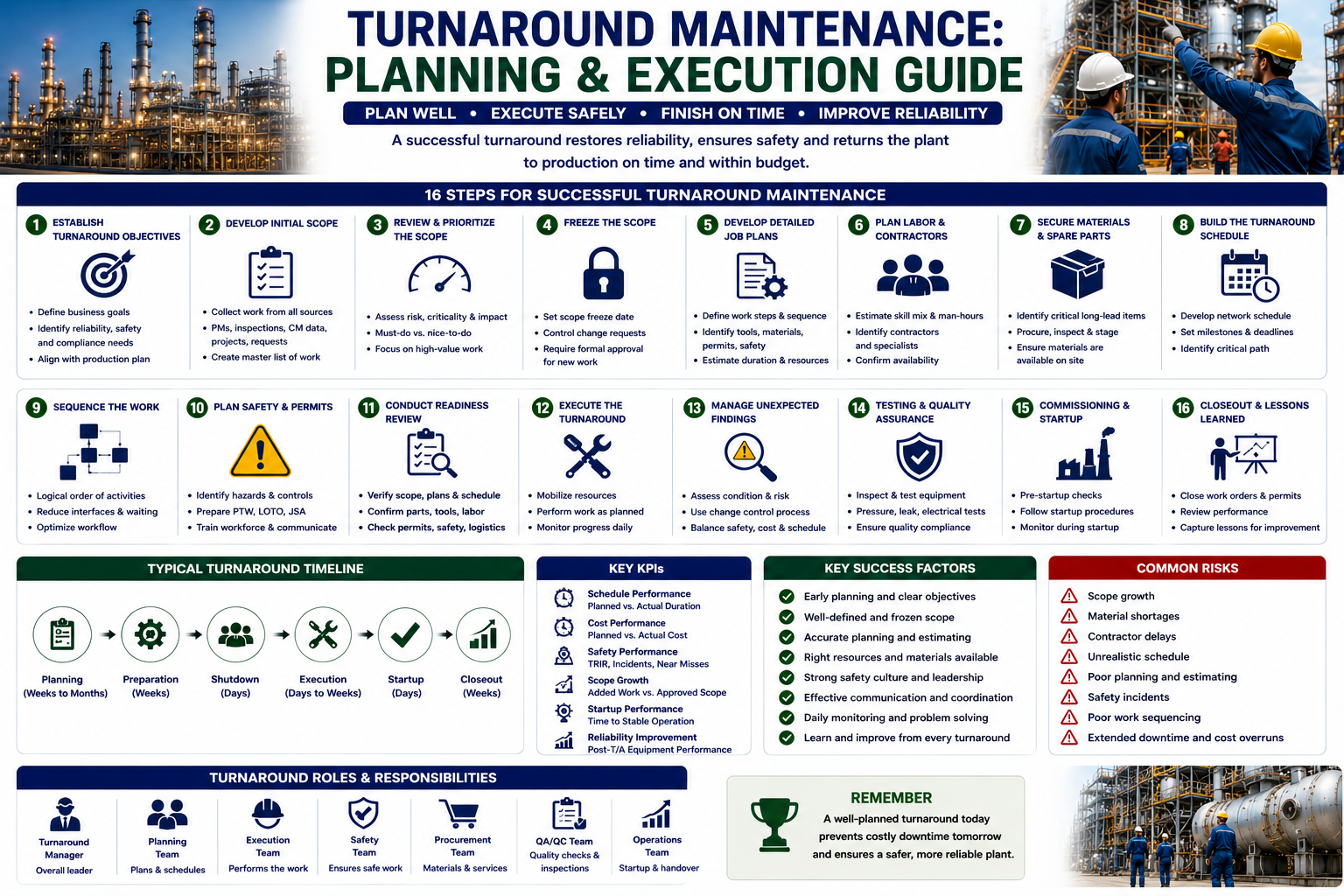
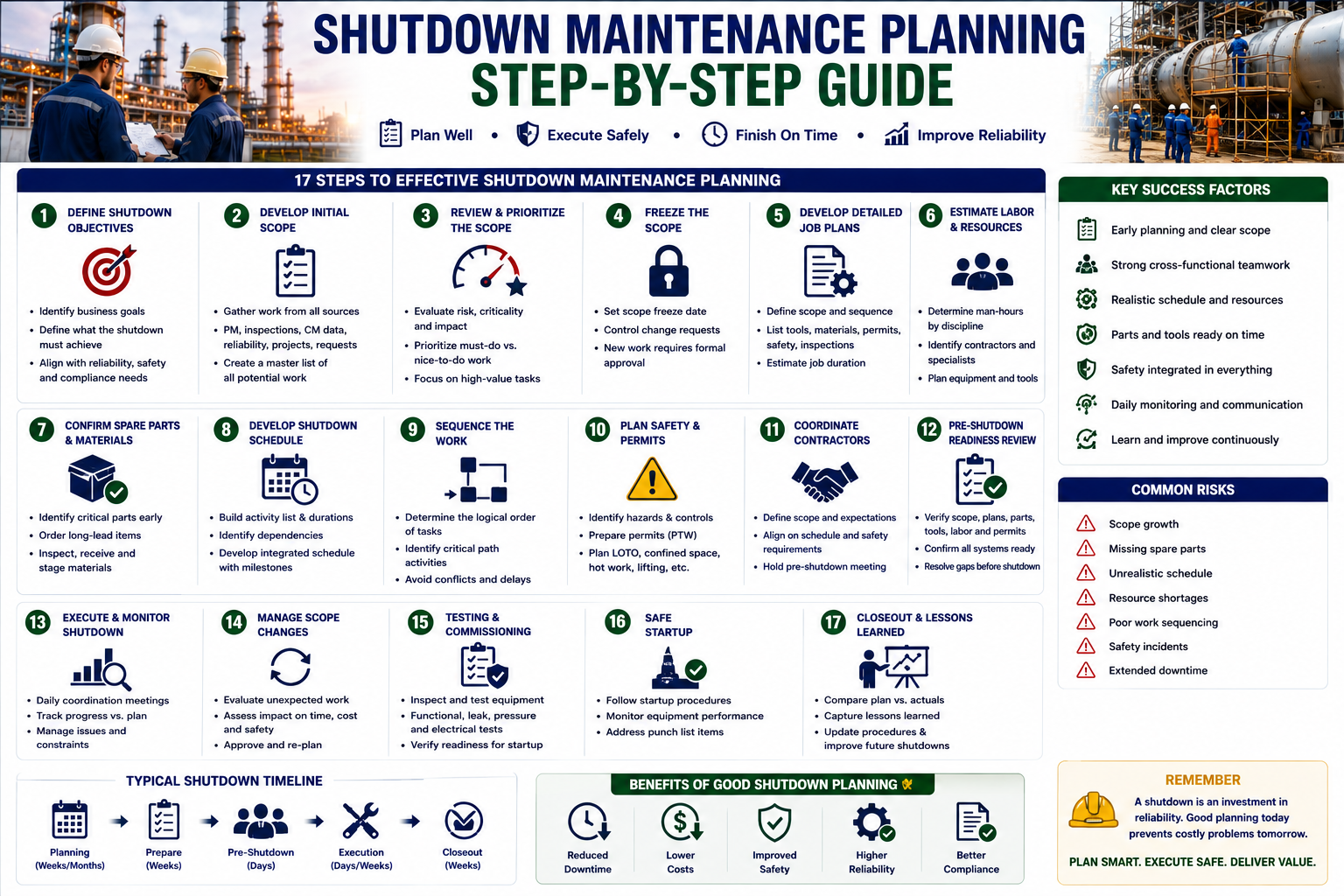
Resource Planning for Shutdowns
Resource planning becomes even more important during shutdowns and turnarounds.
Large shutdowns may require hundreds of workers and significant quantities of materials and specialized equipment.
Planning should include:
- Workforce requirements
- Contractor manpower
- Tool requirements
- Crane and lifting requirements
- Scaffolding
- Spare parts
- Consumables
- Temporary facilities
- Safety equipment
Long-lead materials should be identified months before the shutdown.
A single missing critical component can delay the entire shutdown schedule.
Using a CMMS for Resource Planning
A Computerized Maintenance Management System (CMMS) can help organizations manage maintenance resources.
A CMMS can track:
- Equipment
- Work orders
- Labor
- Job plans
- Spare parts
- Inventory
- Tools
- Maintenance history
- Planned schedules
For example, a maintenance work order can contain the required labor hours, spare parts, tools, and procedures.
This allows planners and schedulers to verify whether a job is truly ready before assigning it to technicians.
Key Maintenance Resource Planning KPIs
Organizations can monitor several indicators.
Labor Utilization
Measures how effectively available maintenance labor is being used.
Schedule Compliance
Measures how much scheduled work is completed as planned.
Material Availability
Measures whether required spare parts are available when needed.
Tool Availability
Tracks whether required tools are accessible when maintenance work begins.
Waiting Time
Measures time lost because technicians are waiting for labor, parts, tools, permits, or equipment access.
Maintenance Productivity
Helps determine how effectively maintenance resources are converted into completed work.
Common Resource Planning Mistakes
Planning Labor Without Skills
Having enough technicians does not help if the required specialist is unavailable.
Scheduling Jobs Without Parts
This creates avoidable delays.
Ignoring Specialized Tools
Technicians may arrive without equipment necessary to complete the work.
Overstocking Everything
Excessive inventory increases cost and can create obsolete stock.
Poor Communication
Maintenance, stores, procurement, and operations must communicate regularly.
Not Using Historical Data
Past job performance can provide valuable information for future planning.
Best Practices
Organizations can improve maintenance resource planning by:
- Maintaining an accurate asset register.
- Creating detailed job plans.
- Estimating labor realistically.
- Maintaining a skills matrix.
- Identifying tools during planning.
- Managing tool calibration.
- Classifying spare parts according to criticality.
- Monitoring supplier lead times.
- Maintaining appropriate inventory levels.
- Verifying resources before scheduling.
- Using CMMS data.
- Capturing technician feedback.
- Reviewing resource constraints regularly.
- Continuously improving job estimates.