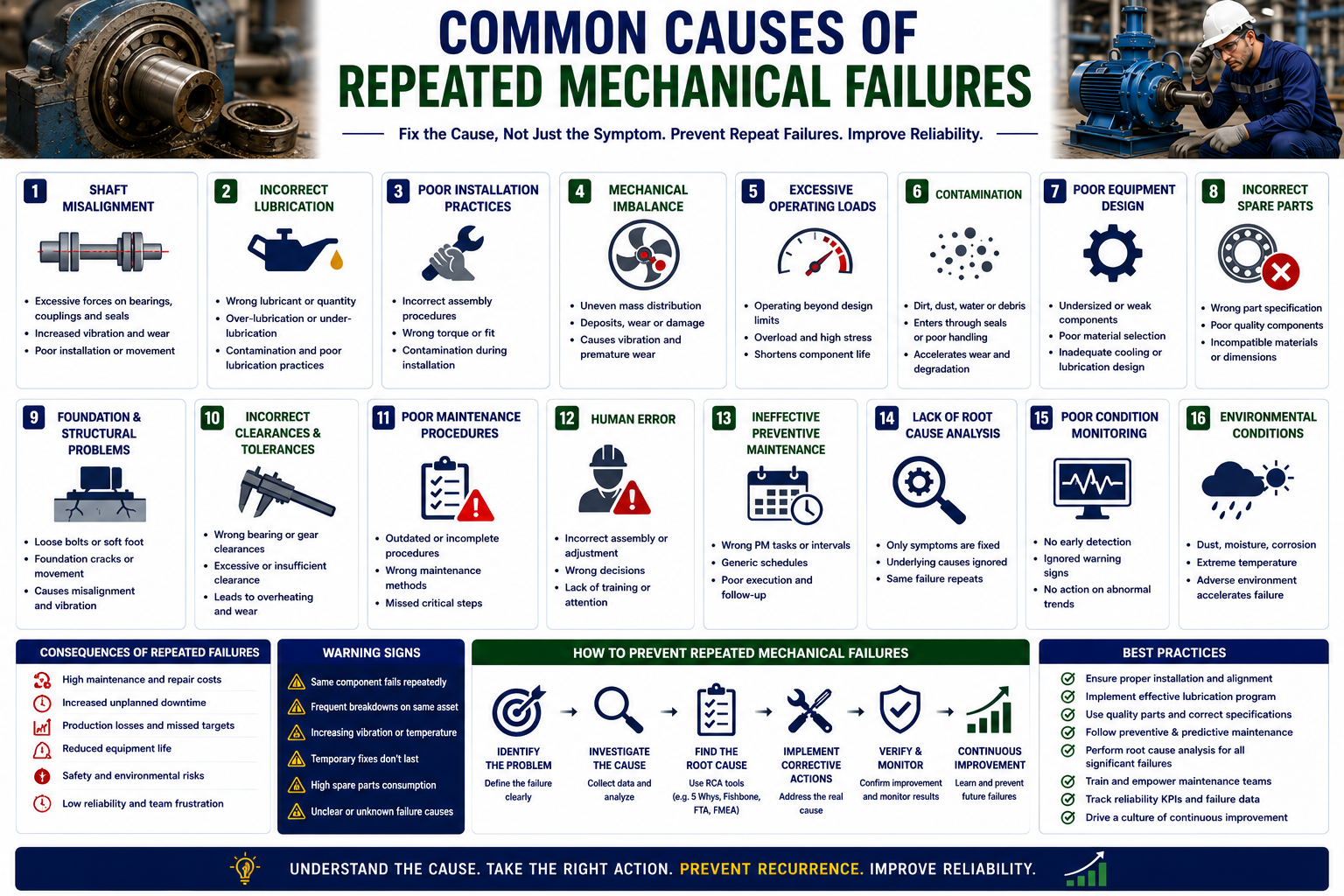
Repeated mechanical failures are among the most frustrating problems faced by maintenance and reliability teams. A machine is repaired, returned to service, and then fails again—sometimes within weeks or even days.
Replacing the failed component may restore equipment operation temporarily, but if the underlying cause is not identified, the same failure can continue to occur.
Repeated failures increase maintenance costs, spare-parts consumption, emergency work, production downtime, and safety risks. They also consume valuable maintenance resources that could otherwise be used for planned reliability improvement.
The solution is to move beyond simply repairing failed components and investigate why the failure keeps happening.
This article explains the most common causes of repeated mechanical failures and how maintenance engineers can prevent them.
What Is a Repeated Mechanical Failure?
A repeated mechanical failure occurs when the same equipment or component experiences the same or a closely related failure multiple times.
Examples include:
- Bearings repeatedly failing
- Couplings repeatedly breaking
- Gear teeth repeatedly wearing or cracking
- Seals repeatedly leaking
- Shafts repeatedly failing
- Pumps repeatedly developing vibration
- Belts repeatedly breaking
- Lubricated components repeatedly overheating
A repeated failure is an important warning sign.
It usually indicates that the organization has corrected the symptom without eliminating the underlying failure mechanism.
For example:
Bearing failure → Bearing replacement → Machine operates → Bearing failure again
A reliability-focused approach asks:
Why is the bearing repeatedly failing?
1. Shaft Misalignment
Misalignment is one of the most common causes of repeated problems in rotating equipment.
When connected shafts are not correctly aligned, additional forces can be transferred through:
- Bearings
- Couplings
- Seals
- Shafts
- Gearboxes
These forces can increase vibration, heat generation, and component wear.
Misalignment can occur because of:
- Poor installation
- Foundation movement
- Thermal growth
- Pipe strain
- Loose mounting bolts
- Equipment movement
- Incorrect alignment procedures
Simply replacing a damaged bearing will not solve the problem if the shaft remains misaligned.
Precision alignment should therefore be performed during installation and after major maintenance activities.
2. Incorrect Lubrication
Lubrication problems are another major contributor to repeated mechanical failures.
A component may fail because of:
- Insufficient lubricant
- Excessive lubricant
- Incorrect lubricant
- Contaminated lubricant
- Incorrect lubrication interval
- Poor lubricant storage
- Mixing incompatible lubricants
Both under-lubrication and over-lubrication can create problems.
For example, insufficient lubrication can increase friction and wear, while excessive grease can increase temperature and affect bearing operation.
A reliable lubrication program should specify:
- Lubricant type
- Quantity
- Application method
- Frequency
- Storage requirements
- Contamination controls
3. Poor Installation Practices
Mechanical components can fail prematurely when they are installed incorrectly.
Common installation errors include:
- Incorrect bearing installation
- Excessive force during assembly
- Incorrect torque
- Improper coupling installation
- Incorrect clearances
- Contamination during assembly
- Incorrect shaft fit
For example, applying force through the rolling elements of a bearing during installation can damage the bearing before the equipment even begins operating.
Installation procedures should therefore be standardized, and technicians should use appropriate tools and techniques.
4. Mechanical Imbalance
Rotating equipment can experience repeated failures when rotating components are out of balance.
Imbalance can result from:
- Uneven mass distribution
- Deposits on rotating components
- Corrosion
- Wear
- Damaged blades
- Improper repairs
- Manufacturing issues
Imbalance creates centrifugal forces that increase with rotational speed.
The resulting vibration can accelerate bearing, coupling, shaft, and foundation problems.
Vibration analysis and dynamic balancing can help identify and correct these conditions.
5. Excessive Operating Loads
Machines are designed to operate within specific load ranges.
Repeated failures can occur when equipment is consistently overloaded.
Examples include:
- Excessive torque
- High process pressure
- Excessive flow
- High mechanical loads
- Frequent overload conditions
- Operation outside the manufacturer’s recommended range
Overloading can increase stress on shafts, gears, bearings, couplings, and other components.
Maintenance and operations teams should therefore work together to verify that equipment is operating within appropriate limits.
6. Contamination
Contamination can significantly reduce the life of mechanical components.
Common contaminants include:
- Dust
- Dirt
- Water
- Chemicals
- Metal particles
- Process materials
Contamination can enter through damaged seals, poor storage practices, open equipment, or inadequate housekeeping.
Bearings, gears, hydraulic systems, and lubricants are particularly vulnerable.
Effective contamination control may require:
- Improved seals
- Filtration
- Proper housekeeping
- Clean lubrication practices
- Correct component storage
- Regular inspections
7. Poor Equipment Design
Sometimes the problem is not maintenance—it is the original equipment design.
Repeated failures may occur because of:
- Undersized components
- Poor material selection
- Inadequate cooling
- Excessive stress
- Poor accessibility
- Weak structural design
- Inadequate lubrication arrangements
If the same component repeatedly fails despite correct maintenance and operation, engineers should question whether the equipment design itself contributes to the problem.
A design modification may provide a more permanent solution than repeated component replacement.
8. Incorrect Spare Parts
Using the wrong replacement component can create recurring failures.
Examples include:
- Incorrect bearing specification
- Wrong seal material
- Incorrect gear dimensions
- Wrong shaft material
- Poor-quality replacement components
- Components that do not meet engineering specifications
A replacement part may physically fit the machine but still be unsuitable for its operating conditions.
Critical spare parts should therefore be specified according to equipment requirements rather than selected solely based on physical similarity or low price.
9. Foundation and Structural Problems
Equipment foundations and support structures play an important role in mechanical reliability.
Problems may include:
- Loose foundation bolts
- Soft foot
- Foundation cracking
- Structural movement
- Poor grouting
- Excessive flexibility
These conditions can contribute to vibration, misalignment, and abnormal loading.
If a machine continues to experience vibration after component replacement, engineers should investigate the foundation and supporting structure rather than focusing exclusively on internal components.
10. Incorrect Clearances and Tolerances
Mechanical components are designed with specific clearances and tolerances.
Incorrect clearances can cause:
- Excessive wear
- Heat generation
- Contact between components
- Reduced efficiency
- Vibration
- Premature failure
Examples include bearing clearances, gear backlash, shaft fits, and seal clearances.
During maintenance, technicians should verify critical dimensions using appropriate measurement equipment.
11. Poor Maintenance Procedures
A maintenance team can unintentionally create recurring failures when procedures are incomplete or outdated.
Problems may include:
- Missing torque specifications
- Incorrect assembly sequence
- Poor alignment instructions
- Inadequate inspection requirements
- Incorrect lubrication instructions
- Missing acceptance criteria
Maintenance procedures should be reviewed regularly and updated when equipment, components, or operating conditions change.
12. Human Error
Human factors can contribute to repeated mechanical failures.
Examples include:
- Incorrect assembly
- Wrong lubricant selection
- Failure to follow procedures
- Incorrect measurements
- Improper equipment adjustment
- Failure to report abnormal conditions
However, simply blaming a technician rarely solves the problem.
A proper investigation should ask why the error occurred.
Was the procedure unclear?
Was the technician properly trained?
Were the correct tools available?
Was the equipment information accurate?
Was production pressure influencing the work?
Understanding these factors can lead to more effective corrective actions.
You may also like: Screw Compressor Vs Reciprocating Compressor: Proven Guide
13. Poor Preventive Maintenance Strategy
A machine may continue failing despite having a preventive maintenance program.
This can happen when PM tasks:
- Do not address the actual failure mode
- Are performed too frequently
- Are performed too infrequently
- Are based only on generic recommendations
- Are not updated using failure history
- Are poorly executed
Preventive maintenance should be connected to known failure mechanisms.
Historical failure data can help determine whether existing maintenance tasks are actually preventing failures.
14. Failure to Perform Root Cause Analysis
One of the biggest reasons mechanical failures repeat is the failure to investigate them properly.
A typical reactive approach is:
Machine fails → Replace component → Restart machine
A proactive approach is:
Machine fails → Preserve evidence → Investigate failure → Identify cause → Correct cause → Monitor results
Root Cause Analysis tools such as 5 Whys, Fishbone Diagrams, Fault Tree Analysis, and FMEA can help identify deeper causes.
15. Poor Condition Monitoring
Condition monitoring can provide early warning of developing mechanical problems.
Techniques such as:
- Vibration analysis
- Thermography
- Oil analysis
- Ultrasonic inspection
- Temperature monitoring
can help identify deterioration before catastrophic failure.
However, condition monitoring is effective only when measurements are collected correctly and acted upon.
If an abnormal vibration trend is identified but no maintenance action is taken, the monitoring system provides little practical reliability benefit.
16. Environmental Conditions
Environmental conditions can accelerate mechanical deterioration.
Potential factors include:
- High temperatures
- High humidity
- Dust
- Water
- Corrosive chemicals
- Excessive vibration
- Outdoor exposure
Equipment operating in harsh environments may require additional sealing, cooling, filtration, corrosion protection, or inspection.
How to Investigate Repeated Mechanical Failures
When the same failure occurs repeatedly, maintenance engineers should follow a structured process.
Step 1: Define the Failure
Clearly identify the equipment, component, failure mode, and consequences.
Step 2: Review Historical Data
Look at previous failures, repairs, operating hours, and maintenance activities.
Step 3: Preserve Evidence
Inspect failed components before disposal or replacement.
Step 4: Identify Failure Patterns
Look for relationships between failures and:
- Operating conditions
- Maintenance activities
- Environmental conditions
- Equipment modifications
Step 5: Perform Root Cause Analysis
Use appropriate RCA methods to identify underlying causes.
Step 6: Implement Corrective Actions
Address the actual cause rather than repeatedly replacing components.
Step 7: Verify the Result
Track equipment performance after the corrective action.
How to Prevent Repeated Mechanical Failures
Organizations can reduce recurring failures by implementing several practices:
Use precision maintenance: Focus on alignment, balancing, correct installation, and accurate measurement.
Improve lubrication: Control lubricant type, quantity, cleanliness, and frequency.
Use condition monitoring: Detect deterioration before functional failure.
Improve maintenance data: Record accurate failure modes and causes.
Perform RCA: Investigate significant and recurring failures.
Review PM strategies: Ensure maintenance tasks address actual failure mechanisms.
Improve training: Develop technician and operator skills.
Review equipment design: Modify assets that have inherent reliability weaknesses.
Monitor reliability KPIs: Track MTBF, MTTR, availability, downtime, and repeat failure rates.