
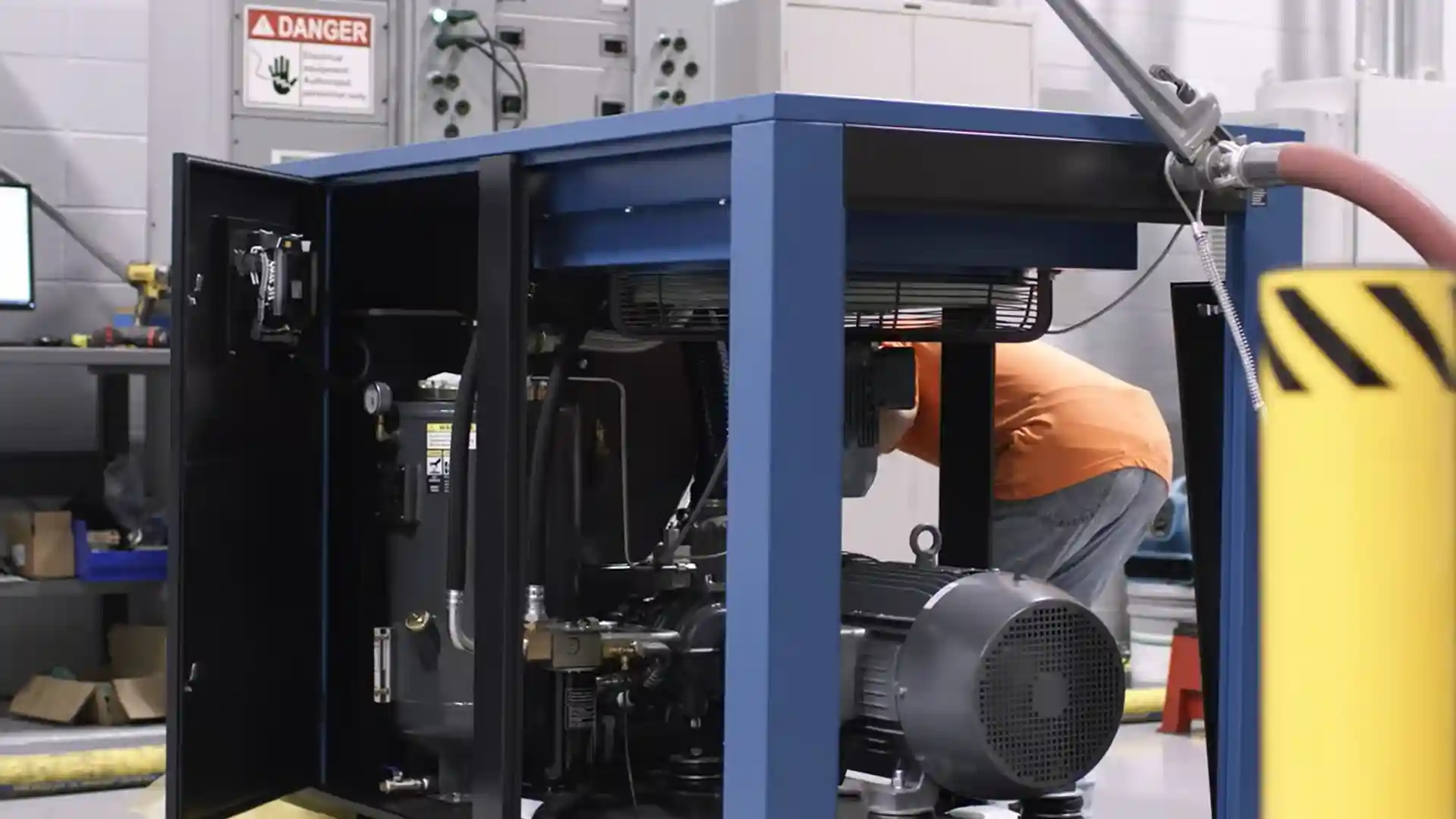
If you have spent any time on a shop floor deciding what to run your air line off of, you already know this decision is not as simple as picking whatever is cheapest at the counter. We get calls every week at Mechstera from plant managers who bought a compressor based on price alone and regretted it within a year. So let’s actually walk through what separates a screw compressor from a reciprocating compressor, because the answer depends heavily on how your facility actually runs, not on a spec sheet.
What A Screw Compressor Actually Does
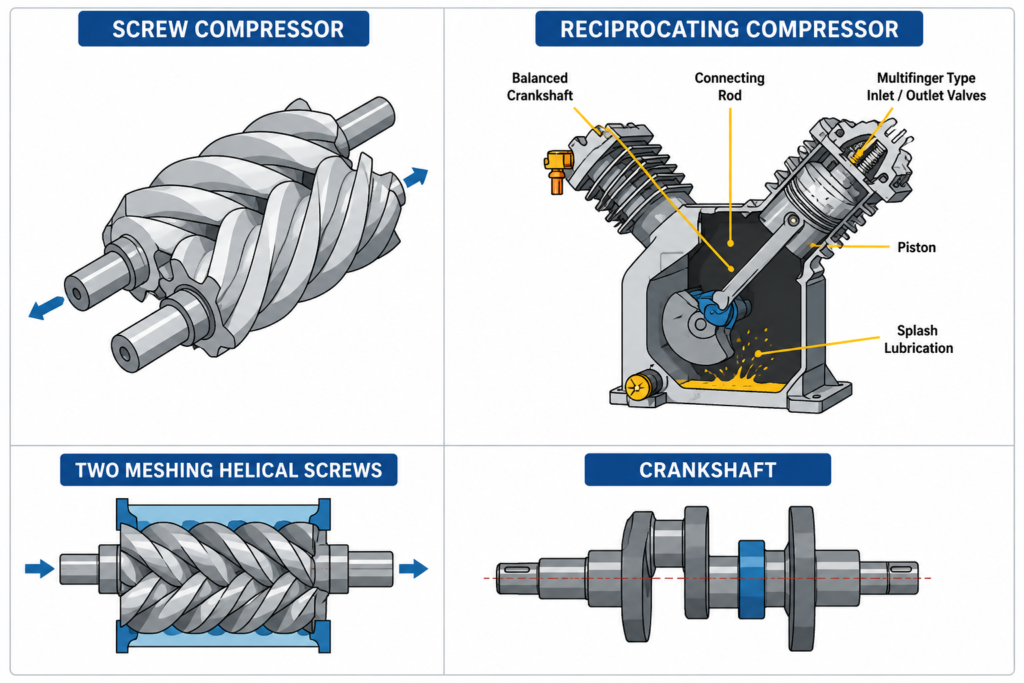
A rotary screw compressor works using two helical rotors that mesh together and trap air between them, squeezing the volume down as the rotors turn. There is no piston, no crankshaft, no valve slapping open and shut a few hundred times a minute. That single design choice changes almost everything downstream, from noise output to how long the unit lasts before you need a rebuild.
In practice, the two rotors never actually touch each other. A thin film of oil (in oil injected models) or precision timing gears (in oil free units) keep them separated while they spin. Because there is no metal on metal contact in the compression chamber, wear happens slowly. Air end temperatures typically sit somewhere between 80 and 99 degrees Celsius during normal operation, which is mild compared to what a piston unit sees.
How A Reciprocating Compressor Works
Reciprocating compressors take the older, more mechanical route. A piston moves up and down inside a cylinder, drawn by a crankshaft, pulling air in on the downstroke and forcing it out through a discharge valve on the up. It is a design that has barely changed since the industrial revolution, and honestly, that is not a knock against it. Simple machines are easy to fix, and any decent mechanic can diagnose a piston compressor with a stethoscope and a bit of patience.
The tradeoff is friction. Piston rings dragging against a cylinder wall thousands of times a minute generate real heat, often pushing internal temperatures to 150 or even 200 degrees Celsius. That heat, combined with constant metal contact between rings, pistons, valves, and the crankcase, means wear adds up faster than it does in a screw unit.
Screw Compressor Vs Reciprocating Compressor: Key Design Differences
Here is a side by side breakdown of how the two designs actually stack up on the factors that matter most to a plant engineer.
| Factor | Screw Compressor | Reciprocating Compressor |
|---|---|---|
| Compression method | Two meshing helical rotors | Piston driven by a crankshaft |
| Moving parts in contact | None, rotors never touch | Many: pistons, rings, valves, crankshaft |
| Operating temperature | Around 80 to 99°C | Around 150 to 200°C |
| Duty cycle | Built for continuous, round the clock operation | Best for intermittent use |
| Wear rate | Very low | Noticeably higher over time |
| Footprint | Compact, small equipment room works fine | Larger, needs more floor space |
| Noise level | Often under 75 dB(A) | Can reach 100 dB(A) or more |
| Capacity retention | Holds capacity well over its service life | Capacity drops as parts wear |
| Cooling | Air cooled in most cases | Water cooling often required above 30 HP |
That table alone tells you why so many continuous process plants have moved toward screw technology over the last two decades. But it does not mean reciprocating units are obsolete, and I want to be clear about that before we go further.
Noise, Space And Duty Cycle In The Real World
Anyone who has stood next to a running piston compressor in a small workshop knows the noise is not subtle. Reciprocating units can climb toward 100 dB(A), loud enough that hearing protection stops being optional. Screw compressors, by comparison, run quieter almost by nature of their design since there is no repeated valve slap or piston slam, and enclosed models can be tucked into a corner of the plant without disturbing anyone nearby.
Space matters too, more than people expect until they are actually laying out a compressor room. A screw package with an integrated dryer and tank can sit in a footprint that a comparable reciprocating setup simply cannot match once you add the extra water cooling equipment that larger piston units usually require.
Maintenance And Wear And Tear
This is where I will offer an opinion rather than just reporting facts: buyers chasing the lowest upfront price on a compressor almost always end up paying more over five years, once you count downtime, part replacement, and energy waste. A screw compressor with sealed bearings can run 40,000 hours before it needs serious attention in some cases, according to field data reported by manufacturers like Atlas Copco, whose engineering blog goes into more detail on how duty cycle affects component life.
Reciprocating units need more frequent valve and ring inspections, but here is the thing, when something does break, a piston compressor is usually far cheaper and faster to fix. You are not swapping out a full air end, you are replacing a valve plate or a ring set.
Meanwhile you can also checkout our Blog on : Types of Valves: Working Principle & Applications
Pros And Cons Of Each Compressor Type
| Screw Compressor | Reciprocating Compressor | |
|---|---|---|
| Pros | Energy efficient at high loads, quiet, low wear, continuous duty, compact footprint | Lower initial cost, simple to repair, handles very high pressure, no oil carryover risk in oil free models |
| Cons | Higher upfront investment, harder for a generalist to repair, requires specialist parts | Louder operation, more moving parts to wear out, capacity drops over time, needs cooldown periods |
Neither column is objectively “better.” A bakery running a single pneumatic tool for twenty minutes a day has no business paying for a full screw package. A bottling plant running compressed air non stop, on the other hand, will burn through a reciprocating unit’s service life in a fraction of the time it would take a screw compressor.
Screw Compressor Vs Reciprocating Compressor: Which One Should You Buy
Before you sign a purchase order, run through this short checklist with your maintenance lead:
- How many hours a day will the compressor actually run
- Do you have space and cooling infrastructure for a larger footprint
- Is noise a concern in the area where it will sit
- What pressure range does your equipment actually require
- Who on staff can service the unit, a generalist or a specialist
If your honest answers point toward long, continuous runtime and limited space, a screw compressor earns its price tag. If you are dealing with occasional, high pressure bursts and want something your own team can maintain without outside help, a reciprocating unit still makes sense in plenty of shops.
Cost, Efficiency And Long Term Value
Upfront pricing almost always favors reciprocating compressors, sometimes by a wide margin. That is exactly why so many small shops start there. But the energy bill tells a different story once you factor in continuous operation. Screw compressors are engineered to sip power more consistently under steady load, while reciprocating units lose efficiency as internal wear increases, meaning the machine slowly costs more to run the same job it did on day one. At Mechstera we typically walk clients through a rough payback calculation before recommending either path, because the right answer really does change based on how many shifts you run.
Common Applications
Reciprocating compressors still dominate in places like small automotive shops, refrigeration units, agriculture, and any application that needs very high discharge pressure in short bursts, such as spray painting or tire service. Screw compressors, meanwhile, have become the standard in manufacturing plants, food and beverage production, pharmaceuticals, oil and gas operations, and any facility running pneumatic tools or process equipment around the clock. If your production line cannot afford a compressed air interruption, that alone usually settles the debate in favor of a screw unit.
Brands matter here too. German manufacturers like Bitzer and Grasso, along with Japanese and Chinese producers such as Mycom and Hanbell, all build well regarded screw platforms, and at Mechstera we have serviced most of them over the years. Reciprocating units tend to be simpler across brands since the underlying mechanism has changed so little in over a century.
Frequently Asked Questions
Is a screw compressor better than a reciprocating compressor?
Neither is universally better. Screw compressors suit continuous, high volume operation with lower noise and wear. Reciprocating compressors suit intermittent use, higher pressure bursts, and setups where a lower purchase price and easy repairs matter more than energy efficiency.
How long does a screw compressor last compared to a reciprocating compressor?
A well maintained screw compressor can run tens of thousands of hours with minimal capacity loss, since its main moving parts never contact each other. Reciprocating compressors typically need more frequent part replacement as rings, valves, and pistons wear from direct contact.
Which compressor type is quieter?
Screw compressors are generally quieter, often staying under 75 dB(A) in enclosed designs, while reciprocating units can reach or exceed 100 dB(A) depending on size and load.
Can a reciprocating compressor run continuously like a screw compressor?
Not comfortably. Reciprocating units generate more internal heat from piston and ring friction, so continuous duty accelerates wear and raises the risk of overheating. They are built with intermittent cycles in mind.

1 thought on “Screw Compressor Vs Reciprocating Compressor: Proven Guide”