
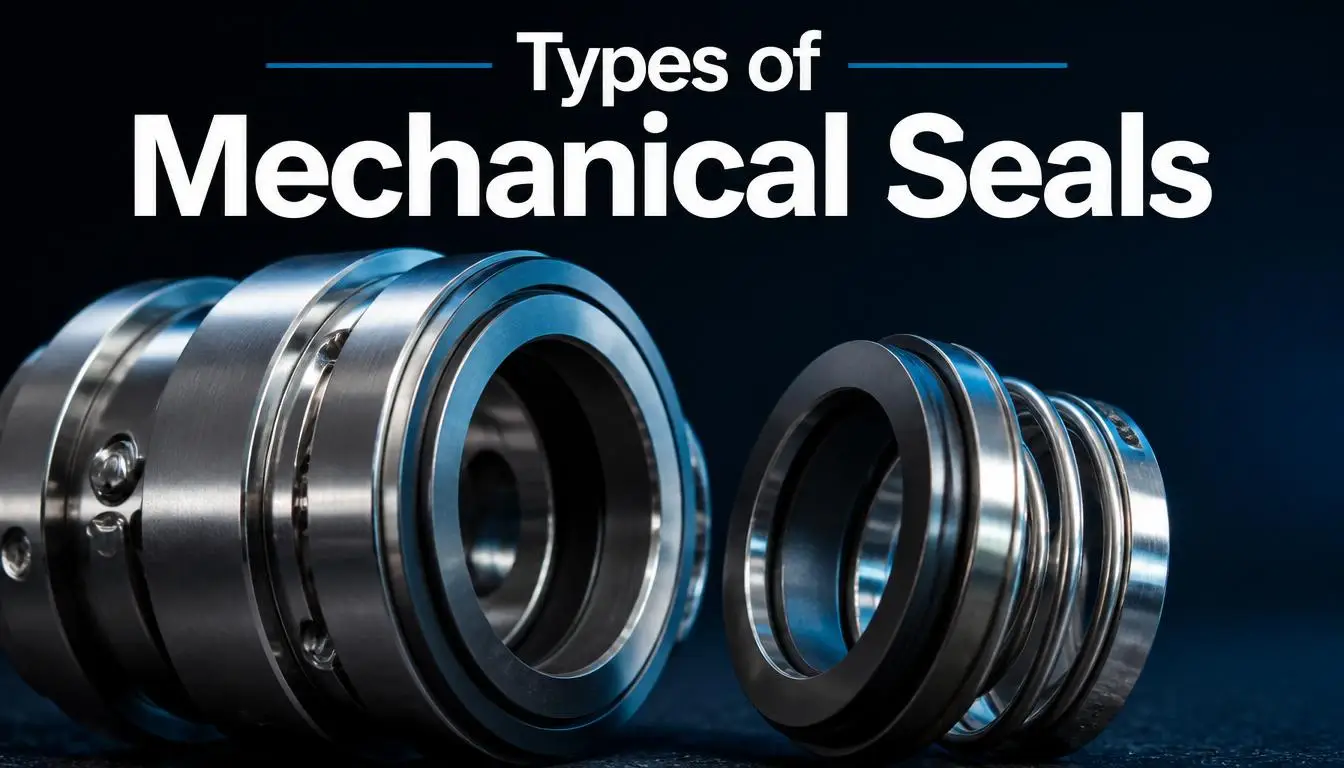
Every rotating machine that moves liquid or gas has one hidden weak point: the place where a spinning shaft passes through a stationary housing. This is exactly where a mechanical seal does its job. Understanding the types of mechanical seals available today helps engineers, plant managers, and maintenance teams choose the right component for pumps, mixers, compressors, and reactors, reducing downtime and extending equipment life.
What Is a Mechanical Seal and Why Does It Matter
A mechanical seal is a precision device fitted around a rotating shaft to prevent fluid or gas from escaping the equipment housing. It typically consists of two flat faces positioned perpendicular to the shaft — one stationary, mounted to the housing, and one rotating with the shaft to keep fluids in and contaminants out. Axial mechanical force combined with fluid pressure keeps these faces in constant contact, which stops leakage while allowing the shaft to rotate freely. Uniqueseals
Mechanical seals replaced older packing-style shaft seals because they leak less, last longer, and require less maintenance while running more efficiently and reliably over extended periods. Today they are standard equipment across chemical processing, oil and gas, food and beverage, pharmaceutical, water treatment, and general industrial manufacturing. ptfedf
Core Components of a Mechanical Seal
Before comparing seal types, it helps to understand what a seal is actually made of. A typical assembly includes a rotating primary face fixed to the shaft, a stationary primary face fixed to the housing, a mechanical loading device such as a spring or metal bellows that biases the two faces together, and static or dynamic secondary seals that compensate for shaft movement while drive mechanisms like set screws and pins provide rotation to the primary seal face. Every seal type discussed below is really a variation on how these same core parts are arranged. Uniqueseals
Main Types of Mechanical Seals
Component Seals
Component seals are the simplest and most economical design. Each part — spring, seat, rotating face, and hardware — is fitted into the pump individually by the technician during assembly rather than arriving as a pre-set unit, which keeps upfront costs low and makes them common in water pumps and small industrial equipment. The tradeoff is that installation demands more skill, since incorrect spring compression or misalignment can shorten seal life significantly. PDH Online
Cartridge Seals
Cartridge seals house the gland, sleeve, springs, and both seal faces as one self-contained, pre-assembled unit that the manufacturer presets before it reaches the plant, simplifying both installation and later maintenance. Because the entire assembly slides onto the shaft as a single piece, it is difficult to install incorrectly, which is why maintenance teams increasingly prefer this design even though it costs more upfront. Cartridge seals can be configured with one or two seal faces depending on the application. Uniquesealsptfedf
Pusher Seals
Pusher seals rely on a dynamic secondary seal, usually an O-ring, that slides axially along the shaft to keep the primary faces in contact as they wear down over time. This design works well across a wide range of pressures and temperatures, but the constant sliding motion of the O-ring makes pusher seals less suited to abrasive slurries or highly corrosive fluids, since the moving elastomer is exposed to wear.
Non-Pusher (Bellows) Seals
Non-pusher seals use a metal or elastomeric bellows instead of a sliding O-ring to maintain face contact. Because there are no sliding parts, wear and maintenance are reduced, making bellows seals ideally suited to dirty, corrosive, or high-temperature applications. Metal bellows versions in particular provide effective sealing across a wide range of temperatures without relying on elastomers at all, which is a major advantage in pharmaceutical and high-purity processes. BestonFlexaseal
Balanced and Unbalanced Seals
Balanced seal arrangements reduce the hydraulic pressure acting directly on the seal faces, which lowers face loading, improves lubrication, and extends seal life. Balanced seals are particularly suited to higher operating pressures, typically above 200 PSIG, and perform well with liquids that have low lubricity or high volatility. Unbalanced seals, by contrast, are a simpler and more affordable option best reserved for lower-pressure duty, generally under 200 PSIG since they can suffer from a much lower mean time between failure despite sometimes showing tighter control of leakage. BestonBeston
Single and Double (Tandem) Seals
Single seals use one pair of sealing faces and remain the most economical, straightforward choice for standard, non-hazardous fluids. Double seals use two complete sets of faces with a barrier or buffer fluid circulating between them providing an extra layer of protection that is especially valuable when handling hazardous or toxic fluids. This tandem arrangement is standard practice in refineries and chemical plants where a single-seal failure cannot be allowed to release product to atmosphere. Beston
Comparing Seal Types at a Glance
| Seal Type | Best Suited For | Key Advantage | Key Limitation |
|---|---|---|---|
| Component Seal | General water and industrial pumps | Low cost, simple parts | Requires skilled installation |
| Cartridge Seal | General industrial applications | Pre-set, easy to install | Higher initial investment |
| Pusher Seal | Variable pressure/temperature duty | Handles wear and misalignment | Weak with abrasive/corrosive fluids |
| Non-Pusher (Bellows) Seal | Corrosive, abrasive, high-temp fluids | No sliding parts, less wear | Limited to medium/lower pressure |
| Balanced Seal | High-pressure oil and gas systems | Longer face life, even lubrication | More complex design |
| Double Seal | Hazardous or toxic fluid handling | Maximum leak protection | Costlier, more complex install |
Pros and Cons of Mechanical Seals as a Whole
| Pros | Cons |
|---|---|
| Very low product leakage compared to packing | Higher initial purchase cost |
| Longer operating life with less routine maintenance | Sensitive to misalignment and dry running |
| Protects bearings and extends pump life | Requires correct fluid compatibility for face and elastomer materials |
| Available in configurations for nearly every fluid and pressure range | Some designs need skilled technicians for correct installation |
How to Choose the Right Mechanical Seal
Selecting a seal is rarely about picking the most advanced design; it is about matching the seal to the actual operating conditions. The fluid being pumped is the single most important factor, since its cleanliness, corrosiveness, and volatility largely determine which support system and face materials are appropriate. Operating pressure narrows the choice between balanced and unbalanced designs, while temperature and shaft speed often decide whether a bellows or pusher configuration will hold up over time. Equipment type also matters, since a mixer, agitator, or reactor may demand a very different seal geometry than a straightforward centrifugal pump. Finally, industry standards and safety regulations, particularly in hazardous or toxic service, frequently mandate double seal arrangements regardless of cost.
For engineers who want deeper technical detail on seal face materials, spring configurations, and API piping plans used to control the seal environment, the GlobalSpec mechanical seals selection guide is a useful reference covering relevant international standards such as BS EN 12756 and ASTM F1511. Flexaseal
Common Failure Points to Watch For
Mechanical seals fail for a small number of recurring reasons: dry running that destroys the lubricating film between faces, misalignment that prevents the faces from staying perpendicular to the shaft, chemical incompatibility between the fluid and the elastomer or face material, and simple wear after years of continuous operation. Routine monitoring of flush lines, vibration, and shaft alignment catches most of these issues before a seal actually fails in service, which is far cheaper than an unplanned shutdown.
Final Thoughts
Choosing among the types of mechanical seals available today comes down to understanding your fluid, your pressure range, and your risk tolerance for leakage. Component and cartridge seals cover general industrial duty, pusher and non-pusher designs split along the line of clean versus dirty or corrosive service, and balanced or double seal configurations step in wherever pressure or hazard levels rise. Getting this decision right at the design stage is one of the simplest ways to protect equipment reliability and avoid costly downtime later.
If you’re evaluating seals for a specific application, it’s worth requesting a detailed spec sheet or consulting a qualified seal manufacturer before finalizing your selection — the right documentation, including any type of mechanical seals PDF with photos your supplier provides, can make comparing options far easier.
#Ignore
types of mechanical seals, mechanical seal types pdf, mechanical seal design, cartridge mechanical seal, component seal vs cartridge seal, pusher seal, non-pusher bellows seal, balanced vs unbalanced seal, double mechanical seal, single mechanical seal, mechanical seal for centrifugal pump, mechanical seal materials, mechanical seal face materials, mechanical seal failure causes, mechanical seal selection guide, mechanical seal applications, mechanical seal manufacturers, mechanical seal for agitator, mechanical seal for reactor, mechanical seal API plan, mechanical seal vs packing seal, mechanical seal maintenance


1 thought on “Types of Mechanical Seals in Pumps | PDF”