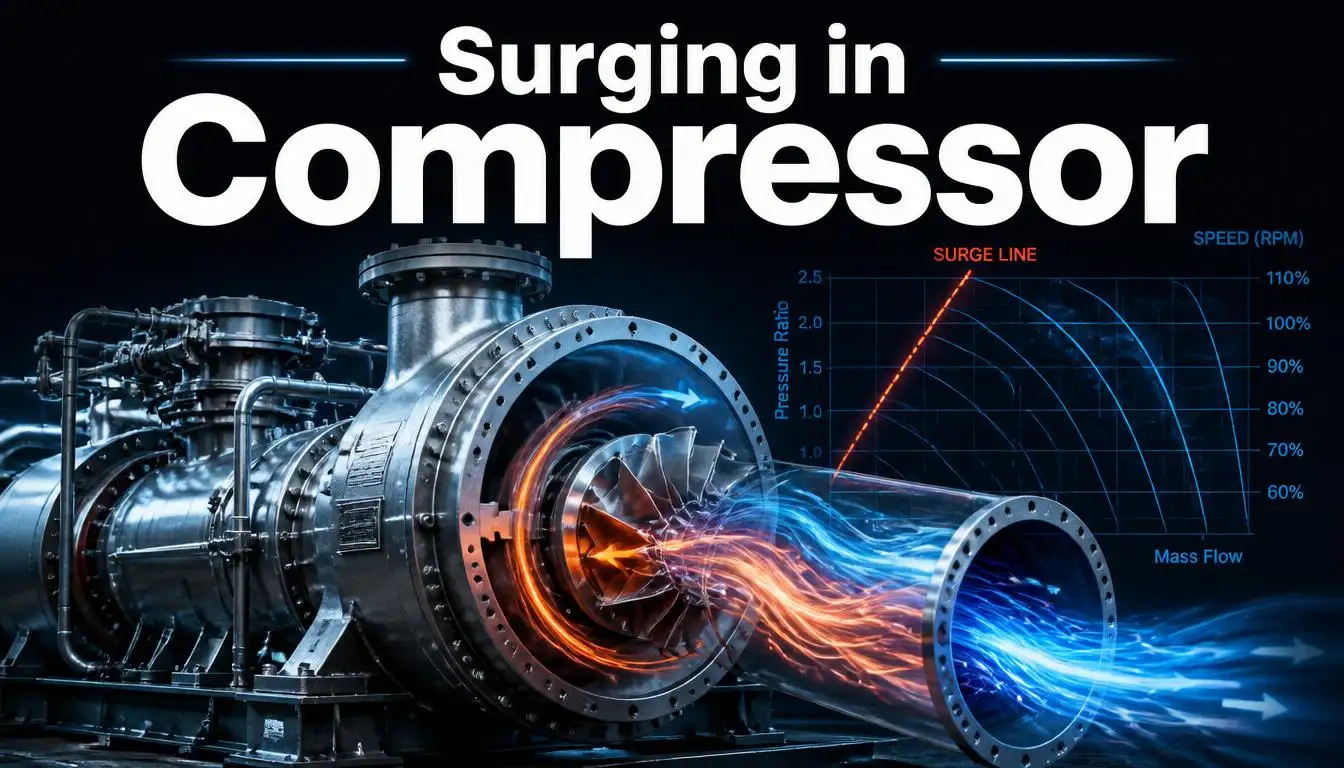
Surging in compressor systems is one of the most disruptive and potentially damaging phenomena in rotating equipment operation. Whether you work with centrifugal compressors in a refinery, a petrochemical plant, or an HVAC system, understanding compressor surging is essential to keeping equipment safe, efficient, and reliable.
In this guide, we’ll break down what compressor surging is, why it happens, how to recognize it, and — most importantly — how to prevent it from damaging your equipment.
What is a Compressor?
Before diving into surging, it helps to define the equipment itself. So, what is a compressor?
A compressor is a mechanical device used to increase the pressure of a gas or vapor by reducing its volume. The compressor definition, in simple terms, is a machine that takes in gas at a lower pressure and discharges it at a higher pressure by doing mechanical work on it.
The compressor meaning extends across several major types:
- Centrifugal compressors — use rotating impellers to accelerate gas and convert kinetic energy into pressure
- Axial compressors — use a series of rotating and stationary blades to compress gas along the axis of flow
- Reciprocating compressors — use pistons within cylinders to compress gas through positive displacement
- Screw compressors — use meshing helical rotors to trap and compress gas
An air compressor machine is simply a compressor designed specifically to compress atmospheric air, commonly used in industrial tools, pneumatic systems, and manufacturing plants. While all types of compressors can experience operational instabilities, surging is a phenomenon almost exclusively associated with dynamic compressors — centrifugal and axial types — rather than positive displacement machines like reciprocating or screw compressors.
What is Compressor Surge?
Now to the core topic: what is compressor surge?
Compressor surge (also called surging in compressor, surge in compressor, or compressor surging) is a flow instability condition that occurs in centrifugal and axial compressors when the gas flow rate drops below a critical minimum value while the compressor continues to try to maintain a required discharge pressure. When this happens, the compressor is unable to keep pumping gas forward against the downstream pressure, and the flow within the compressor briefly reverses direction before returning to normal — often in rapid, repeating cycles.
So what is surging in compressor terms, practically speaking? It’s essentially a violent, cyclical breakdown of stable flow. Instead of a smooth, continuous stream of gas moving from suction to discharge, the compressor experiences:
- A drop in flow toward the surge point
- A momentary flow reversal (backflow from discharge to suction)
- A drop in discharge pressure
- A recovery of forward flow
- Repetition of the cycle, sometimes several times per second
This cycle is what is a compressor surge in mechanical terms — an aerodynamic instability that produces pressure and flow oscillations, audible noise, and mechanical vibration.
Why Does Compressor Surging Occur?
Understanding why surge in compressor systems occurs requires looking at the compressor performance curve — the relationship between flow rate and pressure ratio at a given compressor speed.
Every centrifugal or axial compressor has an operating point defined by the intersection of its performance curve and the system resistance curve (the pressure required by downstream piping, valves, and equipment). To the left of this curve lies the surge line — the boundary beyond which stable operation is no longer possible.
Surging of compressor equipment occurs when the operating point moves to the left of the surge line, meaning:
- Flow rate decreases below the minimum stable point, or
- System back-pressure increases beyond what the compressor can sustain at the current flow
At this point, the compressor can no longer add enough energy to the gas to overcome the downstream pressure. Flow momentarily reverses, pressure drops, and the compressor recovers — only to repeat the same unstable cycle if the underlying condition isn’t corrected.
The gap between the normal operating point and the surge line is known as the surge margin — a critical design and operational parameter that engineers monitor closely to keep compressors operating safely.
Causes of Compressor Surging
Several operational and mechanical factors can push a compressor toward its surge line:
- Reduced system flow demand — when downstream processes require less gas, flow through the compressor drops
- Increased discharge pressure or system resistance — caused by blocked filters, closed valves, or fouled heat exchangers
- Compressor fouling — deposits on impeller blades reduce aerodynamic efficiency and shift the performance curve
- Rapid changes in process conditions — sudden load rejection, upstream pressure fluctuations, or trip events
- Incorrect anti-surge valve settings — a poorly tuned or malfunctioning surge control system fails to open in time
- Multiple compressors in parallel — uneven load sharing can push one unit toward its surge point while others remain stable
- Changes in gas composition or molecular weight — this shifts the compressor’s performance curve, effectively altering the surge point
- Startup and shutdown transients — flow is often low and unstable during these periods, increasing surge risk
Symptoms of Compressor Surge
Recognizing the symptoms early can prevent serious equipment damage. Common signs of surging include:
- Loud, repetitive banging or “whooshing” noises from the compressor casing
- Rapid, cyclical fluctuations in discharge pressure and flow readings
- Noticeable vibration, sometimes severe enough to trigger vibration trip systems
- Fluctuating motor or driver current/power draw
- Rising bearing or casing temperatures over repeated surge cycles
- Audible or visible flow reversal in some open systems
- Compressor trip on high vibration or high temperature protection
Because these symptoms can escalate quickly, most modern compressor protection systems are designed to detect the early signs of instability and intervene automatically.
Effects of Compressor Surging on Equipment
Even brief periods of surging can significantly reduce compressor life, and sustained or severe surging can damage the machine in a single event. Common effects include:
- Mechanical damage to impellers and blades — cyclic loading can cause fatigue cracking over time
- Thrust bearing damage — flow reversal causes axial thrust reversals, overloading thrust bearings
- Seal damage — pressure oscillations stress mechanical seals, leading to leaks
- Coupling and shaft damage — torsional oscillations from repeated surge cycles can fatigue shafts and couplings
- Reduced compressor efficiency — repeated surging accelerates wear, gradually shifting the performance curve
- Unplanned shutdowns — protective trips triggered by surge-related vibration or temperature spikes
- Safety risks — in extreme cases, surging can lead to catastrophic mechanical failure
Because of these risks, surge events — even short ones — are treated seriously in industrial rotating equipment operation and are typically logged and reviewed by reliability engineers.
You May Also Like : Types of Mechanical Seals in Pumps | PDF
Surging in Centrifugal Compressor
Surging in centrifugal compressor units deserves particular attention, since centrifugal machines are the most common type affected by this phenomenon in industrial service (refineries, gas plants, petrochemical facilities, and power generation).
In a centrifugal compressor, gas enters axially and is accelerated radially outward by a rotating impeller, converting kinetic energy into static pressure as it passes through the diffuser and volute. This design is highly efficient across a range of flows, but it has a narrower stable operating range compared to axial compressors, making it more prone to surge under fluctuating process conditions.
Key characteristics of surge in centrifugal compressors include:
- A well-defined surge line on the compressor performance map, unique to each compressor design and operating speed
- Sensitivity to changes in suction temperature, pressure, and gas molecular weight — all of which shift the surge line
- A need for dedicated anti-surge control systems, since manual operator response is generally too slow
- Common application areas: natural gas processing, refrigeration systems, air separation units, and pipeline boosting stations
Because centrifugal compressors are so widely used in critical process industries, anti-surge protection is considered a core part of compressor control system design rather than an optional add-on.
How to Prevent Compressor Surge
Preventing compressor surge relies on a combination of good design, proper control systems, and disciplined operating practices:
- Anti-surge valve (recycle/bypass valve) — automatically opens to recirculate gas from discharge back to suction, maintaining minimum stable flow through the compressor
- Surge controller — a dedicated control system that continuously monitors flow, pressure, temperature, and speed to calculate the real-time distance to the surge line and act before it is reached
- Adequate surge margin — designing the control system to trigger recycle action well before the actual surge line is reached, not right at the boundary
- Regular compressor performance monitoring — tracking discharge pressure, flow, vibration, and temperature trends to detect gradual shifts in the performance curve
- Routine cleaning and maintenance — preventing fouling of impellers and diffusers that can shift the surge point
- Operator training — ensuring personnel understand safe operating limits and respond correctly to alarms
- Proper startup/shutdown procedures — following manufacturer-recommended ramp rates to avoid low-flow conditions during transients
- Parallel compressor load balancing — using automated load-sharing control when multiple compressors operate together
A well-designed surge control system, paired with routine maintenance and operator awareness, is the most effective defense against compressor surging in industrial settings.
Difference Between Compressor Surge and Compressor Stall
Surge and stall are related but distinct phenomena, and the difference matters for troubleshooting:
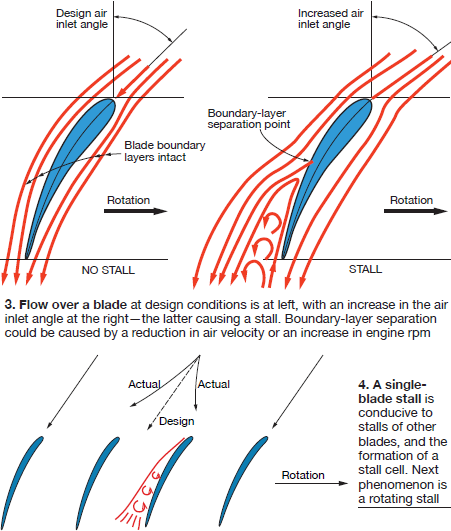
| Aspect | Compressor Surge | Compressor Stall |
|---|---|---|
| Scope | Affects the entire compressor system flow | Localized to individual blades or a stage |
| Flow behavior | Full flow reversal through the compressor | Partial flow separation on blade surfaces |
| Duration | Cyclical, repeating instability | Can be steady or intermittent |
| Severity | Generally more damaging, system-wide | Often less severe, though can lead to surge if uncorrected |
| Detection | Vibration, pressure/flow oscillation, noise | Reduced efficiency, mild vibration, aerodynamic noise |
| Cause | Operating point crosses the surge line | Local blade angle of attack becomes too high |
In many cases, stall is a precursor to surge — localized flow separation can develop into full-system surge if the underlying cause (low flow, high back-pressure) isn’t corrected.
Frequently Asked Questions
What is compressor surge?
Compressor surge is a flow instability in centrifugal or axial compressors where gas flow drops below a critical value, causing the flow to momentarily reverse direction in repeating cycles, along with pressure fluctuations and vibration.
What is surge in compressor?
Surge in a compressor refers to the point at which the machine can no longer maintain forward gas flow against the downstream system pressure, resulting in cyclical flow reversal and instability.
What is compressor surging?
Compressor surging is the ongoing, repetitive cycle of flow breakdown and recovery that occurs once a compressor’s operating point crosses its surge line, typically accompanied by noise, vibration, and pressure oscillation.
Why does compressor surging occur?
Surging occurs when flow through the compressor falls below the minimum stable value for the current discharge pressure — usually due to reduced system demand, increased back-pressure, fouling, or rapid process changes.
How can compressor surge be prevented?
Surge is prevented through anti-surge valves, dedicated surge controllers, adequate surge margin in the control logic, routine maintenance to avoid fouling, and proper operator training on startup/shutdown procedures.
Is compressor surge dangerous?
Yes. Repeated or severe surging can cause serious mechanical damage — including impeller fatigue, thrust bearing failure, seal damage, and shaft/coupling stress — and can lead to unplanned shutdowns or catastrophic failure if not addressed.