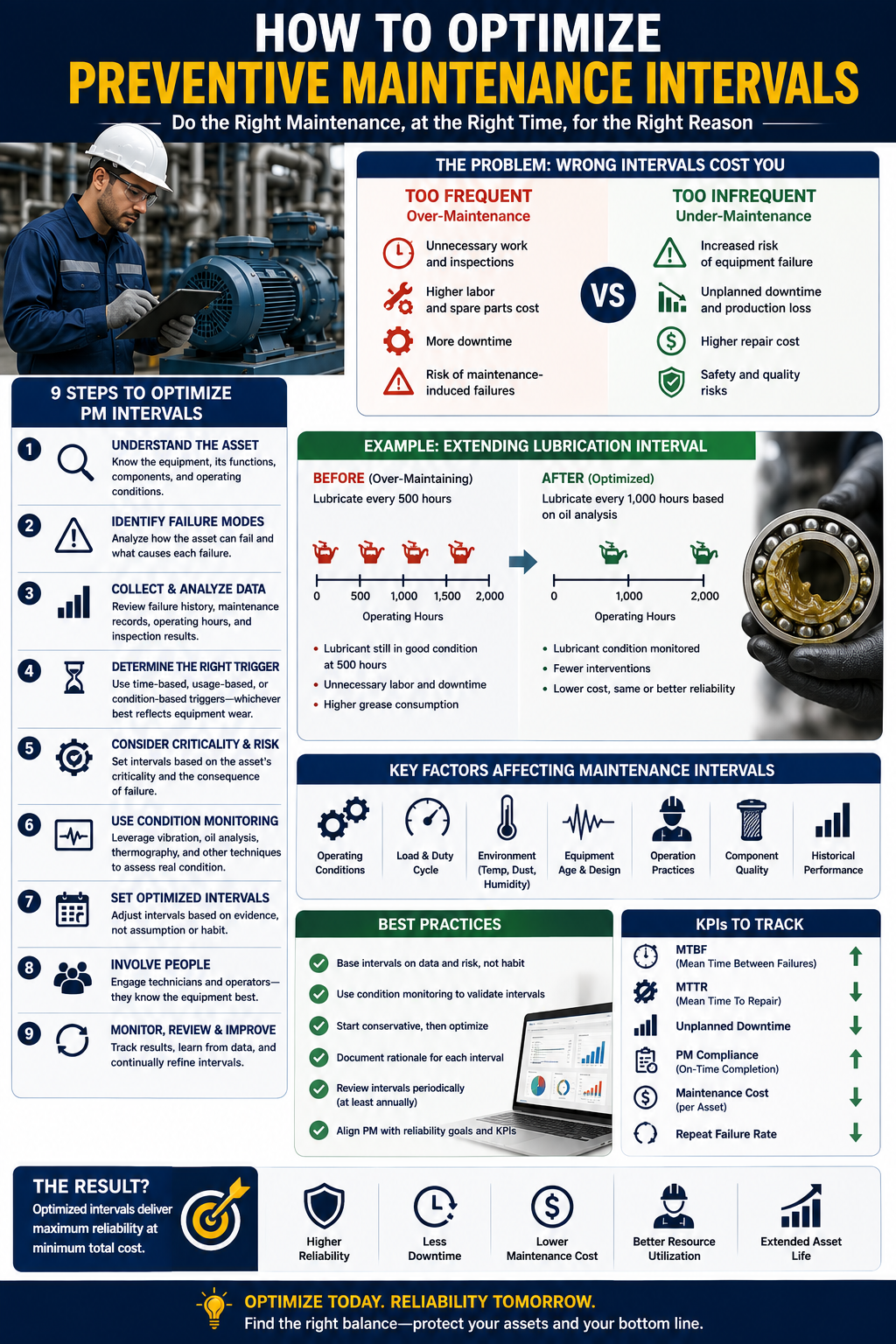
Preventive maintenance is one of the foundations of reliable equipment management. Regular inspections, lubrication, adjustments, testing, and component replacement can help prevent unexpected failures and keep industrial assets operating safely.
However, one of the most common problems in maintenance management is using incorrect preventive maintenance intervals.
If maintenance is performed too frequently, an organization may waste labor, spare parts, and production time. If maintenance is performed too infrequently, equipment may deteriorate and fail before the next scheduled intervention.
The objective is to find the right balance.
Preventive maintenance interval optimization is the process of determining how often a maintenance task should be performed based on equipment reliability, failure behavior, operating conditions, risk, and actual maintenance data.
This guide explains how maintenance engineers can optimize preventive maintenance intervals and develop a more efficient maintenance program.
What Is a Preventive Maintenance Interval?
A preventive maintenance interval is the defined period or usage level between scheduled maintenance activities.
An interval may be based on:
- Calendar time
- Operating hours
- Production cycles
- Mileage
- Number of starts and stops
- Equipment condition
- Process throughput
For example:
- Inspect a pump every 30 days
- Lubricate a bearing every 1,000 operating hours
- Replace a filter every 5,000 operating hours
- Inspect a conveyor after every 500 production cycles
The correct interval depends on the equipment and the specific failure mode being managed.
There is no single maintenance interval that is suitable for every asset.
Why Maintenance Intervals Need Optimization
Many preventive maintenance programs are created using manufacturer recommendations or historical practices.
While these are useful starting points, they may not represent the actual operating environment.
Equipment operating in a dusty environment may deteriorate faster than identical equipment operating in a clean facility. Similarly, a machine operating continuously under high load may require different maintenance intervals from one operating only a few hours each day.
Poorly selected intervals can result in two major problems.
Under-Maintenance
Maintenance is performed too late, increasing the probability of equipment failure.
Over-Maintenance
Maintenance is performed too early, resulting in unnecessary work and potentially introducing maintenance-induced failures.
The goal of interval optimization is to minimize both risks.
1. Understand the Equipment and Its Failure Modes
Before changing a maintenance interval, engineers should understand how the equipment can fail.
Ask:
- What components are most likely to fail?
- What causes those failures?
- Does deterioration increase with operating time?
- Does deterioration depend on equipment usage?
- Are there warning signs before failure?
- What happens if the equipment fails?
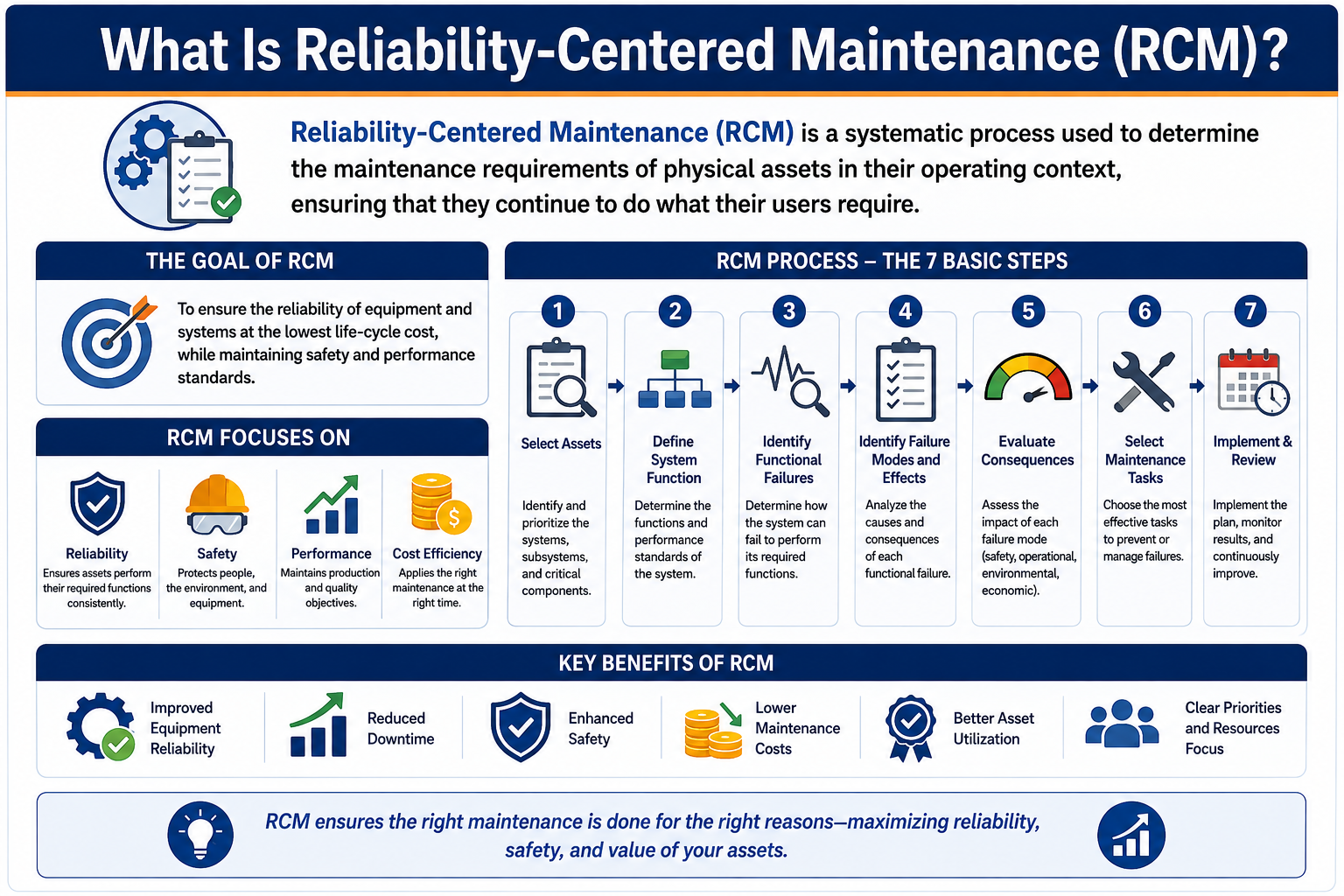
Tools such as Failure Mode and Effects Analysis (FMEA) and Reliability-Centered Maintenance (RCM) can help answer these questions.
For example, a bearing may fail because of:
- Poor lubrication
- Contamination
- Misalignment
- Excessive loading
- Incorrect installation
- Normal fatigue
The appropriate maintenance strategy will depend on the actual failure mechanism.
2. Collect and Analyze Historical Data
Maintenance history is one of the most valuable sources of information when optimizing intervals.
Review historical records for:
- Failure dates
- Component replacement dates
- Operating hours
- Maintenance dates
- Failure causes
- Repair duration
- Repeat failures
- Equipment downtime
- Maintenance costs
Suppose a filter is replaced every three months, but maintenance records show that the filter consistently remains in acceptable condition after six months.
This could indicate an opportunity to review the existing interval.
However, the interval should not simply be doubled without considering equipment criticality, operating conditions, and failure consequences.
Data should support the decision.
3. Determine Whether Time or Usage Is the Better Trigger
Not every maintenance activity should be based on calendar time.
Some equipment deteriorates primarily because of usage.
For example:
- Engines may be maintained based on operating hours.
- Vehicles may be maintained based on mileage.
- Production machinery may be maintained based on production cycles.
- Pumps may be serviced according to operating hours.
Other components may deteriorate because of time.
Examples include:
- Certain lubricants
- Batteries
- Seals
- Corrosion protection systems
- Some electrical insulation materials
In some cases, the best strategy is:
Every 12 months or 2,000 operating hours, whichever comes first.
Choosing the correct maintenance trigger can significantly improve interval effectiveness.
4. Consider Equipment Criticality
Maintenance intervals should reflect equipment criticality.
Critical equipment may require more frequent inspections, condition monitoring, redundancy, or additional maintenance controls.
Criticality analysis should consider:
- Safety consequences
- Production impact
- Environmental consequences
- Quality impact
- Repair cost
- Replacement cost
- Availability of standby equipment
- Failure frequency
For example, a critical cooling pump may require a much more robust maintenance strategy than a small non-critical ventilation fan.
The objective is to match maintenance effort with risk.
5. Review Manufacturer Recommendations
Manufacturer maintenance recommendations can provide a useful starting point.
Manufacturers may specify intervals for:
- Lubrication
- Inspection
- Filter replacement
- Calibration
- Component replacement
- Servicing
However, these recommendations should not always be treated as permanent rules.
Actual equipment conditions may differ because of:
- Climate
- Load
- Operating hours
- Contamination
- Process conditions
- Maintenance quality
- Equipment age
Maintenance engineers should compare manufacturer recommendations with actual equipment performance.
6. Use Condition Monitoring
Condition monitoring can help determine whether a scheduled maintenance interval is still appropriate.
Common techniques include:
Vibration Analysis
Useful for identifying developing problems in rotating equipment.
Infrared Thermography
Useful for identifying abnormal temperature patterns in electrical and mechanical systems.
Oil Analysis
Can provide information about lubricant condition, contamination, and component wear.
Ultrasonic Inspection
Can help identify certain leaks and mechanical or electrical abnormalities.
Online Sensors
Sensors can continuously monitor parameters such as:
- Temperature
- Vibration
- Pressure
- Speed
- Flow
- Energy consumption
If condition monitoring shows that an asset remains healthy beyond its traditional maintenance interval, engineers may be able to reconsider the schedule.
7. Identify the Failure Development Pattern
Understanding how failure develops is critical to setting an effective interval.
Some failures show measurable deterioration before functional failure.
For example:
Normal condition → Increasing vibration → Bearing deterioration → Severe vibration → Failure
If there is sufficient warning time, condition-based maintenance may be more appropriate than replacing the bearing at a fixed interval.
Other failures may occur without a reliable warning period.
In such cases, preventive replacement, functional testing, redesign, or another maintenance strategy may be more appropriate.
8. Use Reliability-Centered Maintenance Principles
Reliability-Centered Maintenance provides a structured method for determining appropriate maintenance strategies.
RCM considers:
- What functions must the asset perform?
- How can the asset fail?
- What causes each failure?
- What happens when the failure occurs?
- What are the consequences?
- What maintenance task can manage the failure?
- What should be done if no effective preventive task exists?
This prevents organizations from selecting maintenance intervals simply because they have always used them.
The maintenance task should have a clear reliability purpose.
9. Test and Adjust Maintenance Intervals
Maintenance interval optimization should be treated as a continuous improvement process.
Suppose an inspection currently occurs every month.
After reviewing several years of data, the maintenance team may determine that a two-month interval is appropriate.
The change should be implemented carefully and monitored.
Track:
- Equipment failures
- Condition-monitoring results
- Downtime
- Maintenance costs
- Inspection findings
- Repeat failures
If performance remains stable or improves, the new interval may be retained.
If failure risk increases, the interval can be adjusted again.
This creates a controlled test-and-learn approach.
10. Avoid Changing Intervals Based Only on Cost
Reducing maintenance frequency can lower short-term maintenance costs, but it can also increase equipment risk.
For example, extending a critical inspection from one month to six months may save labor but could significantly increase the probability of an undetected failure.
Maintenance decisions should therefore consider total lifecycle cost and risk, not just the immediate maintenance budget.
A good question is:
“What is the financial and operational consequence if this maintenance task is delayed?”
11. Use CMMS Data to Monitor Effectiveness
A Computerized Maintenance Management System (CMMS) can help maintenance teams manage and optimize intervals.
Useful CMMS information includes:
- PM completion history
- Equipment failure history
- Work-order duration
- Spare-parts consumption
- Maintenance cost
- Failure codes
- Downtime
- Equipment operating hours
This information allows engineers to identify PM tasks that may be:
- Too frequent
- Too infrequent
- Ineffective
- Duplicated
- No longer required
A CMMS should support engineering decisions rather than simply generate work orders.
12. Involve Technicians and Operators
Maintenance engineers should not optimize intervals using data alone.
Technicians and operators often have valuable practical knowledge.
They may know that:
- A component rarely shows wear at the current interval.
- A particular inspection is difficult to perform.
- Equipment behaves differently under certain loads.
- A specific failure occurs after a certain number of operating hours.
- A maintenance task creates unnecessary downtime.
Combining field experience with maintenance data can produce better decisions.
13. Measure the Results
After changing a preventive maintenance interval, performance should be monitored.
Important KPIs include:
Mean Time Between Failures (MTBF)
An increase can indicate improved equipment reliability.
Mean Time To Repair (MTTR)
Helps determine whether failures are becoming easier or more difficult to recover from.
Unplanned Downtime
Shows whether changes are affecting production availability.
PM Compliance
Measures whether scheduled maintenance is being completed.
Repeat Failure Rate
Helps identify recurring problems.
Maintenance Cost
Shows whether maintenance resources are being used effectively.
The most important measure is not the number of PM work orders completed.
It is whether the maintenance program is actually improving asset performance.
Example of Preventive Maintenance Interval Optimization
Consider an industrial pump with a scheduled lubrication interval of every 500 operating hours.
After reviewing equipment history, engineers discover that:
- Lubricant condition remains acceptable beyond 500 hours.
- No lubrication-related failures have occurred within 1,000 hours.
- Oil analysis is available.
- Some failures are caused by over-lubrication.
The team may decide to investigate extending the lubrication interval while using oil analysis and condition monitoring as additional controls.
Instead of blindly increasing the interval, the organization can establish a controlled strategy:
Monitor condition → Review data → Adjust interval → Monitor performance
This approach reduces the risk of over-maintenance while maintaining reliability.
Common Mistakes in PM Interval Optimization
Avoid these common mistakes:
Using the Same Interval for Every Asset
Different equipment has different failure characteristics.
Automatically Following Old Schedules
Historical practices should be reviewed periodically.
Extending Intervals Without Risk Analysis
Longer intervals are not automatically better.
Ignoring Operating Conditions
Load, temperature, contamination, environment, and duty cycle affect equipment deterioration.
Measuring Only PM Compliance
Completing 100% of PM tasks does not necessarily mean the PM program is effective.
Removing PM Tasks Without Understanding Failure Modes
A task should be removed only after determining that the associated risk is appropriately managed.
Benefits of Optimized Preventive Maintenance Intervals
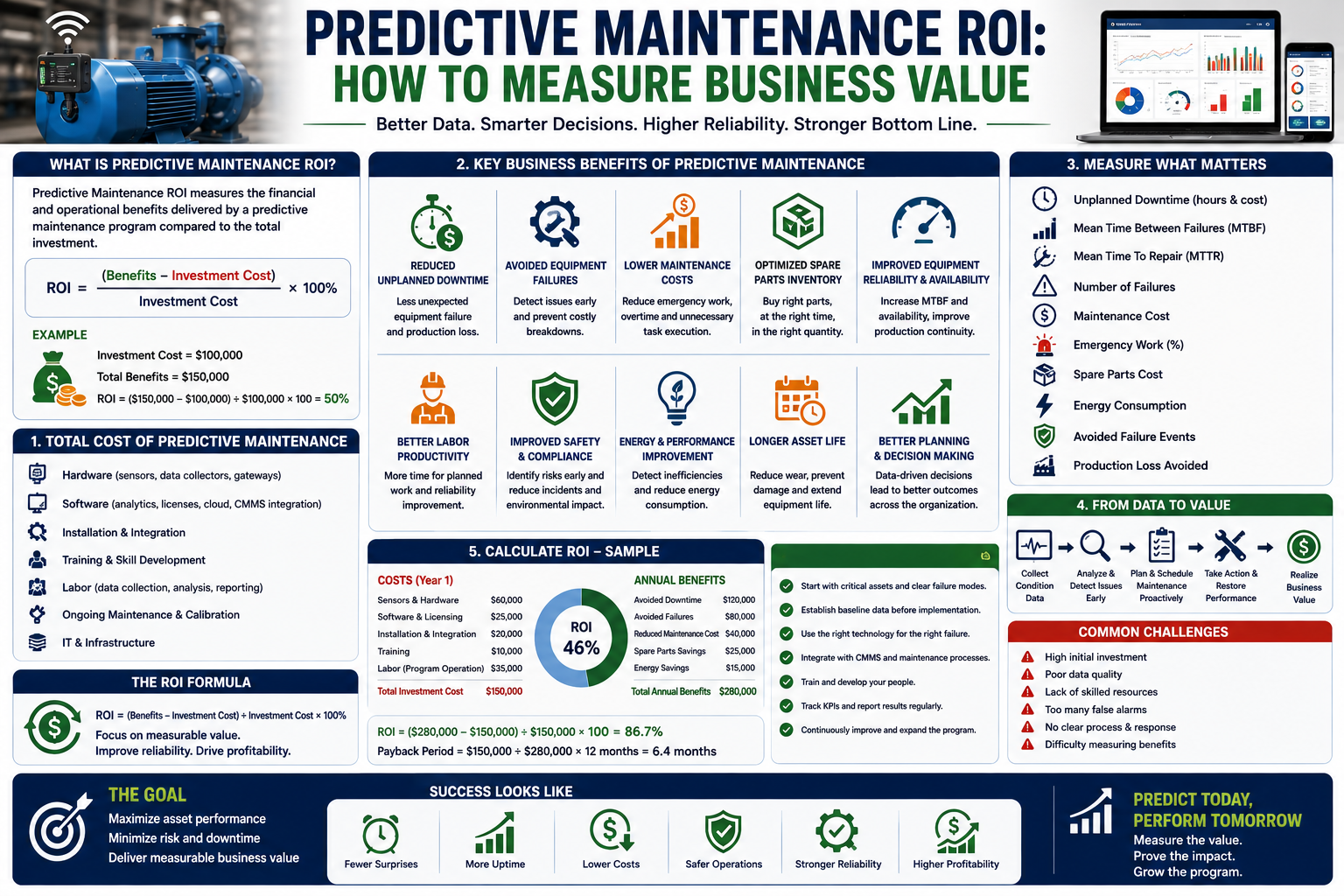
A properly optimized PM program can deliver significant benefits, including:
- Reduced maintenance costs
- Lower spare-parts consumption
- Reduced unnecessary downtime
- Better technician productivity
- Improved equipment reliability
- Fewer maintenance-induced failures
- Improved equipment availability
- Better maintenance planning
- More effective use of condition monitoring
- Longer asset life
Most importantly, optimized intervals allow maintenance resources to be directed toward activities that provide genuine value.