A plate type heat exchanger is a compact heat transfer device used to transfer heat between two fluids without allowing them to mix.
It is widely used in industries such as chemical processing, food and beverage, HVAC, power generation, pharmaceuticals, refrigeration, and oil and gas.
Unlike some conventional heat exchangers that use tubes, a plate heat exchanger uses a series of thin metal plates to create separate flow passages for the hot and cold fluids.
Because of its large heat transfer area, compact design, and high heat transfer efficiency, the plate type heat exchanger is an important part of many modern thermal systems.
This guide explains the construction, working principle, types, advantages, limitations, and applications of plate type heat exchangers.
What Is a Plate Type Heat Exchanger?
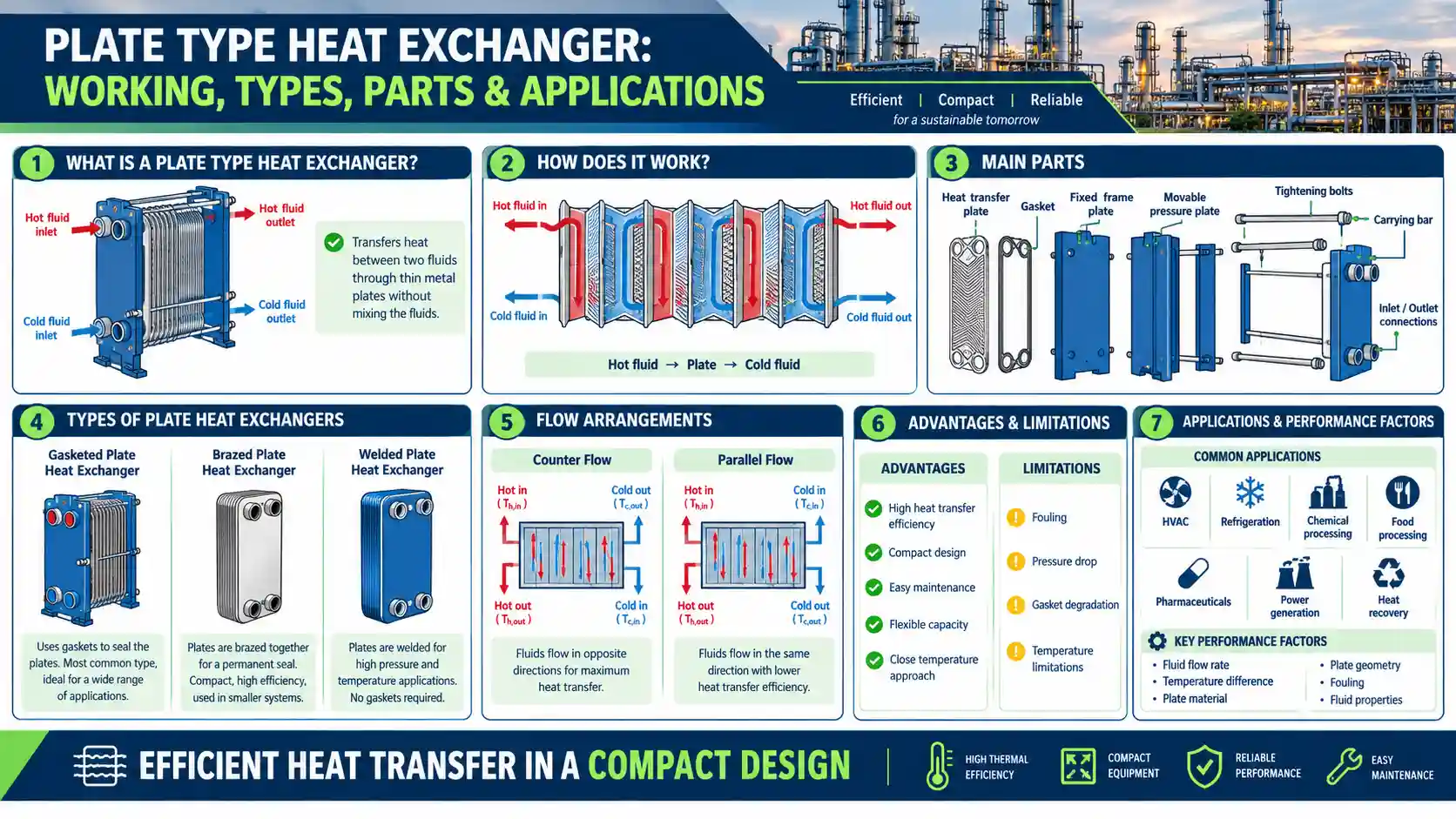
A plate type heat exchanger is a heat transfer device that transfers thermal energy between two fluids through a series of thin metal plates.
The hot and cold fluids flow through alternate passages created between the plates.
Heat passes through the plate from the hot fluid to the cold fluid while the two fluids remain physically separated.
A typical plate heat exchanger consists of:
- Heat transfer plates
- Gaskets
- Fixed frame plate
- Movable pressure plate
- Carrying bars
- Tightening bolts
- Fluid connections
The plates are normally manufactured from materials such as stainless steel, titanium, or other corrosion-resistant alloys depending on the application.
Working Principle of a Plate Type Heat Exchanger
The working principle of a plate type heat exchanger is based on heat transfer through a separating wall.
The hot fluid enters the heat exchanger through one of the connections.
It flows through the passages formed between the plates.
At the same time, the cold fluid enters through another connection and flows through the adjacent passages.
The hot fluid transfers heat to the metal plate.
Heat then conducts through the plate and is transferred to the cold fluid on the other side.
The two fluids do not normally come into direct contact.
The basic heat transfer process can be represented as:
Hot fluid → Heat transfer plate → Cold fluid
For example, if hot water enters at 80°C and cold water enters at 25°C, heat flows from the hot water toward the cold water.
The hot water leaves at a lower temperature while the cold water leaves at a higher temperature.
The actual outlet temperatures depend on factors such as flow rate, heat transfer area, fluid properties, and heat exchanger design.
Construction of a Plate Type Heat Exchanger
A plate type heat exchanger consists of several components that work together to provide heat transfer and fluid separation.
Heat Transfer Plates
The heat transfer plates are the main components of the heat exchanger.
They provide the surface through which heat is transferred from one fluid to another.
The plates are normally thin and contain a corrugated pattern.
The corrugations increase the effective heat transfer area and promote turbulence.
Corrugated Pattern
The surface pattern on the plates creates narrow flow passages.
It also improves fluid mixing and increases turbulence.
Higher turbulence can improve heat transfer performance.
However, increasing turbulence can also increase pressure drop.
Therefore, the plate design must provide a suitable balance between heat transfer and pressure loss.
Gaskets
Gaskets are used to seal the spaces between the plates.
They prevent the hot and cold fluids from mixing and direct each fluid through its intended flow passage.
Gasket material is selected according to factors such as:
- Fluid type
- Temperature
- Pressure
- Chemical compatibility
- Operating conditions
Fixed Frame Plate
The fixed frame plate provides structural support for the heat exchanger.
It also contains the connections through which the fluids enter and leave the equipment.
Movable Pressure Plate
The movable pressure plate holds the plate pack in position.
It can be moved during maintenance so that the individual plates can be inspected and cleaned.
Tightening Bolts
Tightening bolts apply the required compression to the plate pack.
Correct tightening is important because insufficient compression can cause leakage.
Excessive tightening can also damage the plates or gaskets.
How Does a Plate Heat Exchanger Work?
The working process can be understood through a simple sequence.
Step 1: Hot Fluid Enters
The hot fluid enters through its designated inlet connection.
Step 2: Fluid Flows Through Alternate Passages
The hot fluid moves through the passages between selected plates.
Step 3: Cold Fluid Enters
The cold fluid enters through a separate inlet connection.
It flows through the passages adjacent to the hot fluid passages.
Step 4: Heat Transfer Takes Place
Heat moves from the hot fluid through the metal plate and into the cold fluid.
Step 5: Fluids Leave at Different Temperatures
The hot fluid leaves at a lower temperature while the cold fluid leaves at a higher temperature.
The process can therefore be represented as:
Hot fluid → Plate → Cold fluid
Counter Flow and Parallel Flow Arrangement
Plate heat exchangers can use different flow arrangements.
Counter Flow
In counter flow operation, the two fluids move in opposite directions.
For example:
Hot fluid →
← Cold fluid
Counter flow can provide an effective temperature driving force across the heat exchanger.
It is commonly used when a high temperature change is required.
Parallel Flow
In parallel flow, both fluids move in the same general direction.
For example:
Hot fluid →
Cold fluid →
The temperature difference between the fluids generally decreases as they move through the exchanger.
The selected flow arrangement depends on the required thermal performance and system design.
Types of Plate Heat Exchangers
Different plate heat exchanger designs are used depending on operating conditions and maintenance requirements.
1. Gasketed Plate Heat Exchanger
The gasketed plate heat exchanger uses gaskets between individual plates.
The plates are compressed together using a frame and tightening bolts.
This design allows the plate pack to be opened for inspection and cleaning.
It is commonly used in:
- HVAC systems
- Food processing
- Chemical industries
- District heating
- General industrial applications
One major advantage is that additional plates can often be added when greater heat transfer capacity is required, depending on the equipment design.
2. Brazed Plate Heat Exchanger
A brazed plate heat exchanger uses a brazing material to join the plates permanently.
It does not normally use replaceable gaskets.
Because of its compact construction, it is commonly used where space is limited.
Typical applications include:
- Refrigeration
- Air conditioning
- Heat pumps
- Hydraulic systems
- Compact cooling systems
However, the permanently joined construction can make internal cleaning and repair more difficult.
3. Welded Plate Heat Exchanger
In a welded plate heat exchanger, the plates are joined using welding instead of conventional gaskets.
This construction can be useful for applications involving high temperatures, aggressive fluids, or conditions where conventional gasket materials may not be suitable.
Applications can include:
- Chemical processing
- Oil and gas
- High-temperature systems
- Aggressive fluid applications
Plate Heat Exchanger vs Shell and Tube Heat Exchanger
Plate heat exchangers and shell and tube heat exchangers are both widely used for industrial heat transfer.
| Feature | Plate Heat Exchanger | Shell and Tube Heat Exchanger |
|---|---|---|
| Construction | Thin plates | Tubes inside shell |
| Size | Generally compact | Generally larger |
| Heat transfer area | High for its size | Depends on tube arrangement |
| Maintenance | Gasketed types can be opened | Tube-side maintenance may be required |
| Heat transfer coefficient | Generally high | Depends on design and fluid conditions |
| Expansion | Plates can often be added | Usually requires design changes |
| Applications | HVAC, food, chemical, refrigeration | Power, oil and gas, process industries |
The best choice depends on temperature, pressure, fluid characteristics, fouling tendency, available space, maintenance requirements, and cost.
Advantages of Plate Type Heat Exchangers
Plate heat exchangers provide several advantages.
High Heat Transfer Efficiency
The corrugated plates create turbulence and provide a large heat transfer surface.
This can result in efficient heat transfer within a relatively compact unit.
Compact Design
A plate heat exchanger can provide significant heat transfer capacity without requiring the same amount of physical space as some conventional designs.
This makes it useful where installation space is limited.
Easy Maintenance
Gasketed plate heat exchangers can generally be opened by separating the frame plates.
The individual plates can then be inspected and cleaned.
Flexible Capacity
In many gasketed designs, heat transfer capacity can be changed by adding or removing plates.
This provides flexibility when system requirements change.
Lower Material Requirement
The thin plates can provide a large heat transfer area while keeping the overall equipment relatively compact.
Close Temperature Approach
Plate heat exchangers can be designed to operate with relatively small temperature differences between the hot and cold fluid streams.
This can be useful in applications requiring efficient thermal recovery.
Limitations of Plate Type Heat Exchangers
Despite their advantages, plate heat exchangers also have limitations.
Pressure Limitations
Some plate heat exchanger designs have lower pressure capabilities than specialized shell and tube designs.
The allowable pressure depends on the plate construction, joining method, frame, and design.
Temperature Limitations
Gasket materials have specific temperature limits.
High operating temperatures may require welded or brazed designs or specialized gasket materials.
Fouling
Some fluids can deposit material on the plate surfaces.
Fouling reduces heat transfer performance and can increase pressure drop.
Regular inspection and cleaning may therefore be required.
Gasket Degradation
Gaskets can deteriorate because of temperature, chemical exposure, aging, or improper installation.
A damaged gasket can result in leakage or fluid mixing.
Pressure Drop
The narrow passages and corrugated surfaces can create significant turbulence.
Although this improves heat transfer, it can also increase pressure drop.
The design must therefore balance heat transfer performance with pumping requirements.
Factors Affecting Plate Heat Exchanger Performance
Several factors influence the performance of a plate heat exchanger.
Fluid Flow Rate
Increasing fluid flow can increase turbulence and improve heat transfer.
However, it can also increase pressure drop.
Temperature Difference
A larger temperature difference between the hot and cold streams generally provides a greater driving force for heat transfer.
Plate Material
The thermal conductivity and corrosion resistance of the plate material affect equipment performance and service life.
Plate Geometry
Corrugation pattern, plate thickness, and flow-channel design influence turbulence, heat transfer, and pressure loss.
Fouling
Deposits on the heat transfer surface create additional thermal resistance.
This can reduce heat exchanger performance.
Fluid Properties
Properties such as viscosity, density, thermal conductivity, and specific heat affect heat transfer behavior.
Common Applications of Plate Heat Exchangers
Plate heat exchangers are used in many industrial and commercial systems.
Common applications include:
- HVAC systems
- District heating
- Refrigeration
- Food and beverage processing
- Chemical processing
- Pharmaceutical manufacturing
- Oil and gas systems
- Power generation
- Heat recovery systems
- Hydraulic cooling
- Process water heating and cooling
For example, in an HVAC system, a plate heat exchanger can transfer heat between a primary water circuit and a secondary water circuit while keeping the two fluids separated.
Plate Heat Exchanger Cleaning and Maintenance
Regular maintenance helps maintain heat transfer performance.
Common maintenance activities include:
- Inspecting plates
- Checking gasket condition
- Cleaning deposits
- Checking for leakage
- Inspecting tightening bolts
- Monitoring pressure drop
- Monitoring inlet and outlet temperatures
A sudden increase in pressure drop can indicate fouling or blockage.
A reduction in heat transfer performance can also indicate deposits on the heat transfer surfaces.
For gasketed heat exchangers, the plate pack can be opened when deeper inspection or mechanical cleaning is required.
Common Problems in Plate Heat Exchangers
Several problems can affect plate heat exchanger operation.
Leakage
Leakage can occur because of damaged gaskets, incorrect tightening, corrosion, or plate damage.
Reduced Heat Transfer
A reduction in heat transfer can result from fouling, insufficient flow, changes in operating conditions, or inadequate cleaning.
High Pressure Drop
High pressure drop can occur when passages become restricted by deposits or when flow conditions exceed the original design.
Gasket Failure
Gasket aging, chemical incompatibility, excessive temperature, or incorrect installation can result in gasket failure.
Plate Damage
Mechanical damage or corrosion can compromise the integrity of the heat transfer plates.
How to Improve Plate Heat Exchanger Performance
Performance can be improved by maintaining suitable operating conditions and monitoring important parameters.
Useful practices include:
- Monitor inlet and outlet temperatures.
- Monitor pressure drop across the heat exchanger.
- Inspect for leakage.
- Clean the plates when fouling becomes significant.
- Select suitable gasket materials.
- Maintain appropriate fluid flow rates.
- Monitor changes in thermal performance.
- Use suitable plate materials for the fluid.
- Follow the manufacturer’s tightening procedure.
- Investigate abnormal temperature or pressure changes.
Monitoring these parameters can help identify developing problems before they result in major performance losses.
Key Performance Parameters
Important parameters for evaluating a plate heat exchanger include:
- Heat transfer rate
- Inlet temperature
- Outlet temperature
- Flow rate
- Pressure drop
- Heat transfer coefficient
- Fouling condition
- Fluid properties
- Equipment availability
A change in these parameters can provide useful information about the condition and performance of the heat exchanger.
Conclusion
A plate type heat exchanger is a compact and efficient device for transferring heat between two fluids while keeping them physically separated.
Its corrugated plates provide a large heat transfer surface and promote turbulence, allowing effective heat transfer within a relatively small space.
Gasketed, brazed, and welded designs can be selected according to operating temperature, pressure, fluid characteristics, maintenance requirements, and application.
However, factors such as fouling, pressure drop, gasket degradation, and temperature limitations should be considered during selection and operation.
For reliable performance, organizations should monitor temperature, flow rate, pressure drop, leakage, and heat transfer performance and perform cleaning and inspection when required.