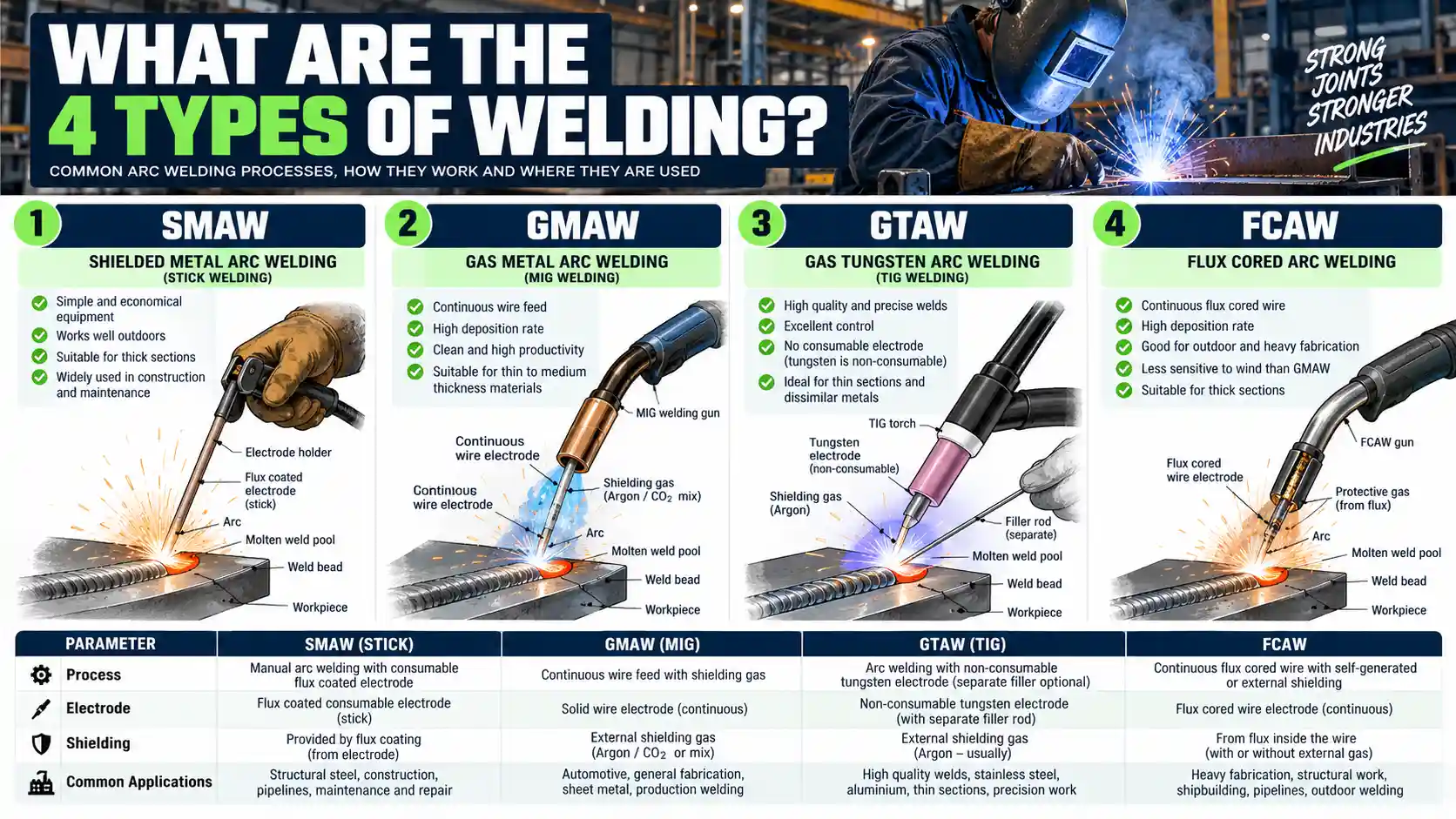
When someone asks what are the 4 types of welding, they are usually referring to four widely used arc welding processes: Shielded Metal Arc Welding, Gas Metal Arc Welding, Gas Tungsten Arc Welding, and Flux Cored Arc Welding. These are commonly known as SMAW, GMAW, GTAW, and FCAW. The Canadian Centre for Occupational Health and Safety also identifies these four among the most common welding processes, while noting that the wider welding field contains many more processes.
At Mechstera, we look at welding from a practical engineering perspective. The right process is rarely determined by price alone. A method that works well for a clean indoor fabrication job may be a poor choice for an outdoor repair or a thick structural component.
This guide explains the four common welding processes, how they work, their advantages and limitations, applications, and the factors that should be considered before selecting one.
What Are the 4 Types of Welding?
The four common welding processes covered in this guide are Shielded Metal Arc Welding (SMAW), Gas Metal Arc Welding (GMAW), Gas Tungsten Arc Welding (GTAW), and Flux Cored Arc Welding (FCAW). They all use an electric arc as the primary heat source, but they differ in electrode design, shielding method, deposition behavior, operating technique, and typical applications.
| Welding process | Common name | Electrode | Shielding method | Typical strength |
|---|---|---|---|---|
| SMAW | Stick welding | Consumable flux coated electrode | Flux coating | Field and repair work |
| GMAW | MIG welding | Continuous solid wire | External shielding gas | Fast production |
| GTAW | TIG welding | Non consumable tungsten electrode | Shielding gas | Precision and quality |
| FCAW | Flux cored welding | Continuous tubular wire | Flux, with or without external gas | High deposition and heavy fabrication |
There is no universally best welding process. A fabricator choosing only by the lowest equipment cost can easily end up paying more through slower production, excessive cleanup, poor weld quality, or rework.
1. Stick welding – Shielded Metal Arc Welding (SMAW)
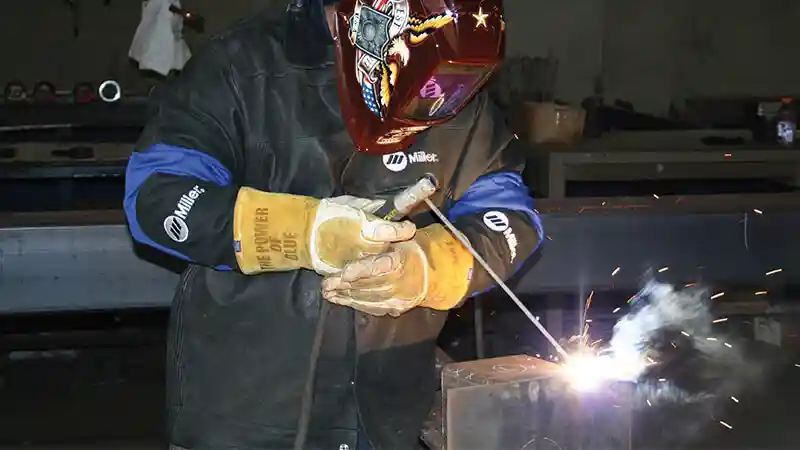
Shielded Metal Arc Welding, commonly called SMAW or stick welding, is one of the most familiar welding processes. It is particularly useful when the work has to be performed away from a controlled fabrication shop.
The process uses a consumable electrode coated with flux. When the electrode approaches the workpiece, an electric arc develops between the electrode and base metal. The resulting heat melts the electrode and part of the base material, producing the weld.
The flux coating plays an important role. During welding, it helps shield the molten weld pool from atmospheric contamination and forms slag over the weld as it cools.
How does stick welding work?
The operator holds the electrode in an electrode holder and maintains a suitable arc length while moving along the joint. The electrode gradually becomes shorter as it is consumed.
This makes SMAW different from wire fed processes such as MIG welding. The operator has to replace the electrode when it becomes too short to continue welding.
Stick welding is particularly useful for repair and construction work because the equipment can be relatively portable and the process does not depend on an external shielding gas supply.
It is also less sensitive to outdoor conditions than gas shielded processes. That does not mean the process can simply be used in any weather. Wind, moisture, electrode storage, joint contamination, and operator technique can still affect weld quality.
Advantages of SMAW
SMAW remains popular because it combines relatively simple equipment with considerable versatility. It can be used on many ferrous materials when the correct electrode is selected, and it is practical for maintenance work where moving large components into a fabrication shop is not realistic.
The process also works well for thicker sections and field applications. Its consumable electrode provides filler metal and flux in one package, which reduces dependence on a separate shielding gas system.
Limitations of SMAW
The process is slower than many continuous wire welding methods because electrodes have to be changed periodically. Slag must also be removed between passes where required.
Weld quality depends heavily on operator technique, electrode selection, storage, current settings, arc length, travel speed, and joint preparation.
Where is SMAW used?
Stick welding is commonly found in structural fabrication, construction, equipment repair, pipeline work, agricultural machinery, shipyards, and maintenance operations.
For field repair, SMAW can be an excellent choice because the equipment can be taken directly to the component rather than bringing the component to a welding booth.
2. MIG – Gas Metal Arc Welding (GMAW)
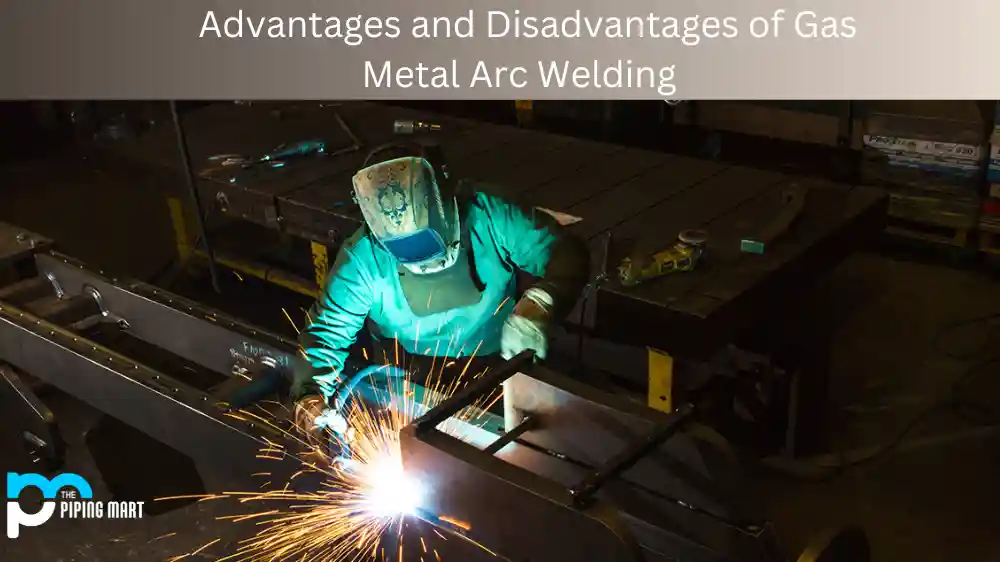
Gas Metal Arc Welding, or GMAW, is commonly known as MIG welding. It is a continuous wire welding process that has become extremely common in fabrication and production environments.
Instead of repeatedly replacing individual electrodes, GMAW feeds a continuous wire electrode through the welding gun. Shielding gas is supplied around the arc to protect the molten weld pool from atmospheric contamination.
The American Welding Society identifies GMAW as one of the major welding processes and maintains dedicated technical material covering its equipment, operation, process control, and applications.
How does MIG welding work?
A wire feeder continuously pushes the electrode through the welding torch. When the wire approaches the workpiece, an arc is established.
The arc melts the wire and base material. The molten metal forms the weld pool and solidifies behind the moving torch.
Shielding gas is important because the molten weld pool can react with oxygen, nitrogen, and other atmospheric contaminants. The selected gas depends on the material and welding procedure.
GMAW is particularly attractive in production because the continuous wire reduces the interruptions associated with changing stick electrodes.
Advantages of GMAW
The main attraction of MIG welding is productivity. Once the equipment is correctly configured, a continuous wire can be fed at a controlled rate, allowing relatively fast welding.
The process is also suitable for mechanized and automated systems. This makes it valuable in manufacturing environments where repeatability and production rate matter.
It can be used with materials such as carbon steel, stainless steel, and aluminum when the correct wire, shielding gas, equipment settings, and procedure are selected.
Limitations of GMAW
MIG welding is more sensitive to the working environment than SMAW because shielding gas can be disturbed by drafts.
Joint fit up, wire feeding, contact tip condition, shielding gas flow, torch position, and equipment maintenance can all influence the result.
For this reason, a process that looks easy to learn can still produce inconsistent welds if the machine is poorly set up or maintained.
Where is MIG welding used?
GMAW is widely used in fabrication shops, automotive manufacturing, structural fabrication, machinery production, sheet metal work, and automated welding cells.
It is particularly useful when production speed and consistent wire feeding are important.
3. TIG – Gas Tungsten Arc Welding (GTAW)
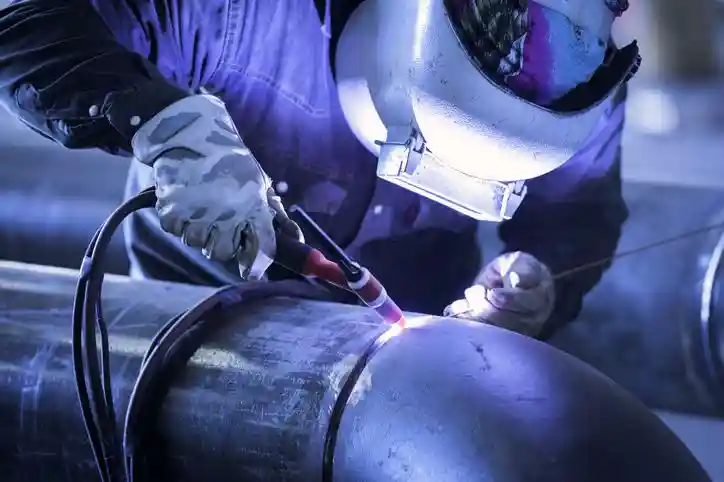
Gas Tungsten Arc Welding, known as GTAW or TIG welding, takes a different approach. Instead of using a consumable electrode as the main electrode, TIG welding uses a non consumable tungsten electrode to establish the arc.
A separate filler rod can be added when additional material is required.
This gives the welder considerable control over the weld pool. That control is one of the main reasons TIG is selected for precision work.
How does TIG welding work?
The tungsten electrode creates an arc between itself and the workpiece. Shielding gas protects the electrode and molten weld pool from atmospheric contamination.
Argon is commonly used for many TIG applications, although shielding gas selection depends on the material and procedure.
When filler material is required, the operator can introduce it separately into the weld pool. This allows control over the amount of filler being added rather than having the electrode itself provide the filler.
Why is TIG welding used for precision work?
TIG welding provides excellent control over heat and filler addition. That makes it useful when weld appearance, penetration control, and cleanliness are particularly important.
It is often selected for thin materials and applications involving stainless steel, aluminum, and other alloys where process control matters.
The American Welding Society notes that GTAW can provide substantial control over deposited weld size, shape, penetration, and root reinforcement, particularly in aluminum welding applications.
Advantages of GTAW
The major advantage is control.
A skilled operator can carefully manage the arc and filler addition to produce a clean, precise weld. The process can also produce excellent weld appearance when the joint preparation, material, shielding, settings, and technique are appropriate.
TIG is therefore useful for applications where quality and precision are more important than maximum deposition rate.
Limitations of GTAW
The same control that makes TIG attractive also makes it demanding.
The operator has to coordinate torch movement, arc length, filler addition, and heat input. This generally makes TIG slower than MIG or FCAW for many production applications.
Equipment setup can also be more involved, particularly when water cooled torches, specialized tungsten electrodes, or additional accessories are required.
Where is TIG welding used?
GTAW is commonly used for stainless steel fabrication, aluminum components, precision fabrication, pipe welding, aerospace related work, laboratory equipment, and applications where weld quality and appearance are important.
For thin material, a carefully controlled TIG process can be much more suitable than a high deposition process that introduces excessive heat.
4. Flux Cored Arc Welding (FCAW)
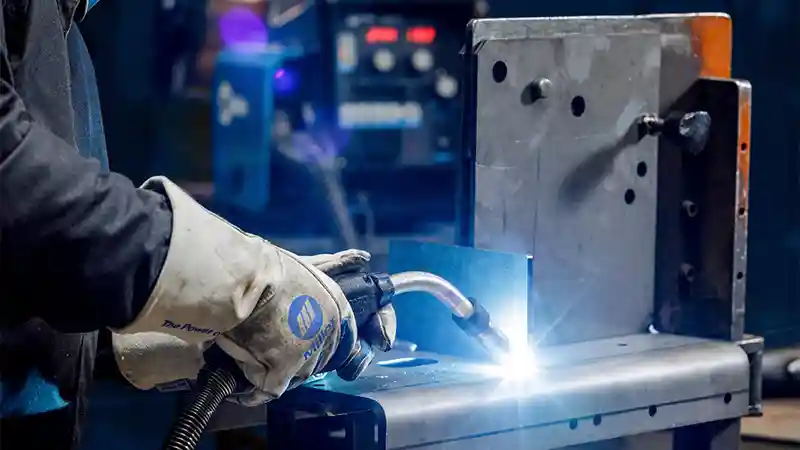
Flux Cored Arc Welding, or FCAW, looks similar to MIG welding because both processes use a continuously fed wire electrode.
The major difference is inside the wire.
FCAW uses a tubular electrode containing flux. Depending on the process, the flux can provide the necessary shielding by itself or the process can use an additional external shielding gas.
How does FCAW work?
The tubular wire is continuously fed toward the workpiece. An electric arc creates the heat required to melt the electrode and base metal.
As the flux inside the wire reacts during welding, it helps protect the molten weld pool. Slag can form over the weld and may need to be removed after welding.
AWS technical material describes FCAW as a process involving flux cored electrodes and covers equipment, materials, process control, weld quality, economics, and safe practices.
Advantages of FCAW
FCAW can provide high deposition rates and is particularly useful for heavier fabrication.
Self shielded FCAW can also be practical for outdoor work because it does not rely on an external shielding gas supply in the same way as gas shielded processes.
This makes it attractive for structural work, construction, heavy equipment, and field fabrication.
Limitations of FCAW
The process can produce more slag and spatter than some other welding methods, depending on the wire and operating conditions.
Cleanup therefore becomes part of the job. If several passes are required, slag removal between passes may add to production time.
The process also requires appropriate wire selection and parameter control. FCAW should not be treated simply as a faster version of MIG.
Where is FCAW used?
FCAW is commonly used for structural steel, heavy equipment, shipbuilding, construction, industrial fabrication, and other applications where high deposition and productivity are valuable.
Different FCAW configurations are selected according to the material, joint, position, required weld properties, and working environment.
You May also Like : Types of Valves: Working Principle: Applications
Comparison of the 4 Types of Welding
The four processes can look similar when viewed from a distance, but their practical behavior is quite different.
| Factor | SMAW | GMAW | GTAW | FCAW |
|---|---|---|---|---|
| Common name | Stick | MIG | TIG | Flux core |
| Electrode | Flux coated rod | Solid continuous wire | Tungsten | Tubular flux cored wire |
| Shielding | Flux | External gas | External gas | Flux, with or without gas |
| Welding speed | Moderate | High | Low to moderate | High |
| Operator control | Moderate | Moderate | Very high | Moderate |
| Outdoor suitability | Good with suitable conditions | Limited by wind | Limited by wind | Good for self shielded FCAW |
| Typical use | Repair and field work | Production fabrication | Precision work | Heavy fabrication |
| Cleanup | Slag removal required | Generally low | Generally low | Slag removal often required |
No row in this table should be interpreted as an absolute rule. Actual performance depends on equipment, joint design, material, welding procedure, operator skill, and production conditions.
What Is the Difference Between MIG and TIG Welding?
MIG and TIG are often compared because both commonly use an external shielding gas, but their operating methods are quite different.
MIG welding uses a continuously fed consumable wire. TIG welding uses a non consumable tungsten electrode and normally adds filler separately when required.
MIG is generally preferred when production speed and deposition rate are important. TIG is usually selected when precise control and weld appearance are higher priorities.
A useful way to think about the difference is simple: MIG prioritizes productivity, while TIG gives the operator more control over the weld.
That does not make TIG automatically better. In a production environment, using TIG where a properly qualified MIG procedure would work can simply increase cycle time and labor cost.
What Is the Difference Between Stick and Flux Cored Welding?
Stick welding uses individual flux coated electrodes, while FCAW uses a continuously fed tubular wire.
Both can be useful for field work and heavy fabrication, but the equipment and operating method are different.
SMAW is often attractive where portability and simplicity matter. FCAW can provide higher deposition rates when continuous wire feeding is beneficial.
The working environment also matters. Self shielded FCAW can be useful where carrying shielding gas is inconvenient, while gas shielded FCAW has different requirements.
Advantages and Disadvantages of the Four Welding Processes
Each process has a useful operating window. Problems generally appear when a process is selected without considering the actual job.
| Process | Main advantages | Main limitations |
|---|---|---|
| SMAW | Portable, versatile, practical for field repairs | Electrode changes, slag removal, lower productivity |
| GMAW | Fast, continuous wire, suitable for production | Sensitive to shielding gas disturbance and setup |
| GTAW | Excellent control, precise welds, good appearance | Slower, higher operator skill requirement |
| FCAW | High deposition, suitable for heavy fabrication, self shielded options | Slag and spatter, wire and parameter selection matter |
How to Choose the Right Welding Process
The welding machine should not be selected before understanding the job. Start with the material, joint, environment, required weld quality, and production target.
The thickness of the material is one factor, but it is not the only one. Position, joint accessibility, required penetration, available power, shielding conditions, electrode or wire availability, and applicable welding procedure requirements can change the decision.
For a small outdoor repair on heavy steel, SMAW may make practical sense. For repetitive indoor fabrication, GMAW can provide better productivity. For a thin stainless component where appearance and heat control matter, GTAW may be the better choice. For heavy structural fabrication where high deposition is valuable, FCAW can be a strong option.
The right answer comes from the complete job requirement rather than the name of the welding machine.
Common Welding Mistakes to Avoid
A technically suitable welding process can still produce a poor joint if the setup or working practice is wrong.
The most common problems include poor joint preparation, incorrect electrode or wire selection, unsuitable current or voltage settings, excessive travel speed, incorrect torch or electrode angle, inadequate shielding, contamination, and poor storage of consumables.
For gas shielded processes, drafts can disturb shielding and contribute to weld defects. For stick welding, moisture and incorrect electrode storage can also affect weld performance.
Another common mistake is judging a weld only by its appearance. A visually attractive bead does not automatically prove that penetration, fusion, dimensions, and mechanical properties meet the required specification.
Welding Safety Considerations
Welding is a hot work operation and should be treated accordingly. The hazards are not limited to burns.
OSHA identifies welding hazards that can include metal fumes, ultraviolet radiation, burns, electrical shock, eye damage, fire, and other workplace risks. Appropriate engineering controls, safe work practices, ventilation, and personal protective equipment are important parts of the work setup.
Before welding, the work area should be assessed for combustible materials and other hazards. Suitable eye and face protection, protective clothing, gloves, and other required PPE should be selected for the operation.
Ventilation deserves particular attention. Welding fumes and gases can be hazardous, and the risk depends on the base material, coatings, filler material, flux, and process. OSHA provides specific guidance on welding fumes, ventilation, hot work, and protective measures.
For industrial work, follow the applicable workplace requirements and qualified welding procedures rather than relying on a generic setting from an online guide.
Which Type of Welding Is Best?
There is no single best process for every application.
If portability and field repair are the priority, SMAW can be a practical choice. If fast production and continuous wire feeding are important, GMAW is often attractive. When precision and control are critical, GTAW has a clear advantage. For heavy fabrication and high deposition, FCAW can be more productive.
The better question is not “Which welding process is best?” It is “Which welding process gives the required weld quality, productivity, safety, and cost for this particular job?”
That distinction matters in real fabrication work.
Frequently Asked Questions
What are the 4 types of welding?
The four commonly referenced processes are SMAW, GMAW, GTAW, and FCAW. Their common names are stick welding, MIG welding, TIG welding, and flux cored welding. There are many other welding processes, so the phrase “four types” normally refers to these widely used arc welding processes rather than every possible welding method.
Which type of welding is easiest to learn?
There is no universal answer because learning difficulty depends on the material, equipment, joint position, and training environment. GMAW is often considered approachable for beginners because the wire feeds continuously, while SMAW requires the operator to manage electrode length and arc conditions manually.
Which welding process is best for thin metal?
GTAW is often selected for thin materials because it provides precise control over heat and filler addition. GMAW can also be effective when the equipment and parameters are correctly selected.
Is MIG welding stronger than TIG welding?
Neither process is automatically stronger. Weld strength depends on the material, joint design, welding procedure, penetration, filler metal, heat input, workmanship, and inspection requirements. A properly produced weld from either process can meet demanding requirements when the procedure is suitable.
Can FCAW be used outdoors?
Yes, particularly self shielded FCAW. Because the shielding is generated by the flux within the electrode, it can be more practical for outdoor applications than processes that depend entirely on external shielding gas. Wind and other environmental conditions still need to be considered.
Is stick welding still used in industry?
Yes. SMAW remains useful for construction, maintenance, repair, structural work, and field applications where portability and operating flexibility are valuable.
Which welding process gives the best appearance?
GTAW is commonly chosen when weld appearance and precise control are major priorities. However, appearance alone should not be used to determine weld quality.
Final Thoughts
Understanding what are the 4 types of welding is useful because each process solves a different fabrication problem.
SMAW provides portability and flexibility, GMAW offers continuous wire feeding and production speed, GTAW provides precise control, and FCAW offers high deposition capability for demanding fabrication work.
The best selection depends on the material, thickness, joint design, welding position, environment, required quality, production rate, and applicable procedure requirements.
For anyone working with welding equipment, learning the names of the processes is only the starting point. Understanding why a particular process is selected is what makes the knowledge useful in an actual workshop or industrial environment.
For additional safety information, OSHA’s Welding, Cutting, and Brazing guidance provides useful information about welding hazards and control measures.