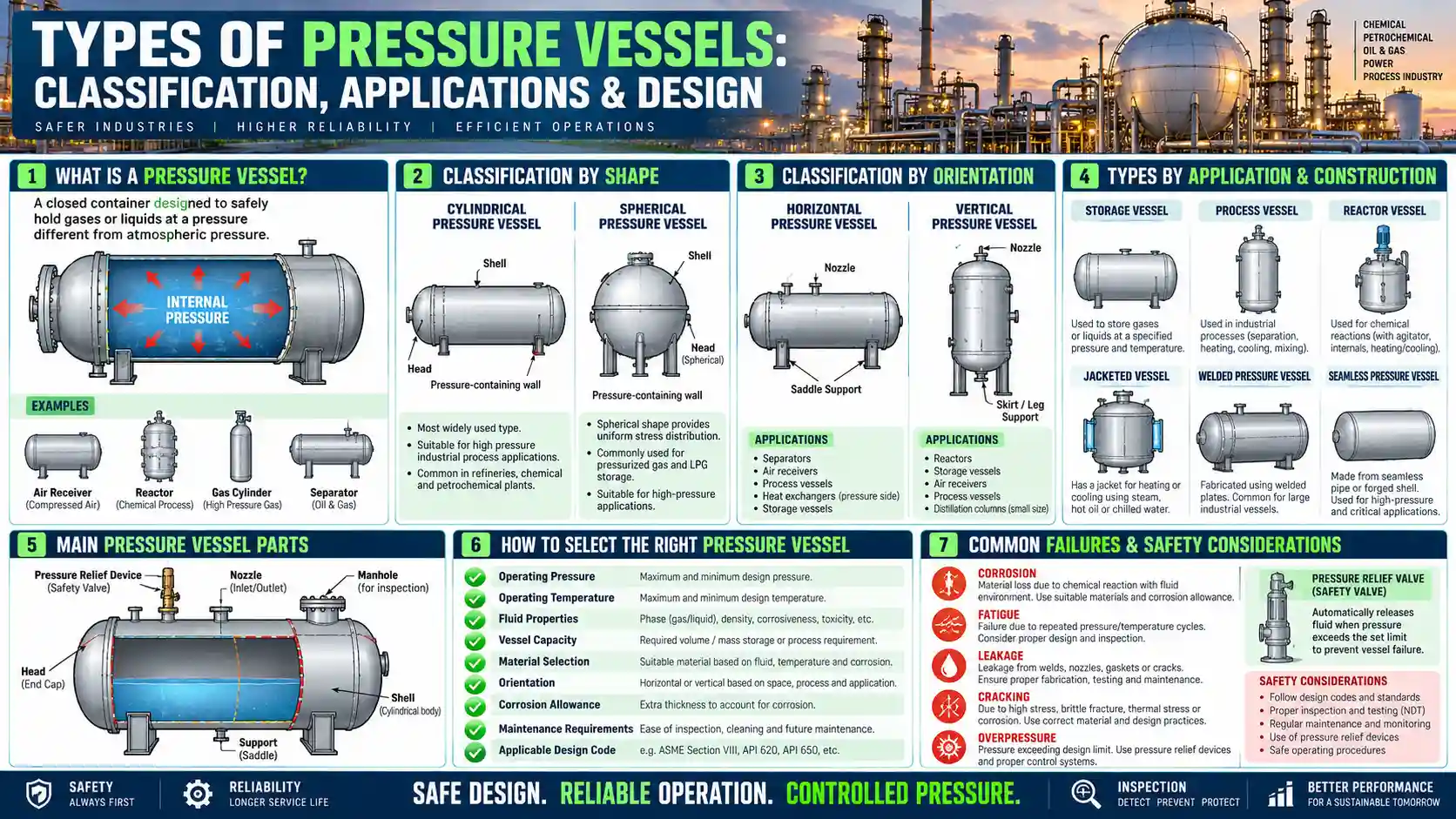
Pressure vessels are important components in many industrial systems where fluids or gases need to be stored or processed under pressure.
They are used in industries such as chemical processing, oil and gas, power generation, pharmaceuticals, food processing, refrigeration, and compressed-air systems.
A pressure vessel must be designed to safely withstand the internal pressure, temperature, fluid characteristics, and other operating conditions.
Different types of pressure vessels are used depending on their shape, orientation, construction method, and application.
This guide explains the major types of pressure vessels, their characteristics, applications, and important design considerations.
What Is a Pressure Vessel?
A pressure vessel is a closed container designed to hold gases or liquids at a pressure that is different from the surrounding atmospheric pressure.
The vessel must safely withstand the pressure acting on its walls and other components.
Common examples include:
- Air receivers
- Boilers
- Storage tanks
- Gas cylinders
- Reactors
- Separators
- Autoclaves
- Accumulators
The design of a pressure vessel depends on factors such as operating pressure, temperature, material, fluid properties, vessel size, and applicable design standards.
How Are Pressure Vessels Classified?
Pressure vessels can be classified in several ways.
Common classifications include:
- Based on shape
- Based on orientation
- Based on construction
- Based on application
- Based on operating pressure
The most common industrial classification is based on the shape and orientation of the vessel.
1. Cylindrical Pressure Vessel
A cylindrical pressure vessel has a cylindrical shell with curved or formed ends.
It is one of the most widely used pressure vessel designs because the cylindrical shape provides an efficient way to contain internal pressure.
The vessel normally consists of:
- Cylindrical shell
- Heads or end closures
- Nozzles
- Manholes
- Supports
- Pressure connections
Cylindrical vessels are commonly used for:
- Air receivers
- Process vessels
- Boilers
- Storage vessels
- Chemical processing equipment
- Separators
For example, an industrial air receiver stores compressed air and supplies it to pneumatic equipment when required.
2. Spherical Pressure Vessel
A spherical pressure vessel has a spherical shell designed to contain pressurized fluids or gases.
A sphere is structurally efficient because the internal pressure is distributed relatively uniformly across the vessel wall.
This can allow a spherical vessel to withstand pressure with less wall material compared with some other shapes for the same volume.
However, manufacturing, transportation, installation, and support can be more complicated.
Spherical pressure vessels are commonly used for:
- LPG storage
- High-pressure gas storage
- Petrochemical applications
- Large-volume pressurized storage
The main advantage of the spherical shape is its favorable strength-to-volume relationship.
3. Horizontal Pressure Vessel
A horizontal pressure vessel is a vessel installed with its longitudinal axis in the horizontal direction.
Horizontal vessels are commonly used when the process requires easy access, gravity-based separation, or convenient piping arrangements.
Typical applications include:
- Gas-liquid separators
- Air receivers
- Process vessels
- Horizontal storage vessels
- Knockout drums
Horizontal vessels are generally supported using structures such as saddle supports.
For example, a horizontal separator can allow liquid to collect at the bottom while gas leaves through an upper outlet.
4. Vertical Pressure Vessel
A vertical pressure vessel is installed with its longitudinal axis in the vertical direction.
Vertical vessels are useful where floor space is limited or where the process benefits from vertical separation and gravity flow.
Common applications include:
- Distillation columns
- Reactors
- Separators
- Absorbers
- Process storage vessels
Vertical vessels may be supported using skirts, legs, or other support arrangements depending on their size and design.
5. High-Pressure Vessel
High-pressure vessels are designed to operate at relatively high internal pressures.
The required construction depends on the pressure, temperature, material, vessel dimensions, and applicable design code.
Common applications include:
- Compressed gas storage
- Hydrogen systems
- Chemical processing
- High-pressure reactors
- Hydraulic systems
High-pressure vessels require careful consideration of wall thickness, stress concentration, fatigue, material selection, and pressure relief.
6. Low-Pressure Vessel
Low-pressure vessels operate at pressures that are relatively close to atmospheric pressure but still require controlled containment.
They may be used for:
- Low-pressure storage
- Process equipment
- Gas handling
- Chemical processing
- Certain heating and cooling systems
The design requirements depend on the specific operating conditions and applicable standards.
7. Storage Pressure Vessel
A storage pressure vessel is designed primarily to store a pressurized fluid or gas.
The stored material may include compressed air, LPG, nitrogen, oxygen, refrigerants, or other industrial fluids.
Common examples include:
- Compressed-air receivers
- LPG vessels
- Gas storage vessels
- Refrigerant receivers
The vessel must be designed for the expected pressure, temperature, fluid properties, and operating cycle.
8. Process Pressure Vessel
A process pressure vessel is used to perform a specific industrial process while the fluid is maintained under pressure.
Unlike a simple storage vessel, the main purpose is usually processing rather than storage.
Process vessels can be used for:
- Mixing
- Chemical reactions
- Separation
- Heating
- Cooling
- Gas-liquid contact
Examples include reactors, separators, absorbers, and process drums.
9. Reactor Vessel
A reactor vessel is a pressure vessel designed to contain and control a chemical reaction.
The vessel may include additional components such as:
- Agitators
- Heating or cooling jackets
- Internal coils
- Baffles
- Nozzles
- Temperature sensors
The design must consider both pressure and process conditions.
For example, a chemical reactor may operate at elevated pressure and temperature while containing corrosive chemicals.
Material selection is therefore an important part of reactor design.
10. Jacketed Pressure Vessel
A jacketed pressure vessel contains an external jacket around part or all of the vessel.
A heating or cooling fluid flows through the jacket to control the temperature of the material inside the vessel.
Jacketed vessels are commonly used in:
- Chemical processing
- Pharmaceutical manufacturing
- Food processing
- Mixing applications
- Batch processing
The jacket allows heat to be transferred without directly mixing the heating or cooling fluid with the process material.
11. Multi-Layer Pressure Vessel
A multi-layer pressure vessel is constructed using multiple layers or sections of material rather than relying on a single thick wall.
This type of construction can be used for certain high-pressure applications.
The construction method depends on the required pressure, material, manufacturing process, and design requirements.
Multi-layer construction can provide advantages in certain specialized applications, but manufacturing and inspection requirements can be more complex.
12. Seamless Pressure Vessel
A seamless pressure vessel is manufactured without a longitudinal welded seam in the main shell.
This construction is commonly associated with certain gas cylinders and specialized high-pressure applications.
The absence of a major longitudinal weld can be beneficial in applications where high pressure and cyclic loading are important considerations.
However, the manufacturing process can be more demanding and is dependent on the vessel size and application.
13. Welded Pressure Vessel
Welded pressure vessels are manufactured by joining plates, shells, heads, and other components using welding processes.
Welding is widely used for industrial pressure vessels because it allows large vessels to be manufactured from steel and other engineering materials.
Important considerations include:
- Welding procedure
- Weld quality
- Heat-affected zones
- Non-destructive testing
- Welding defects
- Post-weld heat treatment where required
The welds must meet the requirements of the applicable design and fabrication standards.
Comparison of Common Pressure Vessel Types
| Type | Main Characteristic | Common Applications |
|---|---|---|
| Cylindrical | Cylindrical shell | Air receivers, process vessels |
| Spherical | Spherical shell | LPG and gas storage |
| Horizontal | Horizontal installation | Separators, receivers |
| Vertical | Vertical installation | Reactors, columns, separators |
| High-pressure | Designed for high pressure | Gas storage, reactors |
| Storage vessel | Mainly used for storage | LPG, compressed air |
| Process vessel | Used for processing | Chemical and process industries |
| Reactor vessel | Contains chemical reactions | Chemical and pharmaceutical industries |
| Jacketed vessel | Temperature controlled using jacket | Batch processing |
| Welded vessel | Components joined by welding | Large industrial vessels |
| Seamless vessel | Main shell without major longitudinal weld | Gas cylinders, specialized applications |
Main Components of a Pressure Vessel
Although construction varies between vessel types, many pressure vessels contain similar components.
Shell
The shell is the main pressure-containing part of the vessel.
It carries the pressure exerted by the contained fluid.
Heads
Heads close the ends of cylindrical vessels.
Common head shapes include:
- Ellipsoidal head
- Hemispherical head
- Torispherical head
- Flat head
The selected head design depends on pressure, geometry, manufacturing requirements, and cost.
Nozzles
Nozzles provide connections for fluid entry and exit.
They may also be used for:
- Instrumentation
- Drainage
- Venting
- Pressure relief
- Inspection
Manhole
A manhole provides access to the internal part of a large pressure vessel for inspection, cleaning, and maintenance.
Supports
Pressure vessels require suitable support structures.
Common support arrangements include:
- Saddle supports
- Skirt supports
- Leg supports
- Lug supports
The support arrangement depends on the vessel orientation, size, weight, and installation requirements.
Pressure Relief Device
A pressure relief device helps protect the vessel from excessive pressure.
Depending on the application, this may include a pressure relief valve or another approved protection system.
Factors Affecting Pressure Vessel Selection
Selecting a suitable pressure vessel requires consideration of several operating conditions.
Operating Pressure
The vessel must safely withstand the maximum expected internal pressure.
Operating Temperature
Temperature affects material strength, corrosion behavior, gasket performance, and other design parameters.
Fluid Properties
The fluid can influence material selection and vessel construction.
Important properties include:
- Corrosiveness
- Flammability
- Toxicity
- Density
- Viscosity
- Chemical compatibility
Vessel Capacity
The required volume influences the vessel dimensions and construction.
Space Availability
The available installation area can influence whether a horizontal or vertical vessel is more suitable.
Maintenance Requirements
The design should provide suitable access for inspection, cleaning, repair, and replacement of components.
Pressure Vessel Design Considerations
Pressure vessel design involves more than simply selecting a suitable shape.
Engineers must consider:
- Internal pressure
- External pressure
- Temperature
- Material strength
- Corrosion allowance
- Wall thickness
- Stress concentration
- Weld quality
- Fatigue
- Supports
- Nozzle loads
- Pressure relief
- Inspection requirements
The vessel should be designed according to the applicable pressure vessel code and engineering standards.
Common Pressure Vessel Failures
Pressure vessels operate under potentially severe conditions, so failure prevention is important.
Common problems can include:
Corrosion
Corrosion can reduce the thickness of pressure-containing components.
If corrosion becomes significant, the pressure-containing capability of the vessel can decrease.
Fatigue
Repeated pressure and temperature cycles can cause fatigue damage over time.
Fatigue is particularly important in vessels exposed to frequent start-up and shutdown cycles.
Leakage
Leakage can occur through damaged welds, gaskets, nozzles, valves, or other connections.
Cracking
Cracks can develop because of fatigue, corrosion, material defects, manufacturing problems, or excessive stress.
Overpressure
Excessive internal pressure can create dangerous loading conditions.
Appropriate pressure protection is therefore an important part of pressure vessel design and operation.
Pressure Vessel Inspection and Maintenance
Regular inspection helps identify developing problems before they become serious.
Important inspection activities may include:
- Visual inspection
- Thickness measurement
- Weld inspection
- Leakage checks
- Corrosion monitoring
- Pressure testing where required
- Non-destructive testing
- Inspection of pressure relief devices
The inspection frequency depends on the vessel design, service conditions, applicable regulations, and operating environment.
Pressure Vessel vs Storage Tank
Pressure vessels and storage tanks may appear similar, but they are designed for different operating conditions.
| Feature | Pressure Vessel | Storage Tank |
|---|---|---|
| Pressure | Designed for significant pressure difference | Usually near atmospheric pressure |
| Construction | Designed for pressure loading | Designed mainly for storage |
| Typical fluids | Pressurized gases and liquids | Liquids and low-pressure fluids |
| Design requirements | More demanding pressure design | Depends on tank type |
| Examples | Air receiver, reactor | Water or fuel storage tank |
The exact classification depends on the operating pressure and applicable design standards.
Applications of Pressure Vessels
Pressure vessels are used across many industries.
Common applications include:
- Chemical processing
- Oil and gas
- Power generation
- Pharmaceutical manufacturing
- Food processing
- Compressed-air systems
- Refrigeration
- Petrochemical processing
- Water treatment
- Hydrogen storage
- Gas storage
For example, an air receiver in a compressed-air system stores pressurized air and helps stabilize the supply available to downstream equipment.
How to Select the Right Pressure Vessel
A suitable pressure vessel should be selected based on the actual process requirements.
A practical selection process can include:
- Determine the required volume.
- Identify the operating and design pressure.
- Determine the operating and design temperature.
- Identify the fluid properties.
- Select a suitable material.
- Determine the required orientation.
- Select an appropriate vessel geometry.
- Consider corrosion allowance.
- Determine inspection and maintenance requirements.
- Verify compliance with the applicable design code.
The final design should be reviewed by qualified engineers because pressure vessels can present serious safety risks if incorrectly designed or operated.
Conclusion
Pressure vessels are important components used for storing and processing fluids under pressure.
They can be classified according to their shape, orientation, construction method, pressure range, and application.
Cylindrical and spherical vessels are common pressure-containing geometries, while horizontal and vertical vessels are selected according to installation and process requirements.
Storage vessels, process vessels, reactors, and jacketed vessels are designed for different industrial functions.
The correct pressure vessel depends on factors such as pressure, temperature, fluid properties, capacity, material, maintenance requirements, and applicable design standards.
Proper design, fabrication, inspection, and maintenance are essential because pressure vessel failure can result in serious equipment damage, production losses, and safety hazards.