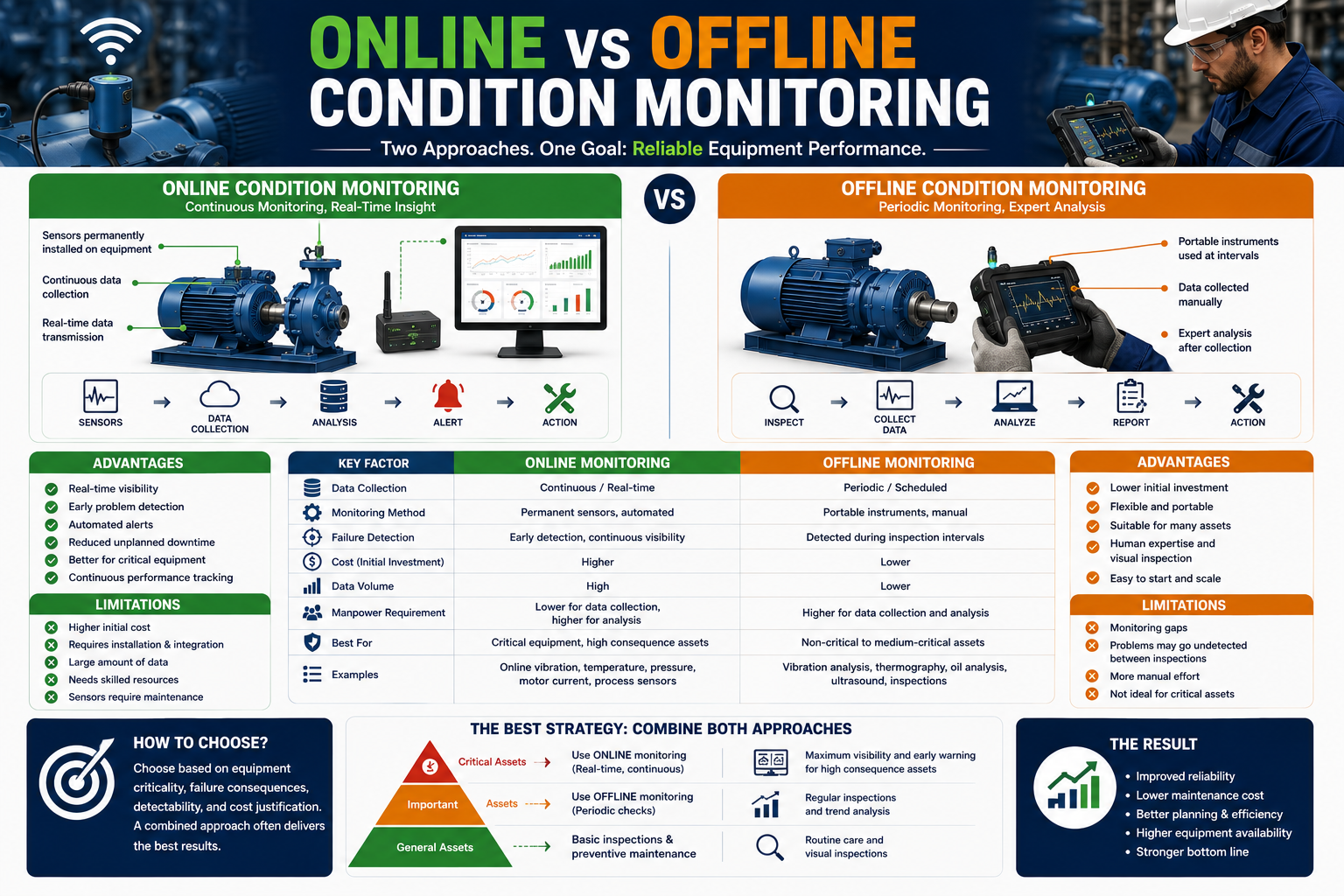
Condition monitoring is an essential part of modern maintenance and reliability engineering. It allows maintenance teams to assess the health of equipment, identify abnormal conditions, and detect developing failures before they cause major breakdowns.
Traditionally, condition monitoring was performed through periodic inspections. A technician would visit equipment at scheduled intervals, collect measurements, and analyze the results. Today, advances in sensors, Industrial Internet of Things (IIoT) technology, automation, and data analytics have made continuous equipment monitoring possible.
This has created two major approaches:
Online condition monitoring and offline condition monitoring.
Both methods can provide valuable information about equipment health, but they differ significantly in how data is collected, how frequently equipment is monitored, and how quickly developing problems can be detected.
Understanding the differences between online and offline condition monitoring can help maintenance engineers select the right strategy for each asset.
What Is Condition Monitoring?
Condition monitoring is the process of measuring and analyzing equipment parameters to determine the health and performance of an asset.
The objective is to identify changes that may indicate deterioration or an impending failure.
Common parameters include:
- Vibration
- Temperature
- Pressure
- Flow
- Lubricant condition
- Electrical current
- Voltage
- Speed
- Acoustic emissions
- Equipment performance
Condition monitoring can support predictive and proactive maintenance by providing information about the actual condition of an asset.
Instead of maintaining equipment only according to a fixed schedule, maintenance teams can use condition information to make more informed decisions.
What Is Online Condition Monitoring?
Online condition monitoring continuously or frequently monitors equipment while it is operating.
Sensors are permanently or semi-permanently installed on the equipment and automatically collect information.
The data may be transmitted to:
- PLC systems
- SCADA systems
- Edge devices
- Cloud platforms
- Condition-monitoring software
- CMMS platforms
- Reliability dashboards
For example, a vibration sensor installed on a critical motor can continuously measure vibration while the motor operates.
If vibration increases beyond a defined threshold, the system can generate an alert for maintenance personnel.
A typical process is:
Equipment → Sensor → Data Collection → Analysis → Alert → Maintenance Action
Examples of Online Condition Monitoring
Online monitoring is commonly used for critical and continuously operating equipment.
Examples include:
- Large electric motors
- Pumps
- Compressors
- Turbines
- Generators
- Gearboxes
- Critical fans
- Transformers
- Continuous production machinery
Online systems are particularly useful when equipment failure could result in significant production losses, safety risks, or expensive secondary damage.
Advantages of Online Condition Monitoring
1. Continuous Equipment Visibility
One of the biggest benefits is the ability to monitor equipment continuously.
Instead of obtaining one measurement every month, maintenance teams can potentially observe equipment behavior throughout its operating cycle.
2. Early Failure Detection
Developing problems can sometimes be identified much earlier.
For example, gradual increases in vibration or temperature may indicate deterioration before a machine reaches a critical condition.
3. Reduced Dependence on Manual Inspections
Automated sensors reduce the need for technicians to manually collect every measurement.
Technicians can focus their time on assets that require investigation.
4. Real-Time Alerts
Online monitoring systems can generate alerts when measurements exceed predefined limits or when unusual trends are detected.
5. Useful for Critical Equipment
Continuous monitoring is particularly valuable for assets where unexpected failure can have major consequences.
Disadvantages of Online Condition Monitoring
Online monitoring also has limitations.
Higher Initial Cost
Permanent sensors, communication infrastructure, software, installation, and integration can require significant investment.
Sensor Maintenance
Sensors themselves must be maintained, calibrated, and checked for reliability.
Large Amounts of Data
Continuous monitoring can generate large volumes of information.
Without proper analytics and alarm management, maintenance teams may experience excessive alerts.
Technical Complexity
Online systems may require expertise in instrumentation, networking, data analysis, automation, and reliability engineering.
Not Suitable for Every Asset
Installing permanent monitoring equipment on low-value or non-critical assets may not provide sufficient economic benefit.
What Is Offline Condition Monitoring?
Offline condition monitoring involves collecting equipment-condition data periodically rather than continuously.
A technician or specialist typically visits the equipment using portable instruments.
Measurements may be collected:
- Weekly
- Monthly
- Quarterly
- During planned inspections
- During maintenance shutdowns
- According to equipment criticality
The collected information is then analyzed to determine whether the equipment condition is changing.
For example, a technician may use a portable vibration analyzer to measure a motor once every month.
If vibration levels increase over several inspections, the maintenance team can investigate the cause.
Examples of Offline Condition Monitoring
Common offline techniques include:
- Portable vibration analysis
- Handheld infrared thermography
- Portable ultrasonic inspection
- Manual temperature measurement
- Oil sampling
- Portable electrical testing
- Visual inspections
- Manual equipment performance checks
Offline monitoring remains widely used because it can provide valuable information without requiring permanent sensors on every asset.
Advantages of Offline Condition Monitoring
1. Lower Initial Investment
Portable instruments can be used across many assets, reducing the need to install permanent sensors everywhere.
2. Flexible
Technicians can use different instruments depending on the equipment and failure mode.
3. Good for Large Asset Populations
A single monitoring specialist can inspect many machines using portable equipment.
4. Human Expertise
Technicians and reliability engineers can observe the equipment directly and combine measurements with visual and operational information.
5. Suitable for Lower-Criticality Assets
For equipment that does not justify continuous monitoring, periodic inspections can provide an economical solution.
Disadvantages of Offline Condition Monitoring
Monitoring Gaps
A machine is only measured during inspection.
A problem that develops between inspections may remain undetected until the next monitoring visit.
Requires Skilled Personnel
Accurate data collection and interpretation may require trained technicians or specialists.
Manual Data Collection
Measurements need to be collected, recorded, transferred, and analyzed.
Limited Real-Time Visibility
Offline monitoring cannot provide the same continuous visibility as permanently installed sensors.
Online vs Offline Condition Monitoring
| Factor | Online Monitoring | Offline Monitoring |
|---|---|---|
| Data collection | Continuous/frequent | Periodic |
| Equipment sensors | Usually permanent | Usually portable |
| Initial cost | Higher | Lower |
| Manual involvement | Lower for data collection | Higher |
| Real-time alerts | Possible | Generally unavailable |
| Data volume | High | Lower |
| Best suited for | Critical assets | Low/medium-criticality assets |
| Failure detection | Potentially earlier | Depends on inspection frequency |
| Flexibility | Lower after installation | High |
| Specialist involvement | Analysis-focused | Data collection and analysis |
Which Is Better?
There is no universal answer.
The appropriate approach depends on:
- Equipment criticality
- Failure consequences
- Failure development time
- Equipment operating pattern
- Monitoring technology
- Cost of monitoring
- Accessibility
- Existing infrastructure
- Required response time
For example, a critical turbine operating continuously may justify permanent online vibration monitoring.
A small auxiliary motor may be better monitored using periodic portable vibration measurements.
The key question is:
How quickly can the failure develop, and how much does it matter if we miss it?
Can Online and Offline Monitoring Be Combined?
Yes.
In many industrial environments, the most effective condition-monitoring strategy uses both approaches.
For example:
Critical Equipment
Use continuous online monitoring.
Important Equipment
Use periodic offline monitoring.
Low-Criticality Equipment
Use operator inspections or basic preventive maintenance.
This creates a tiered condition-monitoring strategy.
A plant might therefore have:
Online monitoring → Critical assets
Offline monitoring → Medium-criticality assets
Routine inspection → Low-criticality assets
This approach allows maintenance resources to be allocated according to risk.
How to Choose the Right Monitoring Approach
Step 1: Perform Asset Criticality Analysis
Identify equipment that has significant safety, production, environmental, or financial consequences if it fails.
Step 2: Identify Failure Modes
Determine how each critical asset can fail.
Step 3: Determine Detectability
Ask whether the developing failure can be detected through vibration, temperature, oil analysis, electrical measurements, or another parameter.
Step 4: Estimate Failure Development Time
If a failure can develop within hours, periodic monthly monitoring may not be sufficient.
If deterioration develops over several months, offline monitoring may be adequate.
Step 5: Compare Costs and Benefits
Compare the cost of permanent monitoring with the potential cost of equipment failure.
Step 6: Define the Maintenance Response
Monitoring is useful only when abnormal conditions lead to an appropriate maintenance action.
Role of Sensors and IIoT
The growth of IIoT is making online condition monitoring more accessible.
Wireless sensors can measure equipment parameters and transmit information to centralized systems.
For example:
Wireless vibration sensor → Gateway → Analytics platform → Condition alert → CMMS work order
This allows maintenance teams to monitor assets remotely and identify abnormal trends without physically visiting every machine.
However, online monitoring should be implemented strategically. Collecting more data does not automatically produce better maintenance.
The organization must have a clear process for analyzing information and responding to alerts.
Condition Monitoring and Predictive Maintenance
Both online and offline monitoring can support predictive maintenance.
The key difference is how quickly and frequently information becomes available.
Offline monitoring may identify a gradual deterioration trend during periodic inspections.
Online monitoring can potentially detect the change much closer to when it occurs.
For critical assets, continuous monitoring can therefore provide valuable warning time.
However, the monitoring method should always match the failure mechanism.
Common Mistakes to Avoid
Installing Online Sensors on Everything
Not every asset requires continuous monitoring.
Ignoring Offline Monitoring
Portable monitoring remains an effective and economical solution for many applications.
Collecting Data Without a Response Plan
Every significant alert should have a defined investigation or maintenance response.
Using the Wrong Monitoring Technology
A vibration sensor cannot detect every possible failure mode.
Ignoring Sensor Reliability
Bad sensor data can result in false alarms or missed problems.
Focusing Only on Technology
Successful condition monitoring requires people, processes, data quality, and maintenance discipline.
The Future of Condition Monitoring
The future of industrial condition monitoring will increasingly combine:
- Smart sensors
- Wireless communication
- Artificial intelligence
- Machine learning
- Edge computing
- Cloud analytics
- Digital twins
- Automated inspections
- CMMS integration
These technologies can help maintenance teams move toward more intelligent, risk-based asset management.
However, the objective should remain the same:
Detect meaningful equipment deterioration early enough to take effective action.