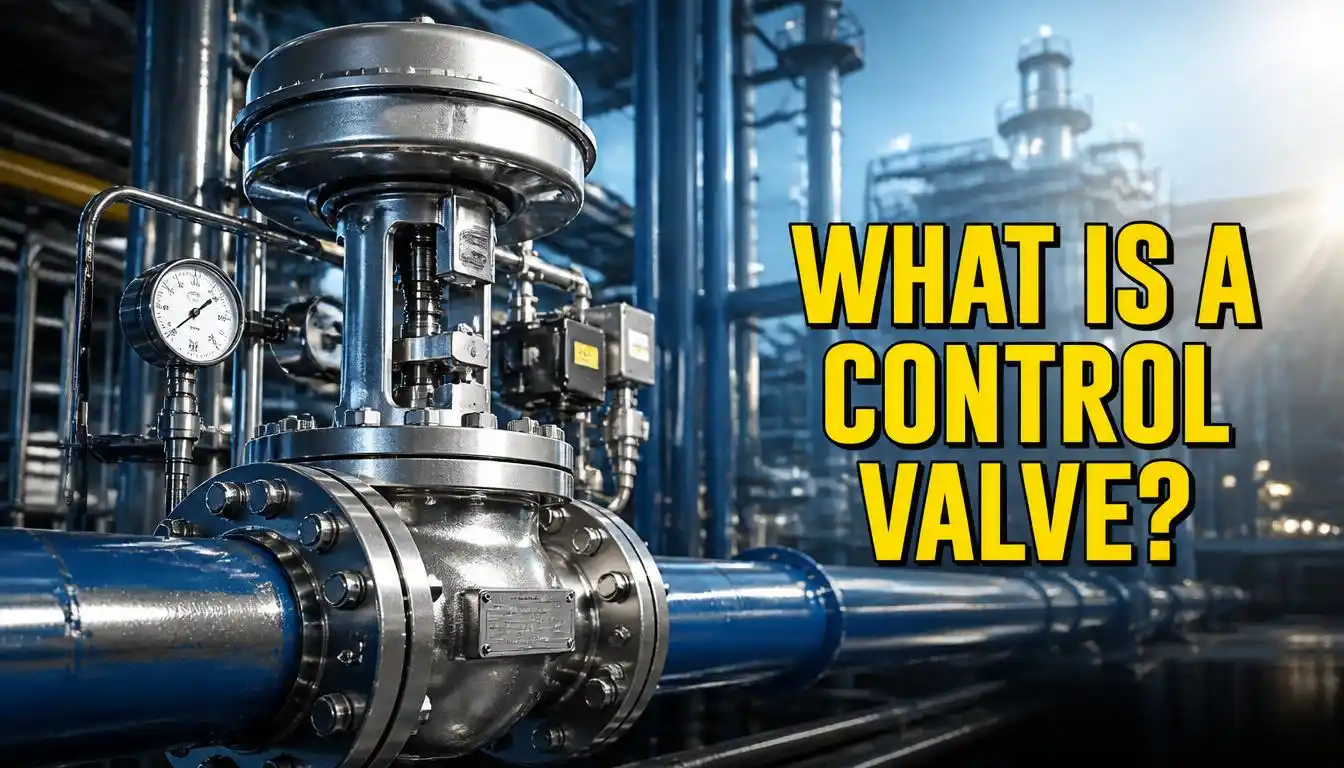
If you’ve ever wondered how a chemical plant keeps a reactor at a precise temperature, or how a power plant maintains steady steam pressure, the answer almost always involves a control valve. These unassuming devices sit at the heart of almost every industrial process, quietly adjusting the flow of liquids, gases, and steam thousands of times a day.
Whether you’re an instrumentation engineer, a plant manager, or simply someone researching “what is a control valve” for a project, this guide covers everything — from working principles and components to types, flow characteristics, and how to choose the right one for your application.
What is a Control Valve?
A control valve is a final control element used in industrial process systems to regulate the flow rate, pressure, temperature, or liquid level of a fluid by varying the size of the flow passage as directed by a signal from a controller. In simpler terms, it’s the “muscle” of an automated control loop — it physically acts on the process based on instructions it receives.
Unlike a simple on/off (isolation) valve, a control valve can modulate — meaning it can open partially to any position between fully closed and fully open, giving precise, continuous control over the process variable.
You might also see this device referred to as a valve control valve, controller valve, or simply process control valve — these are all different phrasings used across the industry for the same core equipment.
Why Are Control Valves Used?
Control valves exist because most industrial processes need to be kept within tight, safe operating limits. A few reasons they’re indispensable:
- Precision regulation of flow, pressure, temperature, and level
- Automated response to changing process conditions without manual intervention
- Safety — preventing overpressure, overheating, or dangerous surges
- Efficiency — minimizing waste of energy, raw materials, and utilities
- Consistency — ensuring product quality by keeping process variables stable
Industries such as oil & gas, power generation, chemical processing, water treatment, food & beverage, and pharmaceuticals all depend heavily on control valves for continuous, automated operation.
Components of a Control Valve
Understanding valve control valve parts is essential to understanding how the whole system works. A typical control valve assembly is made up of three major sub-systems:
1. Valve Body
The valve body is the outer casing through which the fluid actually flows. It forms the main outer casing of the control valve and contains the passage through which the fluid flows, and it must be capable of withstanding system pressure, fluid velocity, and operating temperature conditions. Depending on the application, valve bodies are commonly manufactured from carbon steel, stainless steel, alloy steel, or corrosion-resistant alloys. Instrumentation Blog
2. Actuator
The actuator is the “engine” of the control valve — it converts the incoming control signal into mechanical motion that opens or closes the valve. Actuators can be pneumatic (air-driven), electric (motor-driven), or hydraulic, depending on the application and required force. Datianvalve
3. Trim
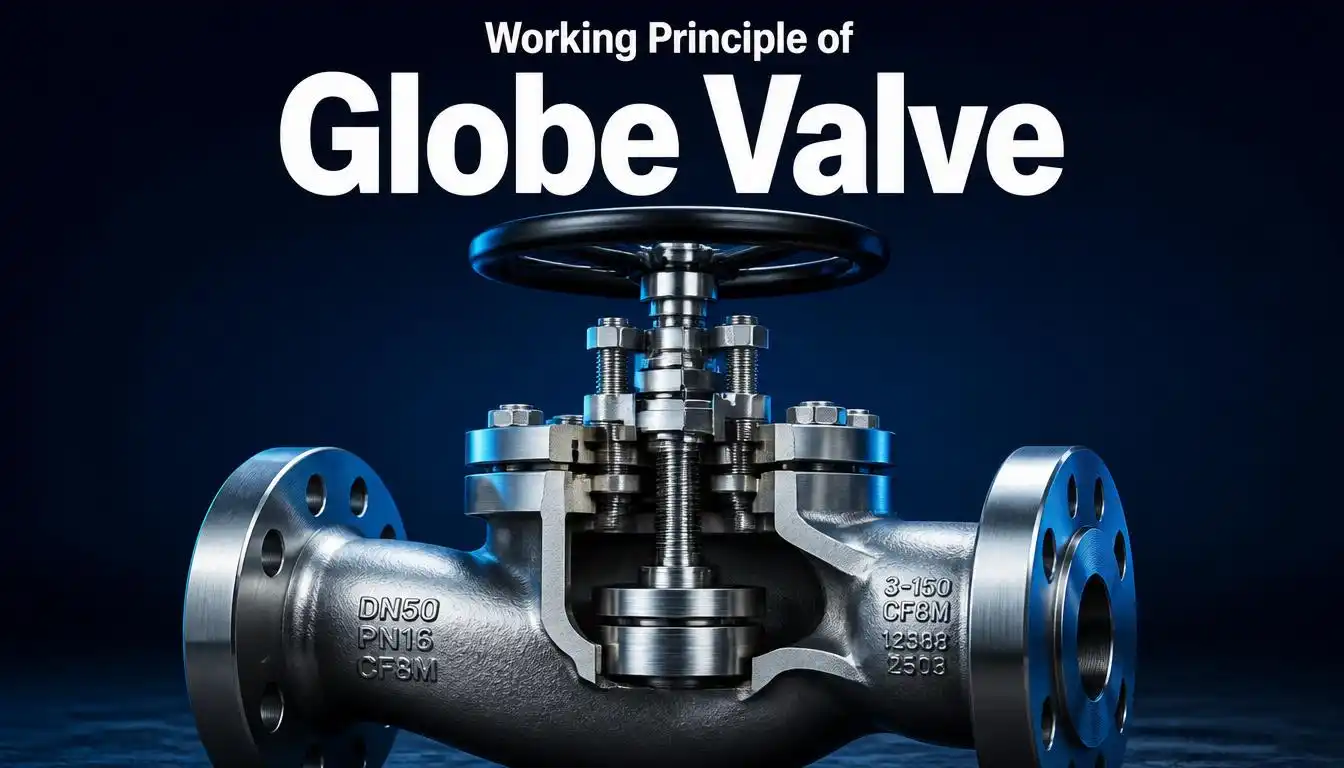
The trim is the internal assembly — including the plug, ball, or disc, along with the seat and stem — that actually performs the flow-control action. The geometry and profile of the trim determine the flow characteristic, how smoothly the valve modulates flow, the pressure drop, and how tight the shut-off is. Instrumentation BlogInstrumentation Blog
4. Positioner
The positioner ensures the valve reaches the exact opening corresponding to the control signal, improving accuracy and stability. This component is critical in closed-loop systems where precision matters. Instrumentation Blog
5. Packing / Seals
These components seal the area around the stem, preventing leakage to the atmosphere and ensuring safe, long-term operation.
6. Stem, Bonnet, and Yoke
The stem connects the actuator to the trim, transmitting motion; the bonnet houses the stem and packing; and the yoke structurally connects the actuator to the valve body.
For a deeper technical breakdown of individual valve body parts and internals, InstrumentationEDU’s guide on control valve working principles is a solid reference.
Control Valve Working Principle
The control valve working principle is built around a closed control loop:
- A sensor (e.g., a pressure, temperature, or flow transmitter) measures the process variable.
- A controller (PLC or DCS) compares this measured value against the desired setpoint.
- The controller sends a signal — typically 3–15 psig for pneumatic systems or 4–20 mA for electrical systems — to the control valve’s actuator. Chemicalengineeringworld
- The actuator converts this signal into physical motion, moving the valve stem (and thus the trim) to a new position.
- The positioner verifies and fine-tunes the exact valve opening against the received signal.
- As the flow area changes, the process variable (pressure, flow, temperature, or level) shifts back toward the setpoint.
This is essentially the control valve principle of operation in every closed-loop industrial system — continuous sensing, comparison, and correction. For a visual, step-by-step explanation aimed at beginners, RealPars’ explainer on control valves is a good companion resource, and the ISA-75 series of standards governs the dimensional and performance requirements these valves must meet.
You May Also Like : Shell and Tube Heat Exchange
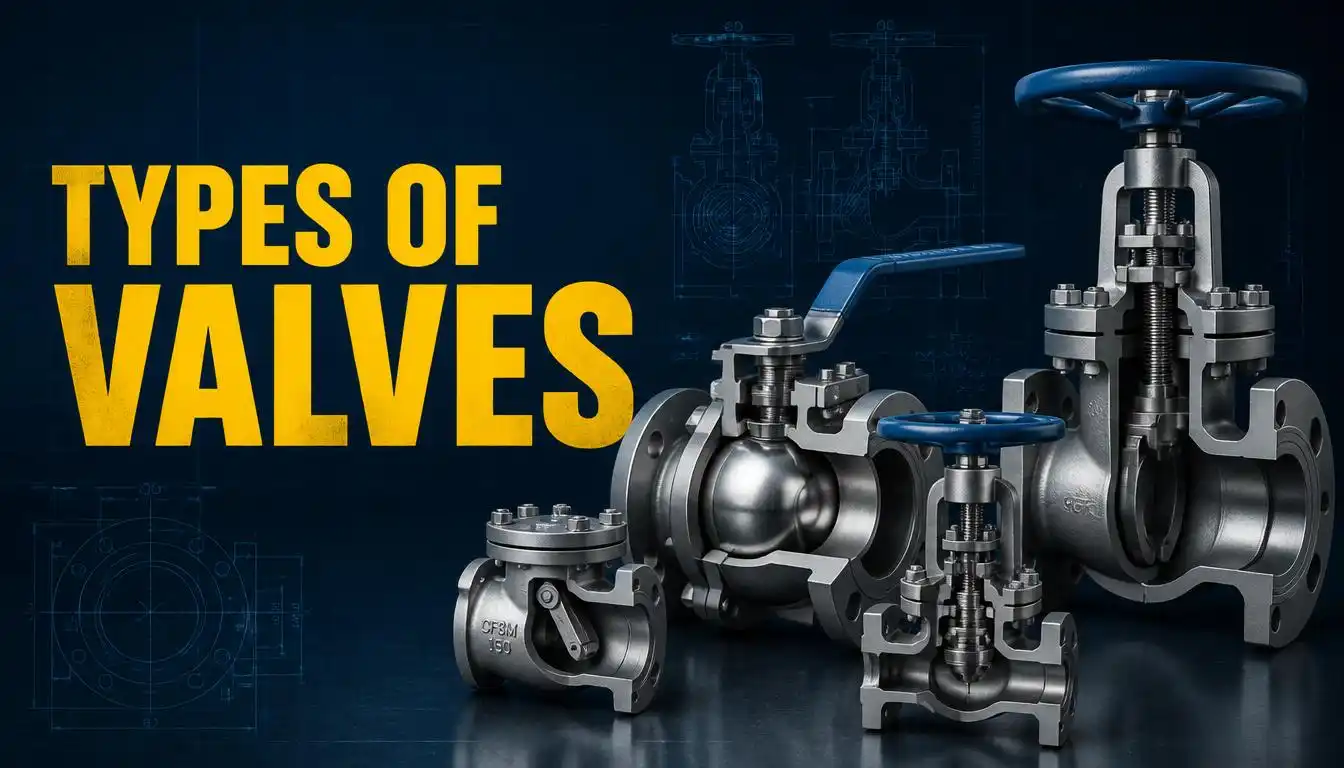
Types of Control Valves
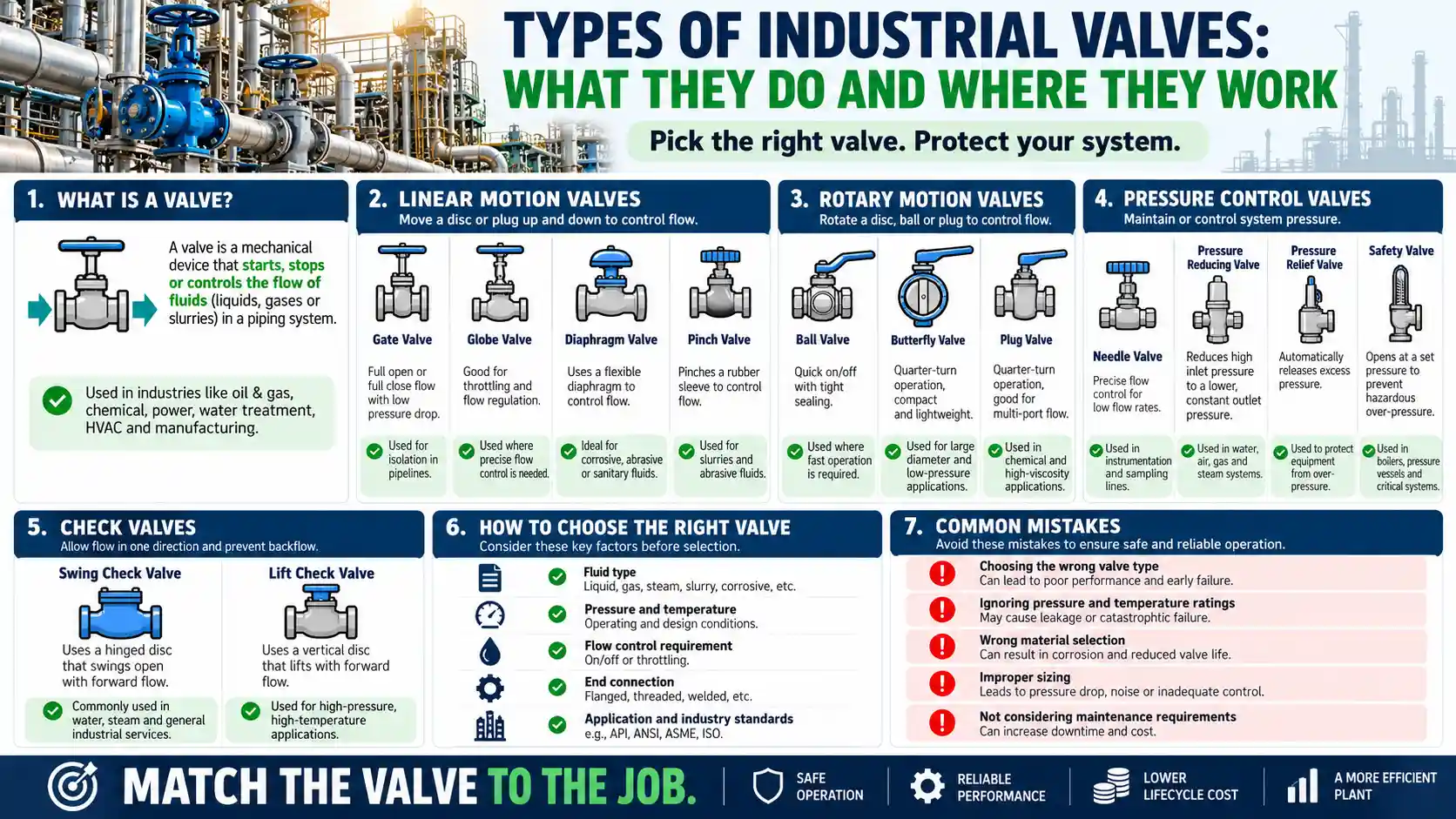
There are several control valve types, generally grouped by body design and motion style.
Linear Motion Valves
These valves move the trim in a straight line (up and down) to control flow.
- Globe Valves – The most common linear valve, offering excellent throttling control and shut-off, using a plug that moves against a seat.
- Gate Valves – Primarily for on/off service rather than fine throttling.
- Diaphragm Valves – Use a flexible diaphragm, ideal for corrosive or slurry-type fluids.
Rotary Motion Valves
These valves rotate the trim (usually 90 degrees) to regulate flow.
- Ball Valves – Use a rotating ball with a hole to control flow, known for tight sealing and fast operation. Datianvalve
- Butterfly Valves – Use a rotating disc to regulate flow; they are lightweight and cost-effective, especially for large-diameter pipelines. Datianvalve
- Plug Valves – Use a cylindrical or tapered plug to control flow, suitable for handling viscous or corrosive media. Datianvalve
By Actuation Method
Control valves are also classified by their driving mechanism — pneumatic, electric, or hydraulic actuated — which affects speed of response, force capability, and suitability for hazardous areas.
For a broader visual catalog of these valve types and their typical applications, see Datian Valve’s guide on control valve basics.
Control Valve Flow Characteristics
Control valve characteristics describe the relationship between valve stem travel (i.e., how far the valve is open) and the resulting flow rate. These characteristics are determined by the shape and design of the valve trim. The three primary types are: Instrumentation Blog
- Linear Characteristic: Flow increases directly proportional to stem travel — every equal movement of the valve stem results in an equal change in flow rate. This type is commonly used in level control and systems where process gain remains fairly constant. Instrumentation BlogInstrumentation Blog
- Equal Percentage Characteristic: Flow increases slowly at first, then rapidly at higher openings, with each increment in valve travel resulting in a percentage increase in flow. This is the most widely used characteristic in process industries because it compensates well for pressure drop variation across the valve. Instrumentation Blog
- Quick Opening Characteristic: Flow increases sharply with the initial valve travel, then levels off. Best suited for on/off or emergency relief applications rather than fine throttling.
Choosing the right characteristic is a key part of proper valve sizing and directly affects loop stability and controllability.
Valve Trim Explained
The trim is worth a dedicated look because it’s the single component with the greatest influence on valve performance. As covered earlier, the trim design largely determines how the valve throttles flow. Trim materials and geometries are selected based on: Instrumentation Blog
- Fluid characteristics (corrosive, abrasive, viscous)
- Pressure drop requirements
- Noise and cavitation control (specialized anti-cavitation or low-noise trims are common in high-pressure-drop services)
- Required flow characteristic (linear, equal percentage, or quick opening)
An equal percentage valve, for instance, uses a specifically contoured plug or cage so the percentage change in flow is constant for each equal increment of valve travel — making it ideal where large pressure drop variations occur across the operating range.
Applications of Control Valves
Control valves are deployed almost everywhere fluid needs to be precisely managed:
- Oil & Gas – pipeline pressure regulation, separator level control, anti-surge control on compressors
- Power Generation – steam turbine control, boiler feedwater regulation
- Chemical & Petrochemical – reactor temperature and pressure control, batch process automation
- Water & Wastewater Treatment – flow regulation, pressure-reducing stations
- Food & Beverage / Pharmaceuticals – sanitary flow control, sterile processing
- HVAC Systems – building-level temperature and airflow control
Common Problems & Maintenance
Even well-engineered control valves face operational challenges over time. Common issues include:
- Cavitation and flashing – caused by excessive pressure drop, leading to trim damage and noise
- Valve stiction (stick-slip) – friction in packing or actuator causing erratic response
- Seat leakage – wear on the seat or plug reducing shut-off tightness
- Positioner calibration drift – leading to inaccurate valve positioning
- Erosion/corrosion – from abrasive or corrosive process fluids degrading the trim and body over time
Routine maintenance — including periodic inspection, positioner calibration, packing replacement, and trim inspection — significantly extends valve life and process reliability.
How to Select the Right Control Valve
Choosing the correct valve involves multiple engineering considerations:
- Process fluid properties – viscosity, corrosiveness, presence of solids
- Required flow characteristic – linear vs. equal percentage vs. quick opening
- Pressure drop and flow capacity (Cv) – properly sized to avoid oversizing/undersizing
- Body material and trim material compatibility with the process fluid
- Actuator type – pneumatic, electric, or hydraulic, based on speed and force needs
- Noise and cavitation potential at expected operating conditions
- Standards compliance – conformance to relevant ISA standards and applicable industry codes
Getting these variables right at the design stage avoids costly rework, premature failure, and control instability later.
Top Manufacturers
When it comes to sourcing reliable equipment, several control valve manufacturers dominate the global market. According to recent industry analysis, leading players include Emerson (Fisher brand), Flowserve, Samson, Metso, Schneider Electric, and Honeywell, with Emerson, Flowserve, and Samson particularly known for reliable and durable control valves, while Metso and Schneider Electric focus on high-precision control and accuracy. THINKTANK
Other well-regarded names include SLB (Cameron), Baker Hughes (Masoneilan), Crane, Bray International, and Curtiss-Wright, depending on the specific industry and severity of service required. You can browse Emerson’s own product range directly on their control valves product catalog.
Control Valve Price
Control valve price varies enormously depending on size, body material, trim design, actuator type, and required certifications — ranging from a few hundred dollars for small commercial/HVAC valves to tens of thousands of dollars for large, severe-service industrial valves with advanced digital positioners and specialty trims. Because of this wide range, it’s best to request a formal quotation from a manufacturer or authorized distributor based on your exact specifications (size, pressure rating, fluid type, and required flow characteristics) rather than relying on a general price list.
FAQs
Q1: What is the basic function of a control valve?
A control valve regulates the flow rate, pressure, temperature, or level of a process fluid by adjusting the size of the flow passage in response to a signal from a controller.
Q2: What is the difference between a control valve and a regular valve?
A regular (isolation) valve is generally either fully open or fully closed. A control valve can modulate to any position in between, allowing precise, continuous regulation of the process.
Q3: What are the main types of control valves?
The main types are globe, gate, diaphragm, ball, butterfly, and plug valves, categorized broadly as either linear-motion or rotary-motion valves.
Q4: What is an equal percentage valve used for?
It’s used where large variations in pressure drop occur across the valve’s operating range, since its flow characteristic compensates well for that variability, ensuring more stable control.
Q5: What signal types do control valves typically operate on?
Most control valves respond to either a pneumatic signal (3–15 psig) or an electrical signal (4–20 mA) from the process controller.
Q6: How much does a control valve cost?
Prices vary widely based on size, material, and complexity — from a few hundred dollars for basic valves to well over ten thousand dollars for large, high-specification industrial valves.
Conclusion
A control valve is far more than a simple pipe fitting — it’s a precision instrument that keeps industrial processes safe, efficient, and stable. From its core components (body, actuator, trim, and positioner) to its working principle and flow characteristics, understanding how a control valve operates is fundamental for anyone working in process automation, instrumentation, or plant engineering.
Whether you’re specifying a new valve, troubleshooting an existing installation, or simply building foundational knowledge, the right combination of valve type, trim design, and sizing will make or break your control loop’s performance.