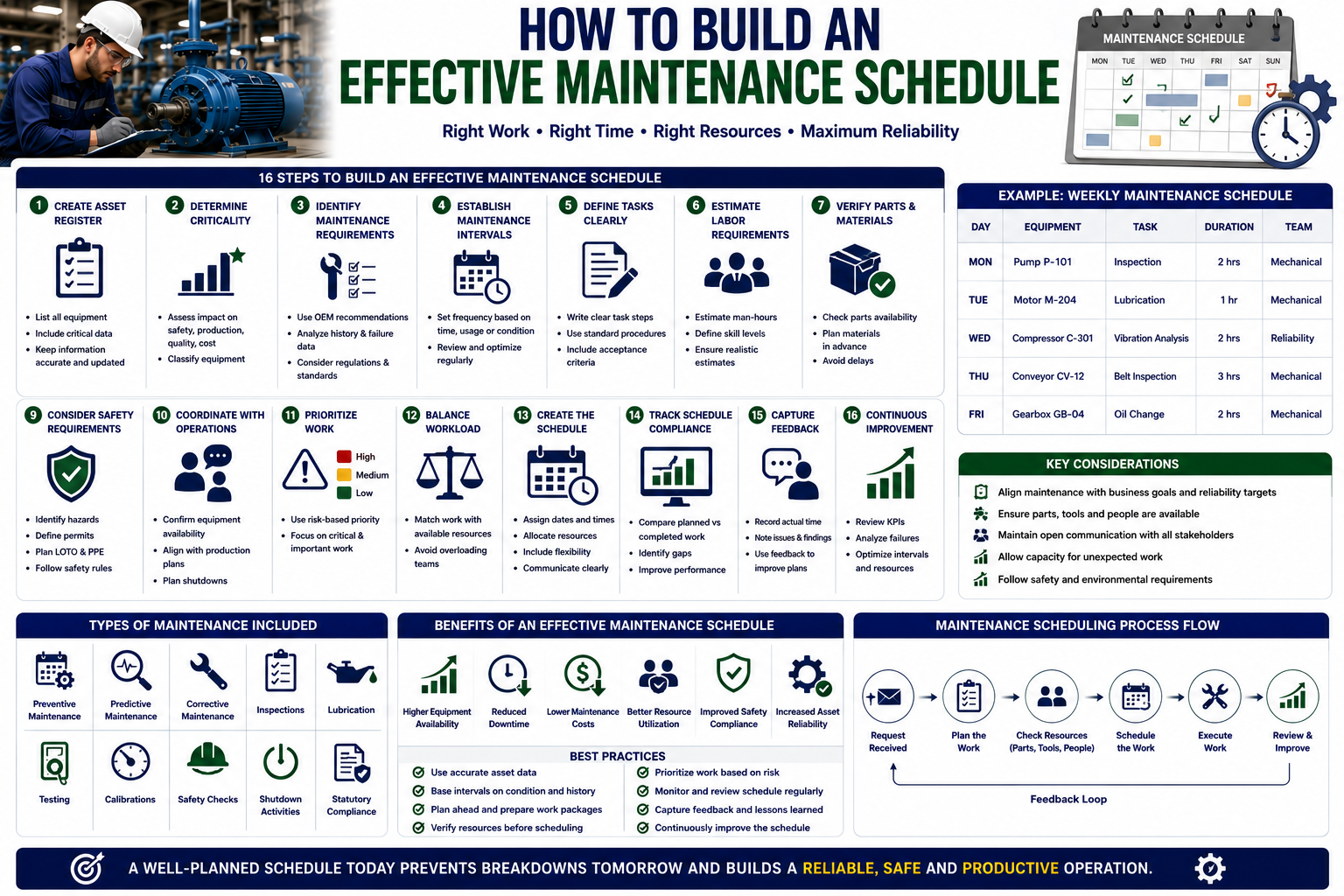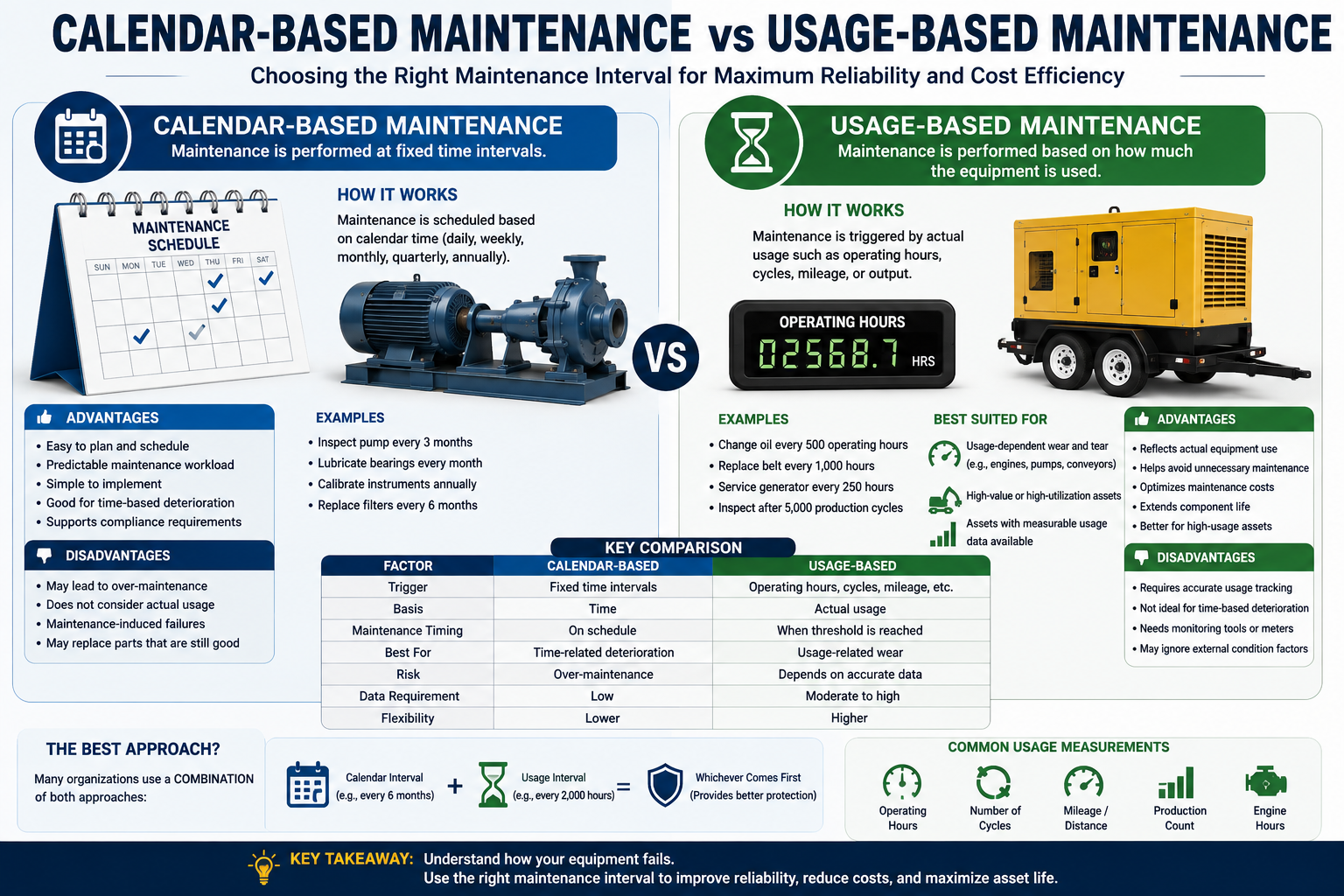
Effective maintenance is essential for keeping industrial equipment safe, reliable, and available. Every asset experiences some form of wear and deterioration during operation, but not all equipment deteriorates at the same rate. Choosing the right maintenance interval can therefore have a major impact on equipment reliability, maintenance costs, and production performance.
Two common approaches to preventive maintenance scheduling are calendar-based maintenance and usage-based maintenance.
Calendar-based maintenance schedules maintenance according to a fixed period of time, while usage-based maintenance schedules work according to how much an asset has actually been used.
Understanding the difference between these approaches can help maintenance engineers avoid unnecessary maintenance, reduce unexpected failures, improve equipment availability, and make better use of maintenance resources.
What Is Calendar-Based Maintenance?
Calendar-based maintenance is a preventive maintenance strategy in which maintenance activities are scheduled according to fixed time intervals.
The maintenance trigger may be:
- Daily
- Weekly
- Monthly
- Quarterly
- Semi-annually
- Annually
For example, a maintenance plan may require a pump to be inspected every three months, an air-conditioning unit to be serviced every six months, or an electrical panel to be inspected annually.
The basic principle is simple:
When the scheduled date arrives, the maintenance task is performed.
Calendar-based maintenance is commonly used because it is easy to understand, schedule, and manage using a CMMS.
Examples of Calendar-Based Maintenance
Some common examples include:
- Monthly equipment inspections
- Quarterly lubrication
- Six-monthly filter replacement
- Annual electrical testing
- Scheduled cleaning
- Periodic calibration
- Annual safety inspections
- Routine visual inspections
Calendar-based maintenance is particularly useful when equipment condition is influenced significantly by time or when maintenance requirements are specified by regulations, standards, contracts, or manufacturers.
Advantages of Calendar-Based Maintenance
Calendar-based maintenance has several benefits.
1. Simple to Plan
Maintenance teams can easily create schedules based on dates.
For example:
Pump inspection → Every 3 months
This makes it easy to allocate technicians, tools, spare parts, and downtime.
2. Predictable Maintenance Workload
Because maintenance activities are scheduled in advance, maintenance managers can estimate upcoming workloads and coordinate resources.
3. Easy CMMS Implementation
Most CMMS platforms can automatically generate work orders based on calendar intervals.
4. Suitable for Time-Dependent Maintenance
Some components deteriorate because of time-related factors.
Examples include:
- Lubricant degradation
- Corrosion
- Seal deterioration
- Battery aging
- Environmental exposure
For these assets, calendar-based maintenance may be appropriate.
5. Supports Regulatory Requirements
Certain inspections and tests may need to occur at defined time intervals.
Disadvantages of Calendar-Based Maintenance
Although calendar-based maintenance is useful, it has limitations.
It May Ignore Actual Equipment Usage
Two identical machines may have completely different operating hours.
Suppose:
Machine A operates 24 hours per day.
Machine B operates 8 hours per day.
If both machines receive the same maintenance every three months, Machine A may have accumulated significantly more operating hours than Machine B.
This can result in under-maintenance for heavily used equipment or unnecessary maintenance for lightly used equipment.
Risk of Over-Maintenance
A component may still be in excellent condition when its scheduled maintenance date arrives.
Replacing it simply because the calendar says it is due can increase costs and create unnecessary maintenance work.
Maintenance-Induced Failures
Every time equipment is opened, adjusted, dismantled, or reassembled, there is some risk of introducing a new problem.
Poor installation, contamination, incorrect tightening, or incorrect adjustment can result in maintenance-induced failures.
What Is Usage-Based Maintenance?
Usage-based maintenance is a preventive maintenance strategy in which maintenance is scheduled according to how much an asset has been used.
Instead of using calendar time, maintenance is triggered by a measurable usage parameter.
Common usage measurements include:
- Operating hours
- Production cycles
- Mileage
- Number of starts and stops
- Throughput
- Engine hours
- Number of operations
- Distance traveled
For example:
Change lubricant every 5,000 operating hours.
This means the maintenance activity occurs when the equipment reaches the specified usage level rather than on a specific calendar date.
Examples of Usage-Based Maintenance
Usage-based maintenance is common in many industries.
Vehicles
Vehicle maintenance may be based on:
- Kilometers
- Engine hours
- Fuel consumption
Heavy Equipment
Construction and mining equipment may be maintained according to engine operating hours.
Manufacturing Equipment
Production machinery may be maintained after a specific number of production cycles.
Pumps and Compressors
Maintenance may be triggered after a specified number of operating hours.
Aircraft and Marine Equipment
Certain maintenance activities may be based on flight hours, cycles, operating hours, or other usage measures.
Advantages of Usage-Based Maintenance
1. Reflects Actual Equipment Use
The biggest advantage is that maintenance intervals are linked to actual equipment utilization.
A heavily used machine receives maintenance sooner than a lightly used machine when the maintenance trigger is based on operating hours.
2. Can Reduce Unnecessary Maintenance
Lightly used equipment may not require maintenance as frequently as heavily used equipment.
3. Better Maintenance Optimization
Usage information can provide a more accurate basis for scheduling certain maintenance activities.
4. Useful for Mobile Equipment
Usage-based maintenance is particularly useful for vehicles, generators, construction machinery, mining equipment, and other assets where operating hours or mileage can be tracked easily.
5. Improved Resource Planning
Maintenance teams can forecast upcoming work based on equipment utilization.
Disadvantages of Usage-Based Maintenance
Usage-based maintenance also has limitations.
Requires Reliable Usage Data
If operating hours, cycles, mileage, or other usage information is not recorded accurately, maintenance schedules may become unreliable.
Not Every Failure Is Usage-Related
Some equipment problems are influenced more by environmental conditions, operating practices, contamination, or component condition than by usage.
Requires Monitoring Systems
Organizations may need meters, sensors, counters, or software integration to accurately track equipment usage.
May Not Address Time-Dependent Deterioration
Some components deteriorate simply because they age, even when equipment is not heavily used.
For example, certain seals, batteries, lubricants, and materials may degrade with time.
Calendar-Based vs Usage-Based Maintenance
| Factor | Calendar-Based Maintenance | Usage-Based Maintenance |
|---|---|---|
| Maintenance trigger | Time | Equipment usage |
| Example | Every 3 months | Every 2,000 operating hours |
| Main advantage | Simple scheduling | Reflects actual utilization |
| Data requirement | Low | Moderate |
| Best suited for | Time-dependent deterioration | Usage-dependent wear |
| Risk | Over- or under-maintenance | Requires accurate usage tracking |
| Common applications | Inspections, calibration, servicing | Vehicles, engines, production equipment |
Which Is Better?
There is no universal answer.
The better approach depends on how the equipment deteriorates.
Calendar-based maintenance may be better when deterioration is strongly related to time.
Usage-based maintenance may be better when deterioration is primarily related to operating hours, cycles, mileage, or production volume.
The key question maintenance engineers should ask is:
“What factor best represents the deterioration of this asset or component?”
If the answer is time, calendar-based maintenance may be appropriate.
If the answer is equipment usage, usage-based maintenance may be more effective.
Can Calendar-Based and Usage-Based Maintenance Be Combined?
Yes.
Many organizations use a combination of both approaches.
For example, a maintenance strategy could specify:
Lubrication: Every 1,000 operating hours or every six months, whichever comes first.
This approach protects against both excessive usage and excessive time between maintenance activities.
Another example could be:
Inspect equipment every three months or after 500 operating cycles, whichever occurs first.
This combined approach can provide greater flexibility and protection.
How to Choose the Right Maintenance Interval
Maintenance engineers should consider several factors.
1. Understand Failure Modes
Identify how the equipment can fail and what causes deterioration.
FMEA and reliability analysis can help identify important failure modes.
2. Analyze Historical Data
Review equipment history to determine:
- Failure frequency
- Operating hours
- Maintenance intervals
- Component life
- Repeat failures
Historical data can reveal whether failures correlate more strongly with time or usage.
3. Consider Equipment Criticality
Critical equipment may require more frequent inspections or additional condition-monitoring techniques.
4. Consider Operating Conditions
Two machines with identical usage may experience different degradation because of:
- Temperature
- Dust
- Humidity
- Load
- Vibration
- Contamination
- Operating environment
These conditions should be considered when establishing maintenance intervals.
5. Use Condition Monitoring Where Appropriate
Calendar- or usage-based maintenance does not always need to be the only strategy.
Condition monitoring can provide additional information about actual equipment health.
Technologies such as vibration analysis, thermography, oil analysis, and ultrasonic inspection can help identify developing problems.
The Role of CMMS in Maintenance Scheduling
A Computerized Maintenance Management System (CMMS) can help manage both calendar-based and usage-based maintenance.
For calendar-based maintenance, the CMMS can automatically generate work orders according to dates.
For usage-based maintenance, the system can use equipment meters such as:
- Operating hours
- Mileage
- Cycles
- Production counts
When the predefined threshold is reached, a maintenance work order can be generated.
A CMMS also allows maintenance teams to track equipment history and evaluate whether maintenance intervals are effective.
Common Mistakes to Avoid
Maintenance departments can make several mistakes when developing maintenance intervals.
Using the Same Interval for Every Asset
Different equipment has different failure characteristics.
Relying Only on Manufacturer Recommendations
Manufacturer recommendations are a useful starting point, but actual operating conditions and equipment history should also be considered.
Ignoring Equipment Usage
A machine operating continuously may require a different maintenance strategy from an identical machine used occasionally.
Ignoring Time-Based Deterioration
Low equipment usage does not necessarily mean that maintenance can be postponed indefinitely.
Failing to Review Maintenance Intervals
Maintenance schedules should be periodically reviewed and optimized based on actual equipment performance.
The Future of Maintenance Scheduling
Modern maintenance programs are increasingly moving toward condition-based and data-driven maintenance.
IoT sensors, equipment monitoring systems, CMMS platforms, and analytics can provide maintenance engineers with more detailed information about asset condition and usage.
Instead of relying entirely on fixed intervals, organizations can combine:
Calendar + Usage + Condition
For example:
Perform routine inspection every six months, service after 2,000 operating hours, and investigate immediately if condition-monitoring data indicates abnormal equipment behavior.
This creates a more flexible and risk-based maintenance strategy.
Conclusion
Calendar-based and usage-based maintenance are both valuable approaches for managing preventive maintenance.
Calendar-based maintenance schedules maintenance according to fixed periods of time. It is simple, predictable, and useful for time-dependent deterioration, regulatory inspections, and routine servicing.
Usage-based maintenance schedules maintenance according to actual equipment utilization, such as operating hours, production cycles, mileage, or number of starts. It can be more effective when equipment wear is closely related to usage.
Neither strategy is universally better.
The right choice depends on the asset, failure mode, operating environment, criticality, available data, and maintenance objectives.
In many cases, the most effective approach is to combine calendar-based and usage-based triggers with condition monitoring and reliability analysis.
The ultimate goal is to avoid both under-maintenance and over-maintenance by performing the right maintenance at the right interval based on how the asset actually behaves.
A well-optimized maintenance schedule can reduce unexpected failures, control maintenance costs, improve equipment availability, extend asset life, and support safer and more reliable operations.