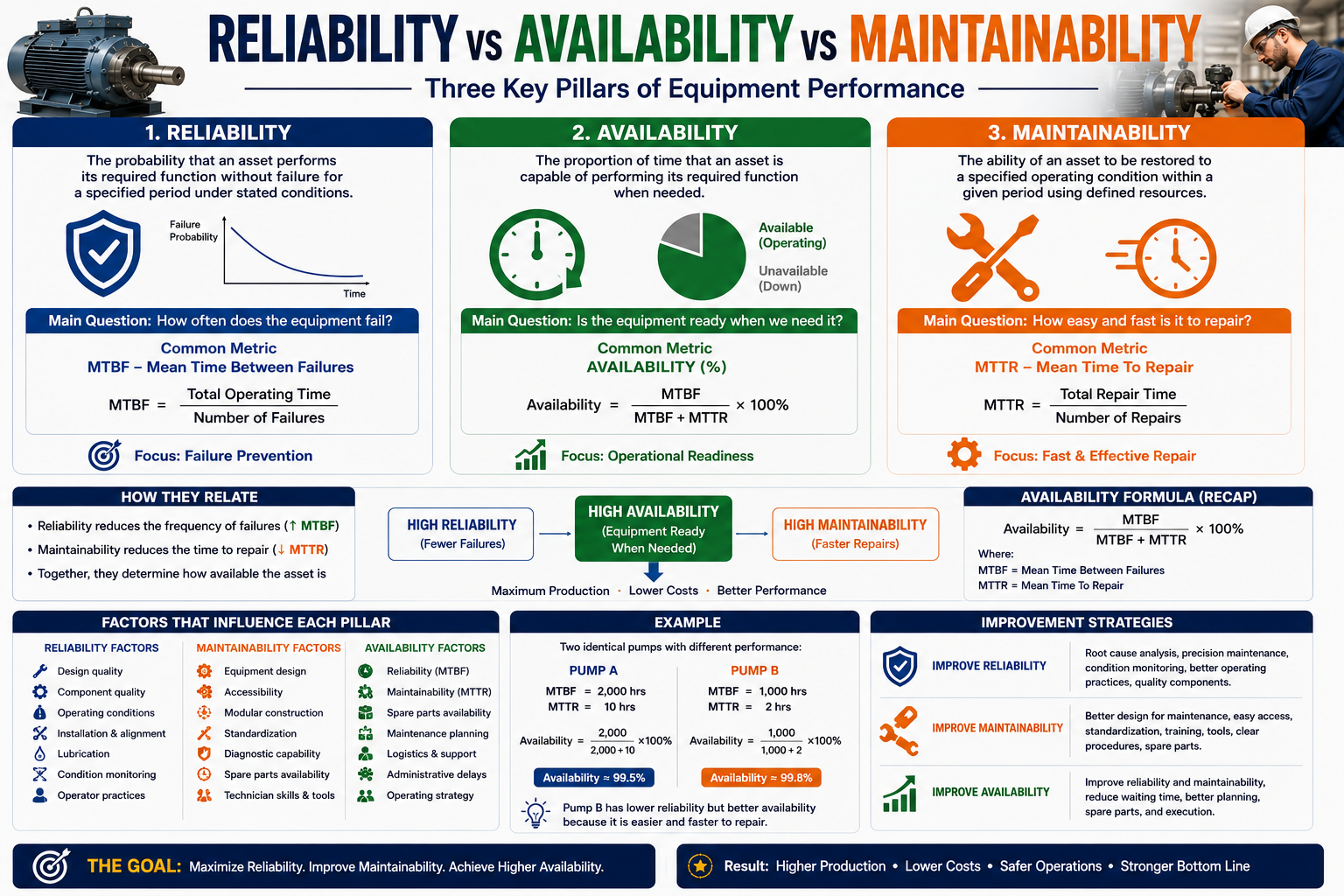
In maintenance engineering and asset management, three terms are used constantly when discussing equipment performance: Reliability, Availability, and Maintainability.
Although these concepts are closely related, they describe different aspects of asset performance. Understanding the difference between them is essential for maintenance engineers, reliability professionals, production managers, and asset managers.
A machine can be highly reliable but difficult to repair. Another machine may be easy to repair but experience frequent failures. Similarly, an asset can have good reliability but still have poor availability if repairs take too long.
Understanding these relationships helps organizations design better maintenance strategies, improve equipment performance, and reduce operational losses.
What Is Reliability?
Reliability is the probability that an asset will perform its required function without failure for a specified period under specified operating conditions.
In simple terms:
Reliability asks: “How likely is this equipment to keep working?”
For example, suppose a pump is expected to operate continuously for 1,000 hours without failure.
If the pump successfully operates for the entire period, it has demonstrated a certain level of reliability.
Reliability is strongly influenced by:
- Equipment design
- Component quality
- Operating conditions
- Installation
- Lubrication
- Maintenance practices
- Operator behavior
- Environmental conditions
- Equipment loading
A reliable machine does not fail frequently.
Example of Reliability
Imagine two industrial motors.
Motor A fails every 1,000 operating hours.
Motor B fails every 5,000 operating hours.
Assuming similar operating conditions, Motor B demonstrates better reliability because it operates longer between failures.
One commonly used reliability metric is Mean Time Between Failures (MTBF).
A simplified calculation is:
MTBF = Total Operating Time ÷ Number of Failures
If equipment operates for 10,000 hours and experiences five failures:
MTBF = 10,000 ÷ 5 = 2,000 hours
A higher MTBF generally indicates better reliability.
However, MTBF alone does not tell us how quickly equipment can be repaired.
That is where maintainability becomes important.
What Is Maintainability?
Maintainability is the ability of an asset to be restored to a specified operating condition within a given period using defined maintenance procedures and resources.
In simple terms:
Maintainability asks: “How easy and fast is this equipment to repair?”
Two machines may have identical failure frequencies but very different repair times.
For example:
Machine A: Average repair time = 2 hours
Machine B: Average repair time = 12 hours
Even if both machines fail at the same frequency, Machine A has better maintainability.
Maintainability depends on factors such as:
- Equipment design
- Accessibility
- Modular construction
- Spare-parts availability
- Diagnostic capability
- Technician skills
- Tools and equipment
- Maintenance procedures
- Equipment location
- Isolation requirements
Good maintainability allows maintenance teams to restore equipment quickly after a failure.
What Is Availability?
Availability is the proportion of time that an asset is capable of performing its required function when needed.
In simple terms:
Availability asks: “Is the equipment ready to operate when we need it?”
Availability is influenced by both reliability and maintainability.
A machine that fails frequently may have poor availability.
A machine that fails rarely but takes several days to repair can also have poor availability.
This is why availability provides a broader view of equipment performance.
A commonly used steady-state approximation is:
Availability = MTBF ÷ (MTBF + MTTR)
Where:
- MTBF = Mean Time Between Failures
- MTTR = Mean Time To Repair
For example, if a machine has:
MTBF = 900 hours
MTTR = 9 hours
Then:
Availability = 900 ÷ (900 + 9)
Availability ≈ 99.0%
This demonstrates how both reliability and repair time influence availability.
Reliability vs Availability vs Maintainability
The easiest way to understand the three concepts is to look at the question each one answers.
| Concept | Main Question | Typical Metric |
|---|---|---|
| Reliability | How often does equipment fail? | MTBF |
| Maintainability | How quickly can equipment be restored? | MTTR |
| Availability | How much time is equipment ready for operation? | Availability % |
They can also be remembered as:
Reliability = Failure resistance
Maintainability = Repairability
Availability = Operational readiness
How Reliability and Maintainability Affect Availability
Reliability and maintainability are not independent from an operational perspective.
Consider two scenarios.
Scenario 1: Reliable but Difficult to Repair
A compressor operates for 10,000 hours before failure but requires 100 hours to repair.
The equipment has excellent reliability but poor maintainability.
Scenario 2: Less Reliable but Easy to Repair
Another compressor fails every 2,000 hours but can be repaired within one hour.
It has lower reliability but excellent maintainability.
The organization needs to evaluate which combination provides the best overall operational availability.
This is why asset management should not focus on only one metric.
Why Reliability Matters
Improving reliability reduces the frequency of equipment failures.
Reliability improvements may involve:
- Better equipment design
- Improved component selection
- Root Cause Analysis
- Failure Mode and Effects Analysis
- Reliability-Centered Maintenance
- Better lubrication
- Improved alignment
- Improved installation
- Condition monitoring
- Operator training
- Equipment modifications
The objective is to prevent recurring failures rather than repeatedly repairing the same problem.
For example, if a pump repeatedly fails because of shaft misalignment, replacing the bearing every few months does not solve the underlying problem.
A reliability-focused approach investigates and eliminates the root cause.
Why Maintainability Matters
Even highly reliable equipment will eventually require maintenance.
Therefore, equipment should be designed and managed so that maintenance can be performed efficiently.
Good maintainability includes:
- Easy access to components
- Standardized parts
- Modular equipment
- Clear maintenance instructions
- Accessible lubrication points
- Good diagnostic systems
- Proper lifting arrangements
- Adequate workspace
- Easily replaceable components
For example, a motor designed with easily accessible bearings may require significantly less maintenance time than one requiring extensive disassembly.
Maintainability should therefore be considered during the design and procurement stage, not only after equipment is installed.
Why Availability Matters
Availability is particularly important in production environments.
A production asset may be technically reliable, but if it is frequently unavailable, production performance will suffer.
Availability can be affected by:
- Equipment failures
- Planned maintenance
- Unplanned repairs
- Waiting for spare parts
- Waiting for technicians
- Waiting for permits
- Long repair times
- Operational constraints
This means maintenance departments should consider the entire downtime process.
For example, if a repair takes only three hours but the equipment waits 15 hours for a spare part, the actual availability impact is much greater than the repair duration alone suggests.
Inherent vs Operational Availability
Availability can be calculated in different ways depending on what is included.
Inherent Availability
Inherent availability generally focuses on equipment reliability and corrective maintenance characteristics, without including factors such as logistics or preventive maintenance delays.
It is useful when evaluating equipment design.
Operational Availability
Operational availability considers the broader operational environment, including:
- Corrective maintenance
- Preventive maintenance
- Logistics delays
- Spare-parts availability
- Administrative delays
- Support resources
Operational availability therefore provides a more realistic view of how available an asset actually is in the field.
How to Improve Reliability
Organizations can improve reliability by focusing on failure prevention.
Useful strategies include:
Root Cause Analysis
Identify and eliminate the underlying causes of recurring failures.
Condition Monitoring
Use vibration, thermography, oil analysis, ultrasonic inspection, and other technologies to detect deterioration.
Precision Maintenance
Improve alignment, balancing, lubrication, installation, and equipment setup.
Better Operating Practices
Ensure equipment is operated within its intended design limits.
Preventive Maintenance Optimization
Make sure maintenance tasks are effective and performed at appropriate intervals.
How to Improve Maintainability
Maintainability can be improved by reducing the time and resources required to perform maintenance.
Organizations can:
- Standardize components
- Improve access to equipment
- Maintain accurate documentation
- Improve spare-parts availability
- Train technicians
- Improve troubleshooting procedures
- Use modular components
- Improve diagnostic systems
- Prepare maintenance kits
- Conduct job planning before shutdowns
A well-planned maintenance activity can significantly reduce downtime.
How to Improve Availability
Improving availability requires a combination of reliability and maintainability improvements.
Organizations should:
- Reduce failure frequency.
- Reduce repair duration.
- Improve spare-parts availability.
- Improve maintenance planning.
- Reduce waiting time.
- Improve technician response.
- Use condition monitoring.
- Optimize preventive maintenance.
- Eliminate recurring failures.
- Improve equipment design where necessary.
The objective is to maximize the amount of productive operating time.
The Role of Maintenance Engineers
Maintenance engineers play an important role in balancing reliability, maintainability, and availability.
They analyze:
- Failure data
- MTBF
- MTTR
- Equipment availability
- Maintenance costs
- Downtime
- Failure modes
- Spare-parts performance
- Condition-monitoring results
They can then determine whether the main problem is:
Too many failures → Reliability problem
Repairs taking too long → Maintainability problem
Excessive total downtime → Availability problem
This distinction helps organizations choose the correct improvement strategy.
Practical Example
Consider a manufacturing pump with the following performance:
- MTBF = 1,000 hours
- MTTR = 10 hours
Approximate availability:
1,000 ÷ (1,000 + 10) = 99.0%
Now suppose engineers identify a recurring bearing failure and improve lubrication and alignment.
MTBF increases to 2,000 hours.
Availability becomes:
2,000 ÷ (2,000 + 10) ≈ 99.5%
Alternatively, if reliability remains unchanged but the maintenance team reduces MTTR from 10 hours to 5 hours:
1,000 ÷ (1,000 + 5) ≈ 99.5%
This example demonstrates an important principle:
Availability can be improved by making equipment more reliable, making it easier to repair, or both.
Reliability, Availability and Maintainability in Asset Management
These concepts are also important during equipment selection and design.
Before purchasing equipment, organizations should ask:
- How frequently is the equipment expected to fail?
- How quickly can failed components be replaced?
- Are spare parts readily available?
- Can technicians easily access critical components?
- What diagnostic features are available?
- What is the expected lifecycle cost?
- What availability can realistically be achieved?
Selecting equipment solely based on purchase price can result in higher lifecycle costs.
A slightly more expensive asset with better reliability and maintainability may provide significantly greater value over its operating life.