
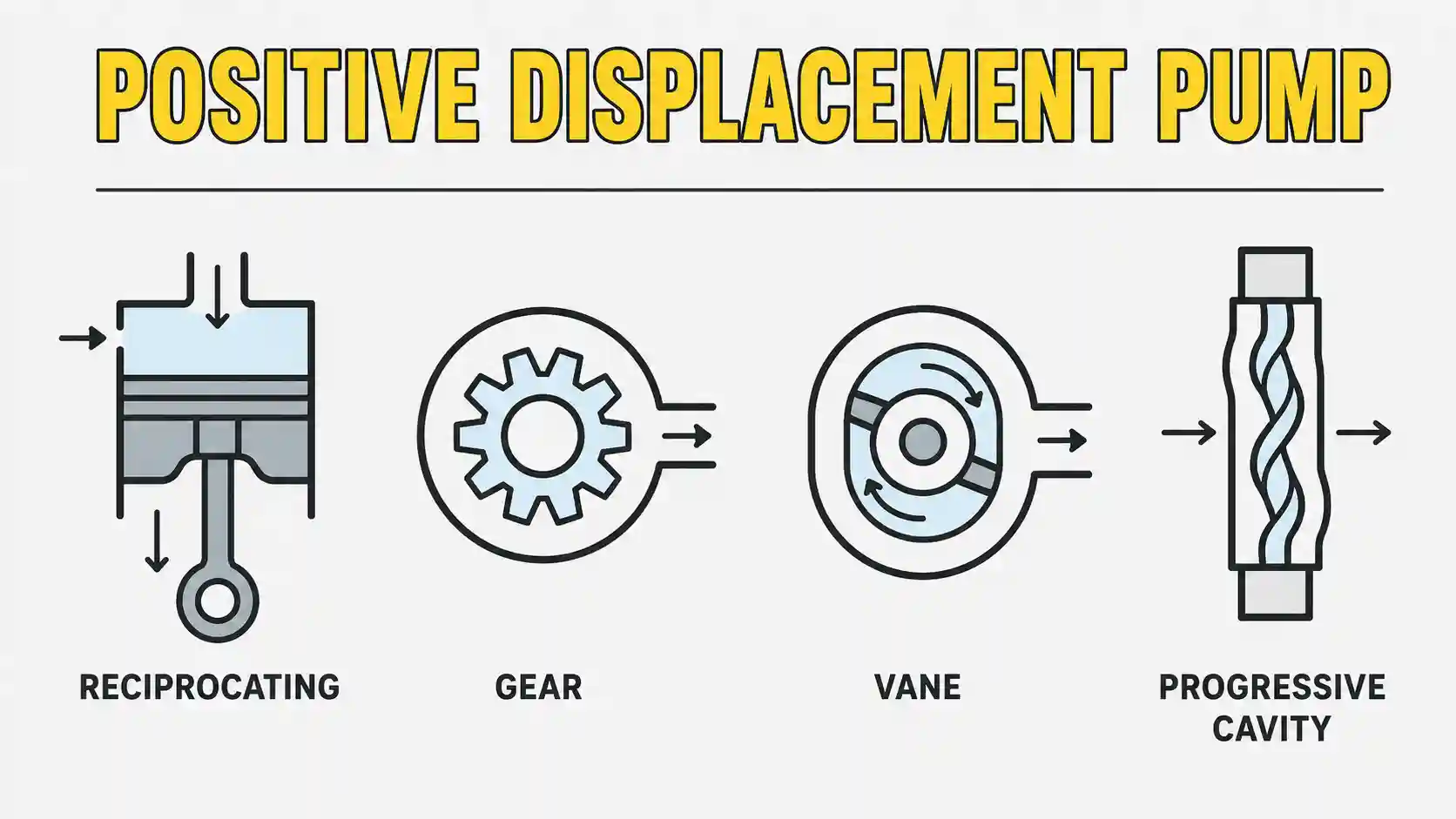
A positive displacement pump is one of the two major pump families used across industry, the other being the centrifugal (rotodynamic) pump. Where a centrifugal pump relies on velocity to move fluid, a positive displacement pump moves fluid by physically trapping a fixed volume in a chamber and pushing it out the discharge — one “gulp” at a time, once per shaft revolution or cycle.
This guide covers what a positive displacement pump is, how it works, the main types you’ll encounter on the plant floor, how it stacks up against a centrifugal pump, and where each type is best applied.
What Is a Positive Displacement Pump? (Definition)
A positive displacement (PD) pump is a pump that moves fluid by mechanically trapping a fixed volume of liquid in a cavity and then forcing that volume out through the discharge port. Because the volume delivered per cycle is essentially constant, a PD pump produces a nearly constant flow rate regardless of the discharge pressure it’s working against — the flow only changes if the pump’s speed changes or if internal slip (leakage) increases.
This is fundamentally different from a centrifugal pump, whose output flow varies significantly with system pressure and pipe resistance. That distinction is the reason PD pumps are the go-to choice for metering, dosing, and high-viscosity applications where flow accuracy matters more than raw speed.
Working Principle of Positive Displacement Pumps
Every positive displacement pump — no matter how different it looks on the outside — works through the same two-step cycle:
- Expansion (suction stroke): A pumping chamber increases in volume, dropping the local pressure below the inlet pressure. Fluid is drawn in from the suction line to fill the void.
- Contraction (discharge stroke): The chamber then decreases in volume, and since the trapped liquid is (essentially) incompressible, it is forced out through the discharge valve or port at whatever pressure is needed to overcome the system resistance.
Because the chamber has a defined, mechanically fixed volume, the pump delivers a set quantity of fluid with every stroke or revolution. This is why PD pumps are described as having constant flow, variable pressure behavior — the exact opposite of a centrifugal pump, which has variable flow and (comparatively) more limited pressure response. At the core of PD pump operation is a simple mechanism of capturing and displacing a set volume of fluid, which keeps flow steady regardless of pressure changes.
Types of Positive Displacement Pumps
Positive displacement pumps fall into two broad families based on how the displacing element moves: reciprocating (back-and-forth motion) and rotary (continuous rotation). The reciprocating group operates via pistons, plungers, or diaphragms, while rotary pumps use gears, lobes, screws, vanes, or peristaltic action.
Reciprocating Pumps (Piston, Plunger, Diaphragm)
Reciprocating pumps use a back-and-forth (linear) motion to draw in and expel fluid through check valves at the inlet and outlet.
- Piston pumps use a piston moving inside a cylinder, sealed by piston rings, to displace fluid. Common in high-pressure applications like hydraulic test rigs and oilfield service pumps.
- Plunger pumps are similar to piston pumps but use a smooth cylindrical plunger with stationary packing/seals instead of moving piston rings, which allows them to handle much higher pressures. They’re widely used in high-pressure washing, chemical injection, and water-jet cutting.
- Diaphragm pumps use a flexible diaphragm, driven mechanically or by compressed air (as in an air-operated double-diaphragm pump), to push fluid through check valves. Because the diaphragm isolates the moving parts from the fluid, these pumps are popular for corrosive, abrasive, or hygienic fluid transfer.
Rotary Pumps (Gear, Screw, Vane, Lobe)
Rotary pumps use continuous rotation instead of a back-and-forth stroke, which generally gives smoother flow with less pulsation.
- Gear pumps trap fluid between the teeth of two meshing gears and the pump casing, carrying it around from suction to discharge. Widely used for lubricating oils, fuel transfer, and viscous fluids.
- Screw pumps use one or more intermeshing helical screws (rotors) to move fluid axially along the screw’s length. Their smooth, low-pulsation flow makes them well suited to viscous products.
- Vane pumps use spring-loaded or hinged vanes mounted in a rotor that slides against the casing wall, trapping fluid pockets as the rotor turns. Common in low-to-medium viscosity fuel and hydraulic applications.
- Lobe pumps work similarly to gear pumps but use two or three-lobed rotors that don’t contact each other, making them a common choice in food, dairy, and pharmaceutical processing where hygiene and gentle product handling matter.
Positive Displacement Pump vs Centrifugal Pump
The single biggest difference between the two pump families comes down to how flow responds to pressure. All positive displacement pumps operate on the principle that a set volume is trapped in the pumping chamber and conveyed from the inlet to the outlet with every revolution of the shaft, giving a nearly constant flow rate as system pressure rises or falls. A centrifugal pump, by contrast, is a kinetic machine that continuously adds energy to the fluid through a rotating impeller, and its flow output drops as system pressure (head) increases.
| Parameter | Positive Displacement Pump | Centrifugal Pump |
|---|---|---|
| Flow behavior | Nearly constant, independent of pressure | Varies with system pressure/head |
| Pressure response | Can generate very high pressure at low flow | Pressure (head) is limited by impeller design and speed |
| Viscosity handling | Efficient with high-viscosity fluids | Efficiency drops sharply as viscosity increases |
| Flow control | Must use a bypass/relief valve — never dead-head or fully close discharge | Can be throttled at the discharge valve safely |
| Typical use cases | Metering, dosing, high-pressure, viscous or shear-sensitive fluids | High-flow, low-to-moderate pressure water and process transfer |
| Common risk | Overpressure/pipe rupture if discharge is blocked | Cavitation if suction conditions are inadequate |
Because a PD pump will keep building pressure even against a closed valve, every PD pump installation needs a pressure relief or bypass line — this is a key design difference from centrifugal systems, where cavitation risk (tied to available net positive suction head) is the more common failure mode to watch for instead.
Applications of Positive Displacement Pumps
PD pumps are chosen wherever precise, pressure-independent flow matters more than raw throughput:
- Chemical dosing and metering — accurate, repeatable small-volume injection (water treatment, chemical feed systems)
- High-pressure cleaning and water-jet cutting — plunger pumps generating very high discharge pressures
- Fuel and lubrication oil transfer — gear and vane pumps moving viscous fluids reliably
- Food, beverage, and pharmaceutical processing — lobe pumps handling shear-sensitive or hygienic products
- Oil and gas — well-service pumps, mud pumps, and chemical injection skids
- Hydraulic power systems — piston pumps supplying pressurized hydraulic fluid to actuators and cylinders
Advantages & Disadvantages
Advantages
- Delivers a constant, predictable flow rate regardless of discharge pressure
- Capable of generating very high discharge pressures
- Handles high-viscosity, shear-sensitive, and non-Newtonian fluids efficiently
- Self-priming in most designs, useful where suction lift is required
Disadvantages
- Pulsating flow in reciprocating types (can require dampeners)
- Requires a pressure relief/bypass valve — cannot be run against a closed discharge
- Generally more moving parts and higher maintenance than a comparable centrifugal pump
- Lower maximum flow capacity compared to large centrifugal pumps
FAQs
What is a positive displacement pump?
A positive displacement pump is a pump that moves fluid by trapping a fixed volume in a chamber and forcing it out through the discharge, producing a nearly constant flow rate regardless of system pressure.
What are positive displacement pumps used for?
They’re used wherever accurate, pressure-independent flow is needed — chemical dosing, high-pressure cleaning, fuel and lubrication transfer, hydraulic systems, and food/pharma processing.
What are the main types of positive displacement pumps?
The two main families are reciprocating pumps (piston, plunger, diaphragm) and rotary pumps (gear, screw, vane, lobe).
Is a positive displacement pump better than a centrifugal pump?
Neither is universally “better” — PD pumps suit accurate metering, high pressure, and viscous fluids, while centrifugal pumps suit high-flow, lower-pressure water and process transfer. The right choice depends on the required flow, pressure, and fluid properties.
Can a positive displacement pump run with the discharge valve closed?
No. Because it keeps forcing a fixed volume through with every cycle, a closed discharge will cause pressure to rise until something fails. PD pump systems always include a relief or bypass valve.
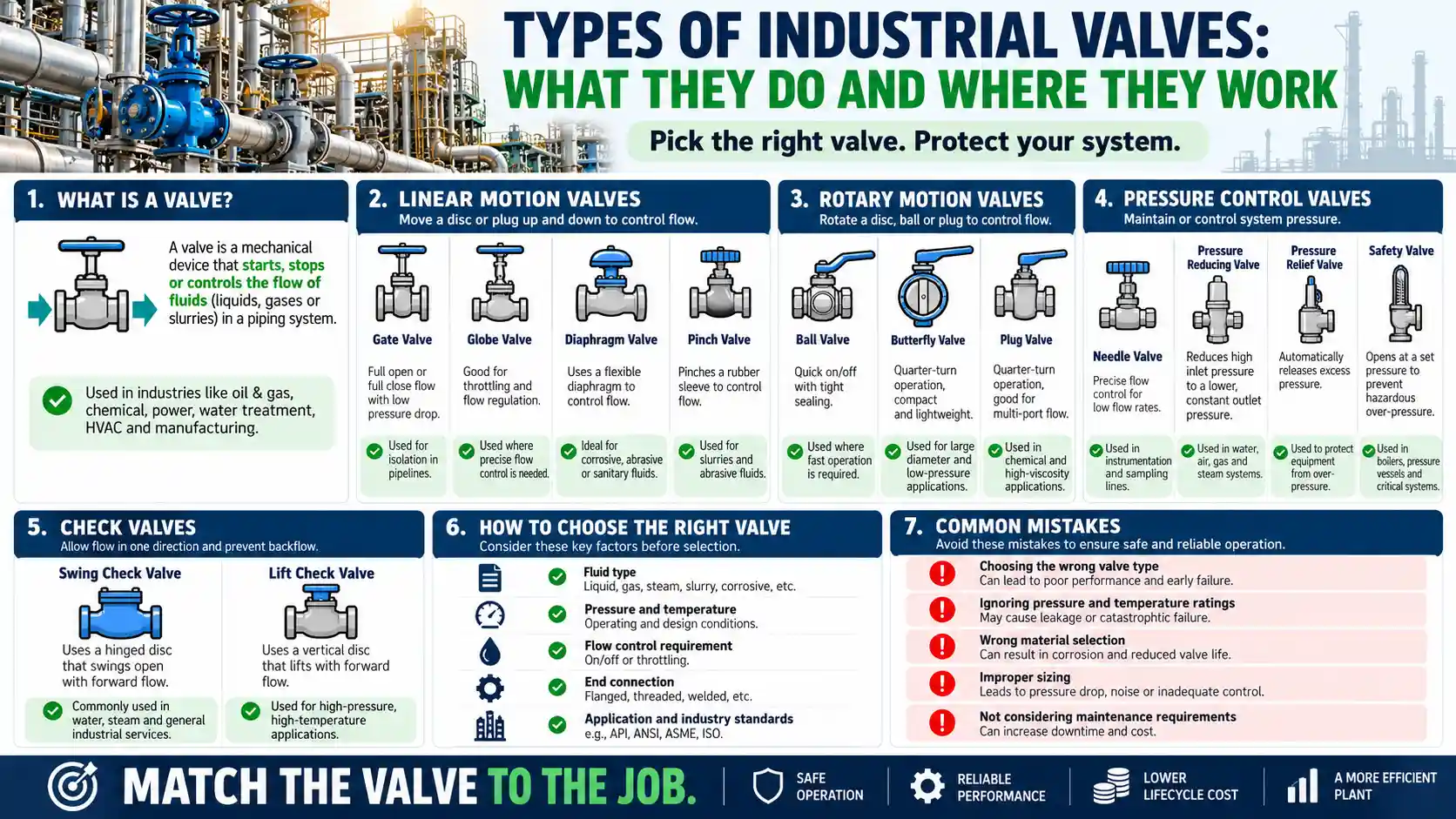
Related reading: for more on the sealing and flow-control components that often pair with these pump systems, see our guide to types of mechanical seals and our overview of types of valves used to control and isolate pump discharge lines.
Further reading (external):


2 thoughts on “Positive Displacement Pump: How It Works & Its Types”