A belt conveyor looks simple until you have to size one that runs reliably under a real production load. Most conveyor problems don’t come from the belt itself—they come from poor decisions around belt tension, drive sizing, idler spacing, or structural support that only show up after the system is in service. In this guide, we’ll break down how a belt conveyor works, the design decisions that actually matter, the different conveyor types, and where each is best suited, so you end up with a practical engineering reference instead of another high-level overview.
Belt Conveyor Working Principle
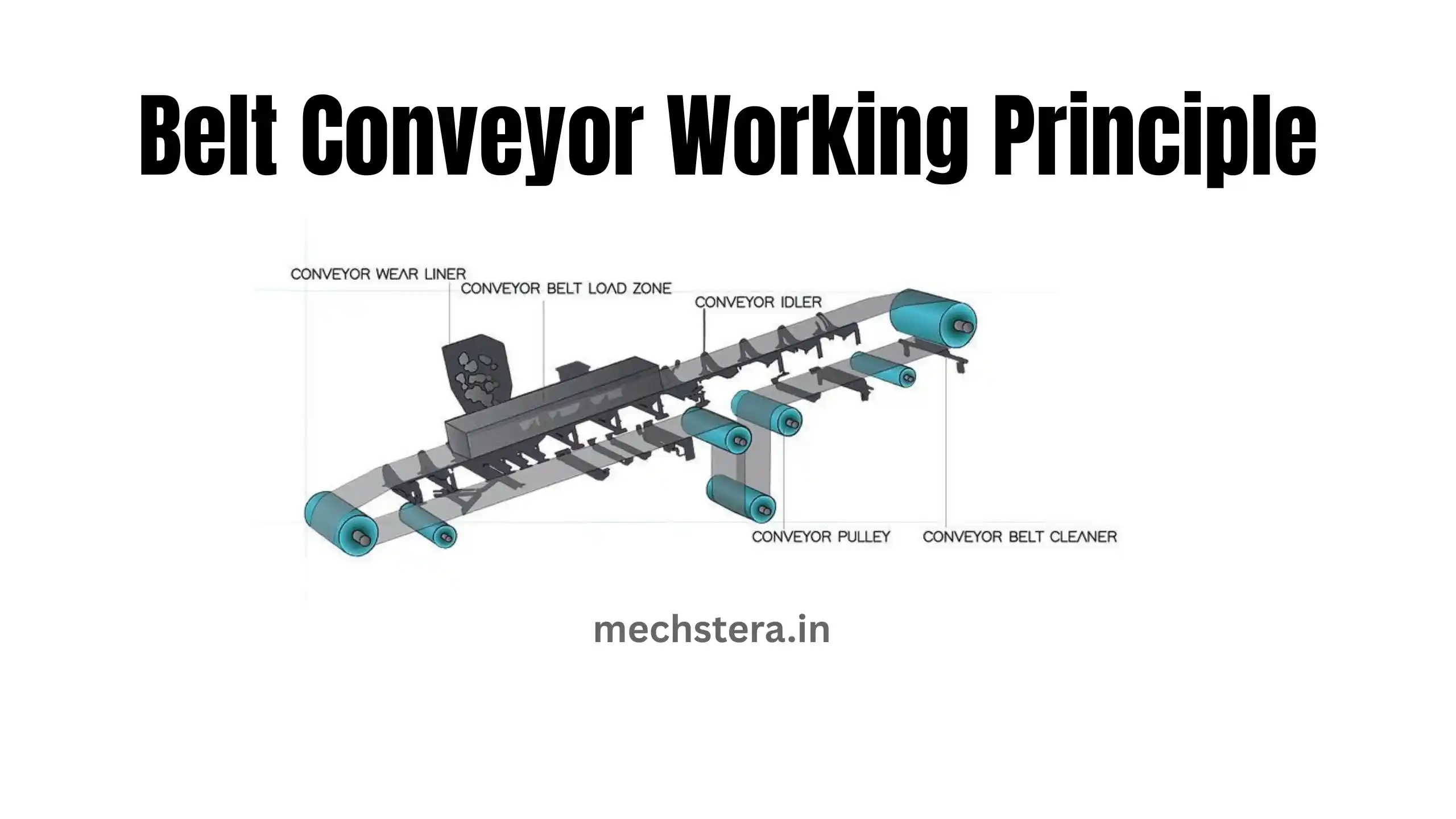
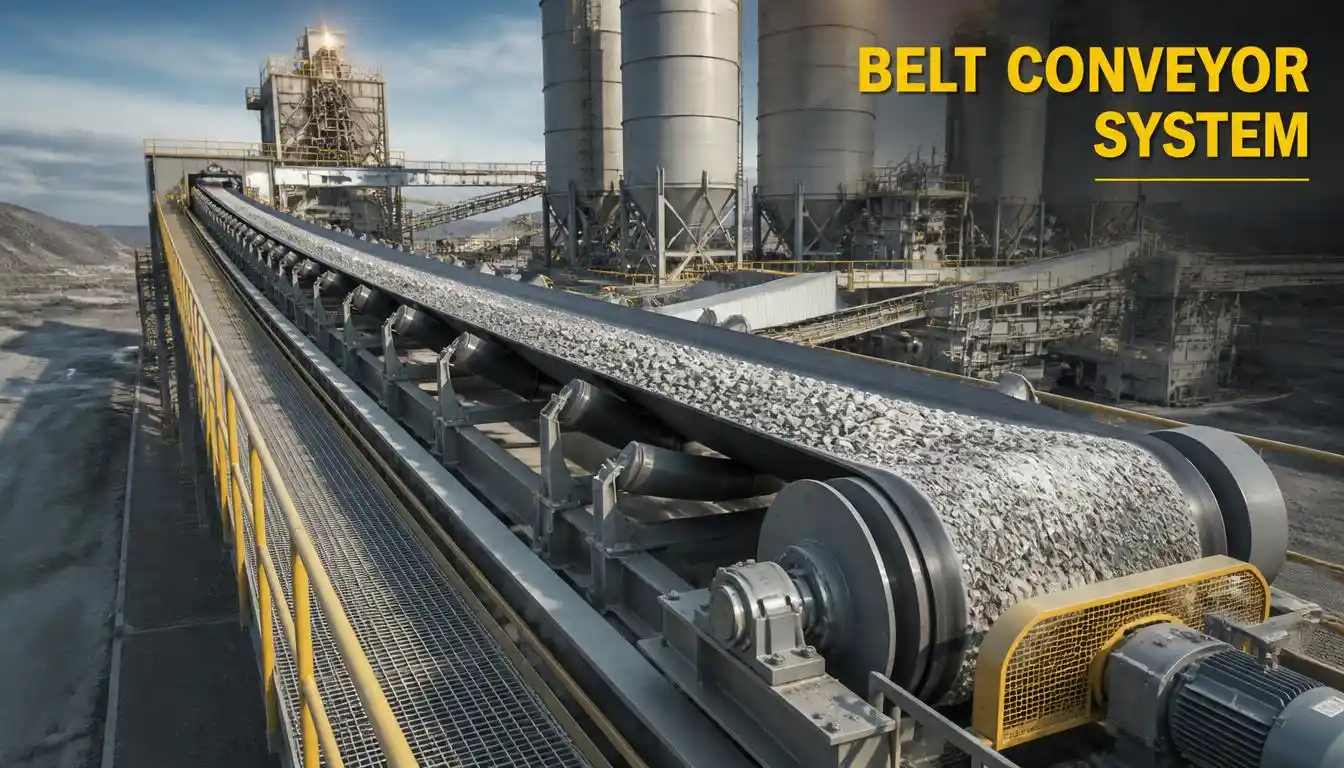
The working principle of a belt conveyor is straightforward, but getting it to run reliably depends on more than just looping a belt around two pulleys. The belt travels continuously between the head pulley and the tail pulley, with the head pulley typically driven by an electric motor through a gearbox or gearmotor. As the drive pulley rotates, friction between the pulley lagging and the belt transfers torque, pulling the belt—and the material sitting on it—along the conveyor.
The return side of the belt wraps around the tail pulley and heads back to the loading point, while a series of carrying and return idlers support the belt to limit sag, maintain tracking, and reduce rolling resistance. Bulk material is normally fed onto the belt through a hopper or loading chute near the tail end. At the discharge end, the belt curves around the head pulley, and the material continues forward under its own momentum, separating cleanly from the belt without any additional mechanical assistance.
Although the operating principle is simple, conveyor performance depends heavily on correct belt tension, pulley diameter, idler spacing, and loading conditions. Get those wrong, and you’ll spend more time dealing with belt mistracking, excessive wear, or material spillage than moving product.
Understanding this working principle is essential before selecting components, because every subsystem, from the belt conveyor pulley to the tensioning device, exists to keep this friction driven motion smooth, consistent, and safe under load.
Belt Conveyor Parts and Their Functions
A typical belt conveyor system consists of several critical components working together. The belt itself is usually made of rubber, PVC, or fabric reinforced material depending on the application. The pulleys, including the head pulley, tail pulley, and sometimes a snub pulley, guide and drive the belt. Idlers or rollers, spaced at regular intervals, support the belt and the load it carries, reducing friction and belt wear. The frame or structure holds all components in alignment and bears the overall load of the system. A tensioning device, often a screw takeup or gravity takeup, maintains the correct belt tension to prevent slippage on the drive pulley. Finally, the drive unit, comprising a motor and gearbox, provides the rotational power needed to move the belt.
Understanding the complete belt conveyor parts list helps engineers troubleshoot issues faster. For instance, excessive belt sag often points to worn idlers or insufficient tension, while belt mistracking usually traces back to misaligned pulleys or uneven loading.
Belt Conveyor Roller Types
Rollers, or idlers, come in several configurations depending on load and application. Flat rollers support the belt in a horizontal plane and are common for light duty applications. Troughing rollers are angled to form a trough shape that cradles bulk material and prevents spillage, commonly seen in troughed belt conveyor systems used in mining and aggregate handling. Impact rollers, placed at loading points, absorb the shock of material falling onto the belt and protect it from damage. Return rollers support the belt on its return path after the material has been discharged.
Types of Belt Conveyors
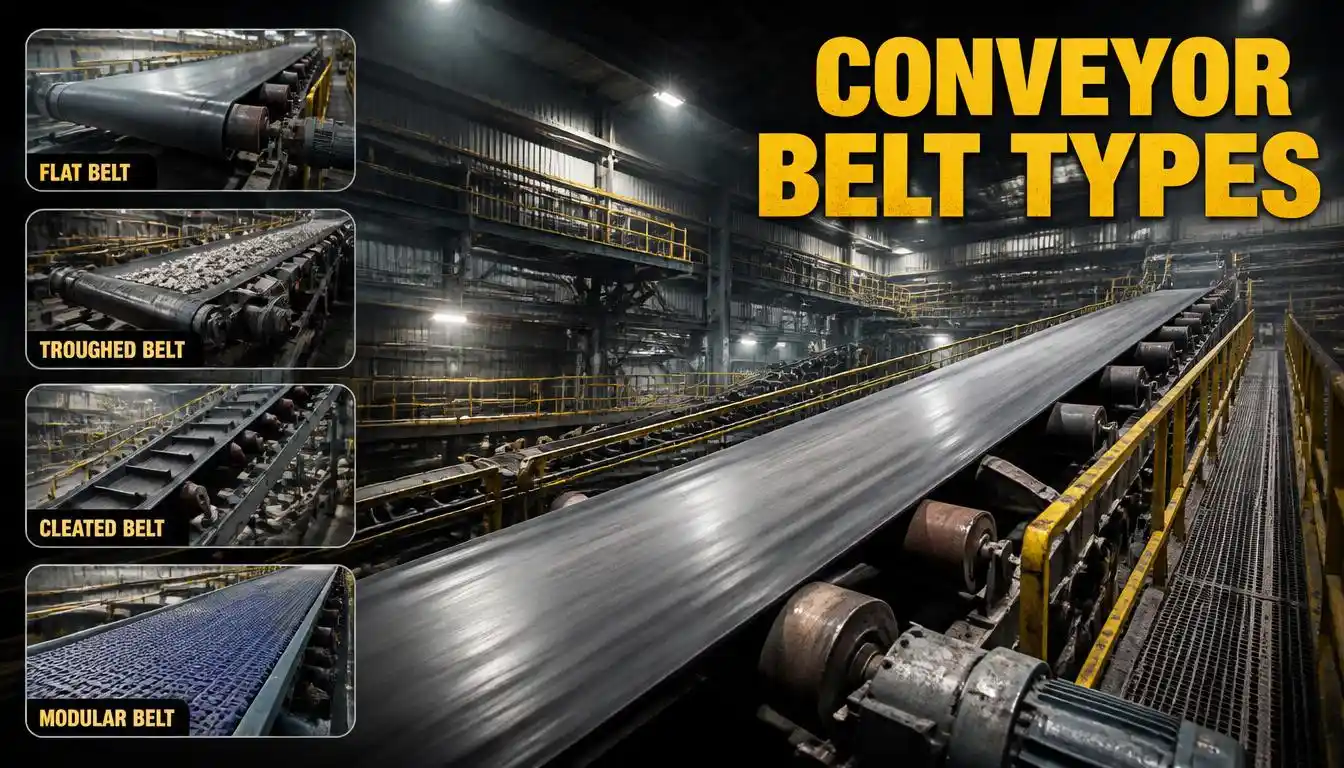
There are several belt conveyor variants engineered for specific industrial needs. A flat belt conveyor moves items on a level surface and is ideal for packaging lines and assembly operations. An inclined belt conveyor transports material upward or downward at an angle, often used to move material between different floor levels in a facility, and typically requires cleats or a chevron belt conveyor surface pattern to prevent material from sliding back down. A telescopic belt conveyor can extend and retract in length, making it useful for loading trucks or containers of varying sizes without repositioning the entire unit. A modular belt conveyor uses interlocking plastic segments instead of a continuous rubber belt, offering easy cleaning and part replacement, which makes it popular in food processing environments. A rubber belt conveyor, the most traditional configuration, uses a vulcanized rubber belt suited for heavy duty bulk material transport such as coal, ore, or aggregate.
Below is a simple comparison table outlining common belt conveyor types and their typical applications.
| Belt Conveyor Type | Typical Load | Common Industry |
|---|---|---|
| Flat Belt Conveyor | Light unit loads | Packaging, assembly |
| Inclined Belt Conveyor | Bulk or unit loads | Warehousing, agriculture |
| Troughed Belt Conveyor | Bulk granular material | Mining, aggregates |
| Modular Belt Conveyor | Food or light items | Food processing |
| Telescopic Belt Conveyor | Palletized goods | Logistics, shipping |
| Rubber Belt Conveyor | Heavy bulk material | Mining, cement, quarry |
Belt Conveyor Design Considerations
Belt conveyor design begins with defining the required capacity in tonnes per hour or units per minute, followed by selecting belt width and speed to meet that capacity without excessive material spillage. Engineers must calculate the effective tension needed to move the loaded belt, accounting for friction at idlers, the weight of the material, and the incline angle if any. This effective tension determines motor power requirements and belt strength specifications. Belt selection also depends on the material being transported since abrasive materials like crushed stone require thicker, more wear resistant belts compared to lighter packaged goods.
Structural design must also account for the supporting frame, which needs to withstand not just the static load of the conveyor components but also the dynamic load of moving material, along with vibration and thermal expansion in outdoor installations. Many practicing engineers, including the technical team at Mechstera.in, rely on established sizing methods published by organizations such as CEMA, which provide standardized formulas for idler spacing, belt tension, and power calculations. For readers who want to go deeper into these formulas, the Conveyor Equipment Manufacturers Association publishes detailed technical guidance at https://www.cemanet.org, which is a widely referenced resource in bulk material handling design.
Belt Conveyor Diagram and Drawing References
A belt conveyor diagram typically shows the head pulley, tail pulley, idler spacing, and the belt path in both loaded and return sections, along with the incline angle if the conveyor is not horizontal. Students working on belt conveyor drawing pdf assignments often find it useful to study standard schematic layouts before creating their own CAD models, since these diagrams reveal how tension and support points are distributed across the length of the system. Reviewing conveyor standards from academic engineering departments, such as those published by MIT OpenCourseWare at https://ocw.mit.edu, can offer additional context on mechanical power transmission principles that apply directly to conveyor drive systems.
Belt Conveyor HSN Code and Industrial Classification
For procurement and import documentation, the belt conveyor hsn code typically falls under heading 8428, which covers lifting, handling, loading, or unloading machinery. Manufacturers and buyers should confirm the exact subheading with customs authorities or a licensed HSN classification reference, since specific codes can vary depending on whether the conveyor is sold as a complete system or as individual parts.
Belt Conveyor Manufacturers and Sourcing
When selecting among belt conveyor manufacturers, engineers should evaluate not just upfront cost but also after sales support, spare parts availability, and adherence to relevant ISO or CEMA standards. A conveyor built without standardized components can become difficult to maintain once a supplier discontinues a particular part. For buyers researching supplier standards, the International Organization for Standardization maintains conveyor belt testing and safety standards at https://www.iso.org, which is useful for verifying that a manufacturer’s equipment meets recognized benchmarks.
Pros and Cons of Belt Conveyor Systems
| Aspect | Advantage | Limitation |
|---|---|---|
| Load Capacity | Handles high volume efficiently | Limited by belt strength |
| Energy Efficiency | Lower power use than pneumatic systems | Power rises with incline angle |
| Maintenance | Simple mechanical parts | Belt wear over time |
| Flexibility | Multiple types for different loads | Fixed path once installed |
| Material Handling | Gentle on fragile items | Not ideal for very fine powders |
Practical Maintenance Insights
Belt tracking issues, premature idler wear, and belt slippage are the most common operational problems engineers encounter with belt conveyor systems. Routine inspection of idler bearings, periodic tension checks, and prompt replacement of worn rollers extend the service life of the system significantly. Teams at Mechstera.in generally recommend documenting baseline tension and alignment values during commissioning so that future maintenance checks have a clear reference point for comparison.
Frequently Asked Questions
What is the difference between a flat belt conveyor and a troughed belt conveyor?
A flat belt conveyor keeps the belt surface level and is suited for unit loads, while a troughed belt conveyor angles the side idlers to cradle bulk material and prevent spillage during transport.
How is belt conveyor speed determined during design?
Belt speed is calculated based on the required material throughput, belt width, and the characteristics of the material, balancing efficient transport with minimizing spillage or belt wear.
Why do cleated or chevron belt conveyors exist?
Cleated and chevron patterns are added to the belt surface to prevent material from sliding backward on inclined sections, which is essential for steep angle transport of bulk goods.
What causes belt mistracking in a belt conveyor system?
Mistracking usually results from misaligned pulleys, uneven loading on one side of the belt, or worn idlers that no longer support the belt evenly across its width.
Are modular belt conveyors more expensive than rubber belt conveyors?
Modular belt conveyors often have a higher initial cost due to their segmented construction but can offer lower long term maintenance costs since individual segments can be replaced without changing the entire belt.
What industries rely most heavily on inclined belt conveyor systems?
Mining, agriculture, and construction material handling industries frequently use inclined belt conveyors to move bulk material between different elevation levels within a facility.