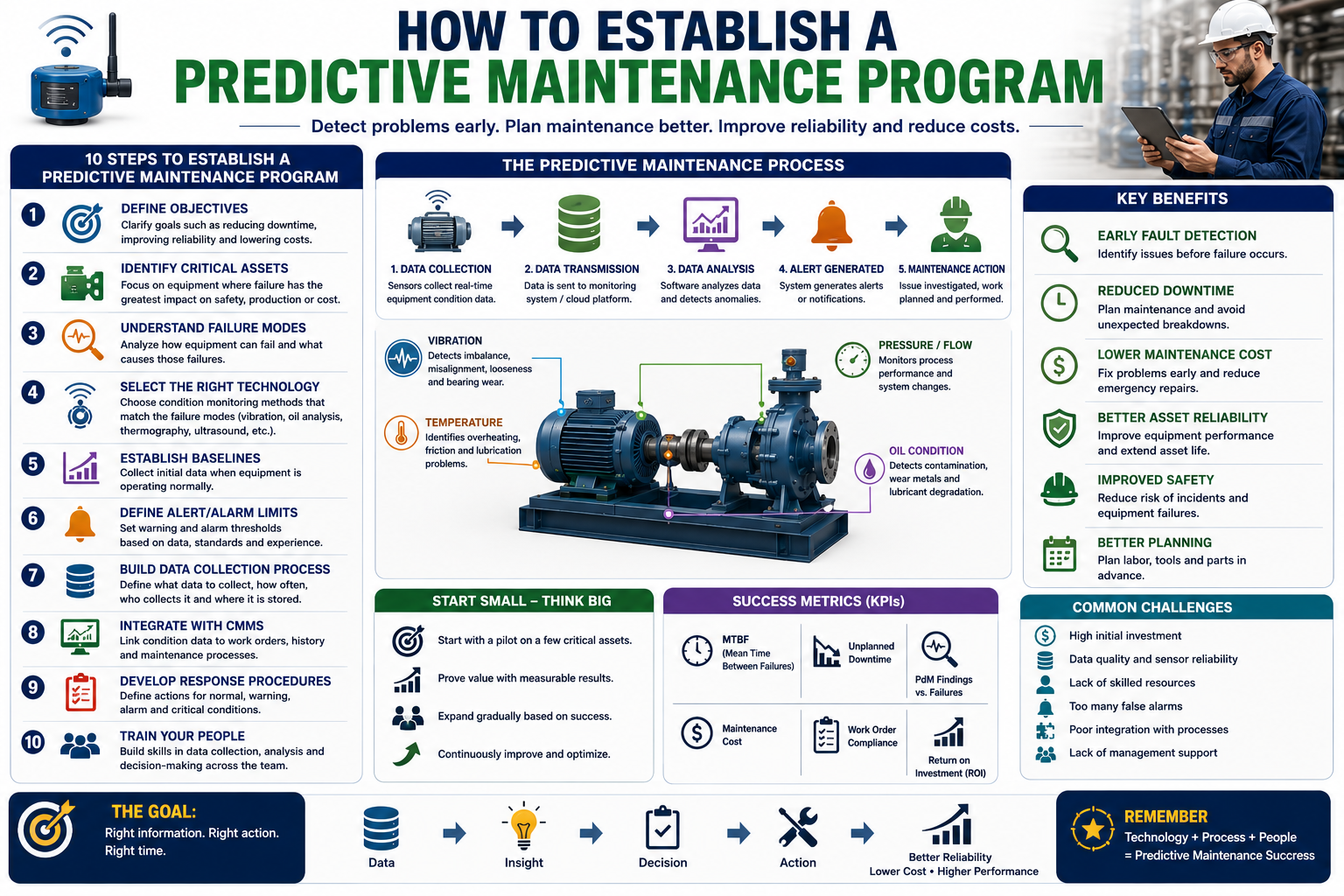
Predictive maintenance is becoming an increasingly important part of modern industrial asset management. Manufacturing plants, power generation facilities, oil and gas operations, mining sites, processing plants, and other industrial organizations are using condition-monitoring technologies to identify equipment problems before they result in unexpected failures.
Unlike reactive maintenance, which waits for equipment to fail, predictive maintenance uses equipment condition, sensor data, inspections, and engineering analysis to determine when maintenance may be required.
However, purchasing sensors or predictive-maintenance software alone does not create a successful predictive maintenance program. A reliable program requires the right assets, technologies, people, processes, data, and maintenance response.
This guide explains how organizations can establish a practical and effective predictive maintenance program.
What Is Predictive Maintenance?
Predictive maintenance is a maintenance strategy that uses equipment-condition information to identify developing problems and determine when maintenance should be performed.
Instead of replacing a component simply because it has reached a predetermined date, maintenance teams monitor equipment and look for signs of deterioration.
For example:
Normal condition → Abnormal condition detected → Condition monitored → Maintenance planned → Component repaired or replaced
Common predictive maintenance technologies include:
- Vibration analysis
- Infrared thermography
- Oil analysis
- Ultrasonic inspection
- Motor current analysis
- Temperature monitoring
- Pressure monitoring
- Online sensors
The objective is to detect problems early enough to take corrective action before functional failure occurs.
Why Establish a Predictive Maintenance Program?
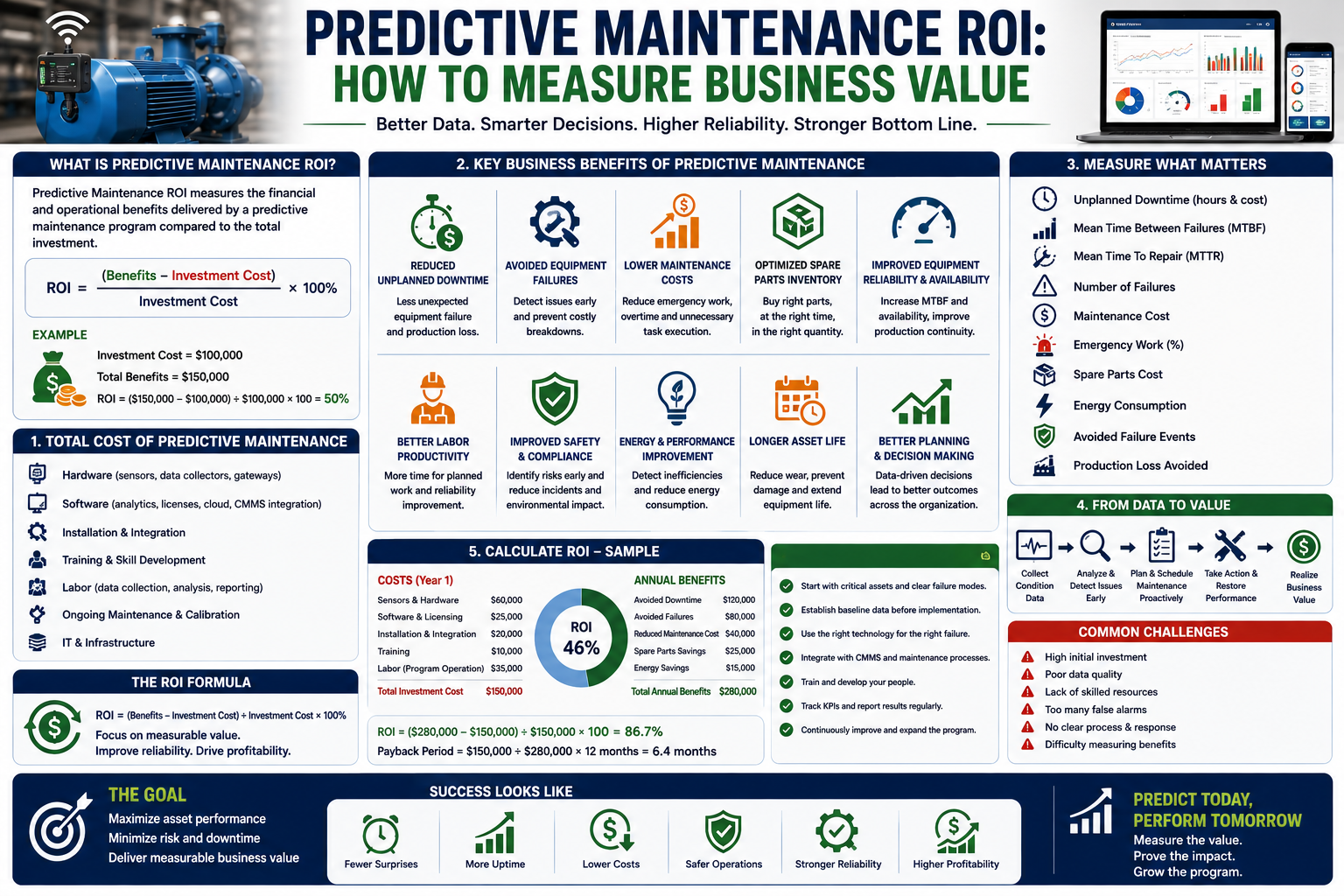
A well-designed predictive maintenance program can provide several benefits.
These include:
- Reduced unplanned downtime
- Earlier failure detection
- Improved equipment reliability
- Better maintenance planning
- Reduced unnecessary component replacement
- Lower maintenance costs
- Improved equipment availability
- Better spare-parts planning
- Increased asset life
- Improved safety
Predictive maintenance is particularly valuable for critical equipment where unexpected failure can have significant production, financial, environmental, or safety consequences.
Step 1: Define the Objectives
Before purchasing equipment or installing sensors, clearly define what the predictive maintenance program is expected to achieve.
Possible objectives include:
- Reduce unplanned equipment downtime by a specific percentage.
- Detect critical equipment failures earlier.
- Reduce emergency maintenance.
- Increase Mean Time Between Failures (MTBF).
- Reduce maintenance costs.
- Improve equipment availability.
- Reduce repeat failures.
Clear objectives make it easier to measure whether the program is delivering value.
Step 2: Identify Critical Assets
Do not begin by installing sensors on every asset.
Start with equipment where predictive maintenance can provide the greatest benefit.
Perform an asset criticality analysis based on factors such as:
- Safety impact
- Production impact
- Environmental consequences
- Equipment replacement cost
- Repair cost
- Failure frequency
- Downtime duration
- Availability of standby equipment
Examples of potentially suitable assets include:
- Critical pumps
- Large electric motors
- Compressors
- Gearboxes
- Turbines
- Fans
- Generators
- Conveyors
- Transformers
The objective is to focus resources where failure prevention provides the greatest business value.
Step 3: Understand Equipment Failure Modes
Identifying critical equipment is only the beginning.
The next step is to understand how the equipment fails.
For example, a pump may experience:
- Bearing failure
- Shaft misalignment
- Impeller damage
- Mechanical seal failure
- Cavitation
- Lubrication problems
Each failure mode may require a different monitoring technique.
Vibration analysis may be useful for bearing deterioration and misalignment, while temperature monitoring may identify overheating.
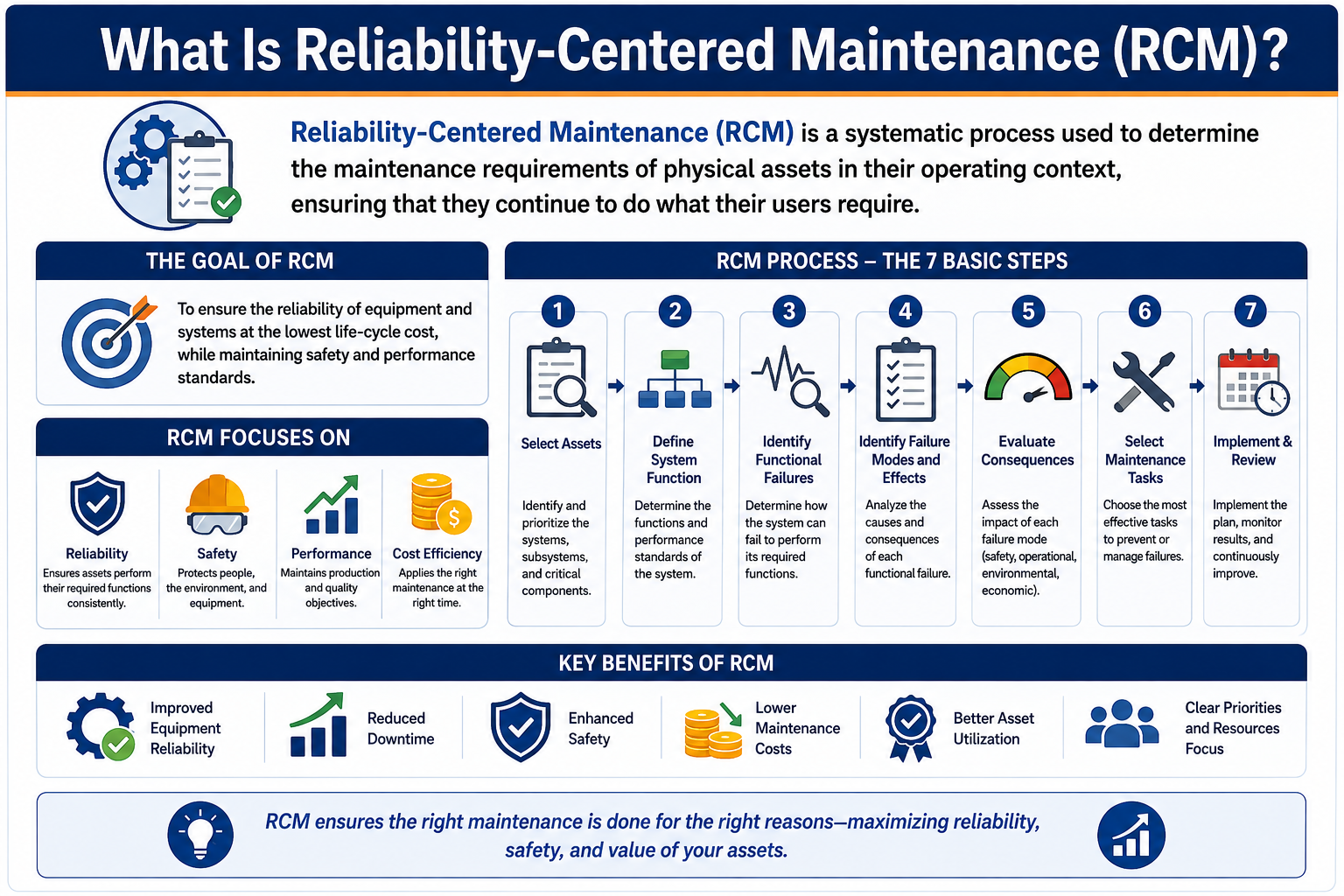
Tools such as Failure Mode and Effects Analysis (FMEA) and Reliability-Centered Maintenance (RCM) can help identify appropriate predictive maintenance tasks.
Step 4: Select the Right Technology
The monitoring technology should be selected based on the failure mode.
Vibration Analysis
Useful for rotating equipment such as motors, pumps, fans, compressors, and gearboxes.
It can help detect:
- Imbalance
- Misalignment
- Bearing problems
- Mechanical looseness
- Gear defects
Infrared Thermography
Useful for electrical panels, motors, transformers, bearings, and other equipment where abnormal heat may indicate a problem.
Oil Analysis
Useful for gearboxes, hydraulic systems, engines, compressors, and other lubricated equipment.
It can identify contamination, lubricant degradation, and signs of component wear.
Ultrasonic Inspection
Can be used for detecting certain leaks, mechanical conditions, and electrical abnormalities.
Temperature and Process Sensors
Temperature, pressure, flow, and other process measurements can help identify changes in equipment performance.
The best predictive maintenance program may use several technologies rather than relying on one technique.
Step 5: Establish Equipment Baselines
Predictive maintenance depends on understanding what normal equipment condition looks like.
After installing a monitoring system, collect baseline information when equipment is operating normally.
Baseline measurements may include:
- Normal vibration
- Normal temperature
- Normal pressure
- Normal current
- Normal flow
- Normal lubricant condition
Without a reliable baseline, it can be difficult to determine whether a measurement represents a genuine abnormal condition.
Step 6: Define Alarm and Alert Limits
Once baseline conditions are established, appropriate alarm levels should be defined.
For example:
Normal → Warning → Alarm → Critical
Alarm thresholds should be based on factors such as:
- Equipment type
- Manufacturer information
- Industry standards
- Historical data
- Engineering analysis
- Equipment operating conditions
Alarm limits should be reviewed over time.
A threshold that works for one machine may not necessarily be appropriate for another.
Step 7: Build a Data Collection Process
Predictive maintenance generates large amounts of information.
The organization needs a structured process for collecting and managing this data.
Define:
- What measurements will be collected?
- How often will they be collected?
- Who will collect them?
- Where will the data be stored?
- Who will analyze the data?
- What happens when an abnormal condition is identified?
For critical assets, continuous monitoring may be appropriate.
For lower-risk assets, periodic inspections may provide sufficient information.
Step 8: Integrate Predictive Maintenance With the CMMS
A predictive maintenance program should not operate separately from the maintenance organization.
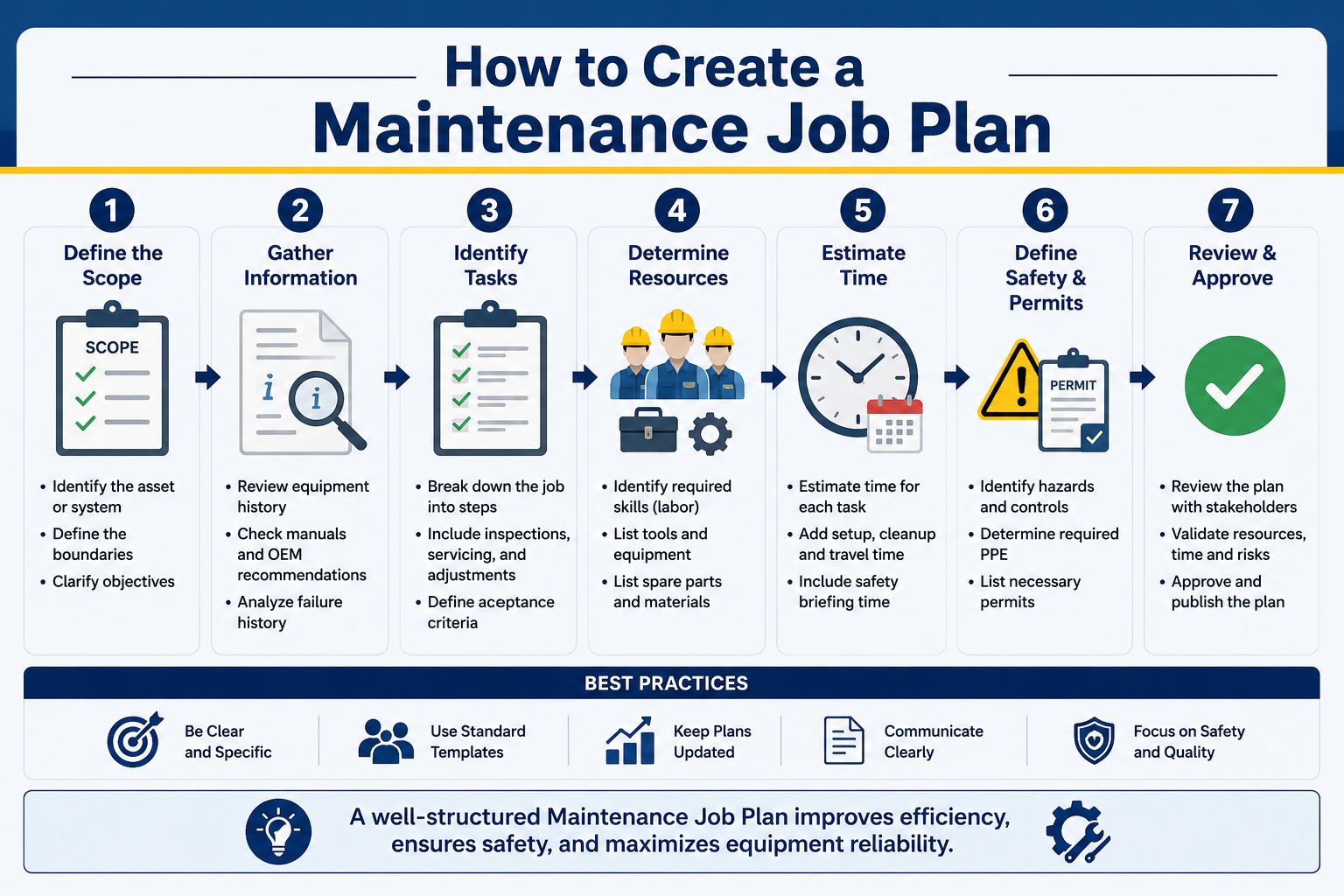
Condition-monitoring information should ultimately lead to a maintenance decision.
A typical process may look like:
Sensor → Condition alert → Engineering review → Work request → Planned work order → Repair → Verification → Equipment history
Integrating predictive maintenance with a Computerized Maintenance Management System (CMMS) can help ensure that identified problems are properly tracked and resolved.
Step 9: Develop a Clear Response Procedure
One of the most common mistakes in predictive maintenance is collecting data without defining what to do with it.
Every significant alert should have a response process.
For example:
Normal Condition
Continue monitoring.
Warning Condition
Increase monitoring frequency and investigate the equipment.
Alarm Condition
Create a maintenance work order and plan corrective action.
Critical Condition
Evaluate whether the equipment should be removed from service immediately or under controlled conditions.
The exact response should depend on equipment criticality and failure consequences.
Step 10: Train Maintenance Personnel
Predictive maintenance requires appropriate technical skills.
Employees may need training in:
- Vibration analysis
- Thermography
- Oil analysis
- Ultrasonic inspection
- Sensor technology
- Data analysis
- Failure diagnosis
- CMMS operation
- Root Cause Analysis
However, predictive maintenance should not become the responsibility of only one specialist.
Maintenance technicians, engineers, planners, operators, and reliability professionals should understand how the program works and how their roles contribute to it.
Step 11: Start With a Pilot Program
Organizations should consider starting small.
Select a limited number of critical assets and establish a pilot predictive maintenance program.
For example:
5–10 critical pumps or motors
Track their condition over several months.
Evaluate:
- Number of detected problems
- Warning time before failure
- Avoided failures
- Maintenance cost
- Downtime reduction
- False alarms
- Technician workload
Use the results to improve the program before expanding it across the facility.
Step 12: Measure Program Performance
A predictive maintenance program should be measured using meaningful KPIs.
Useful indicators include:
Unplanned Downtime
Has unexpected downtime decreased?
Mean Time Between Failures
Has equipment reliability improved?
Mean Time To Repair
Are maintenance teams responding more effectively?
Failure Detection Rate
How many meaningful equipment problems are being identified before failure?
Avoided Failure Events
How many potential failures were detected and corrected before they caused major downtime?
Maintenance Cost
Is the program providing sufficient financial value?
False Alarm Rate
Are monitoring systems generating excessive alerts that do not represent real problems?
The objective is to demonstrate measurable improvement rather than simply collect data.
Common Predictive Maintenance Mistakes
Organizations should avoid several common mistakes.
Installing Sensors Everywhere
More sensors do not automatically mean better maintenance.
Start with critical assets and clear failure modes.
Collecting Data Without Action
Data has little value if nobody analyzes it or responds to abnormal conditions.
Ignoring Data Quality
Incorrect sensor installation, poor calibration, or unreliable measurements can create false alarms.
Focusing Only on Technology
Predictive maintenance is a maintenance-management process, not simply a technology project.
Failing to Train Employees
Technology is only effective when employees understand how to interpret and use the information.
Not Measuring Results
Without KPIs, it is difficult to determine whether the program is creating value.
The Role of Artificial Intelligence in Predictive Maintenance
Artificial intelligence and machine learning are increasingly being used to analyze industrial equipment data.
AI systems can identify patterns across large datasets and potentially recognize combinations of parameters associated with equipment deterioration.
For example, an analytics platform may detect a relationship between:
- Increasing vibration
- Rising temperature
- Changing motor current
and a particular failure mode.
However, AI should support engineering judgment rather than replace it.
Maintenance engineers still need to verify the condition, identify the failure mechanism, and determine the appropriate corrective action.
Benefits of a Mature Predictive Maintenance Program
When properly implemented, predictive maintenance can transform the maintenance function from reactive troubleshooting to proactive reliability management.
A mature program can provide:
- Earlier failure detection
- Better maintenance planning
- Reduced emergency work
- Improved equipment availability
- Lower downtime
- Better spare-parts planning
- Reduced unnecessary maintenance
- Improved asset reliability
- Longer equipment life
- Better maintenance decision-making
The greatest benefit comes when predictive information is connected directly to maintenance execution.
Conclusion
Establishing a predictive maintenance program requires much more than purchasing sensors or monitoring software.
A successful program begins by defining clear objectives, identifying critical assets, understanding failure modes, selecting appropriate monitoring technologies, establishing equipment baselines, and creating clear alarm-response procedures.
The program should then be integrated with the CMMS and supported by trained maintenance personnel.
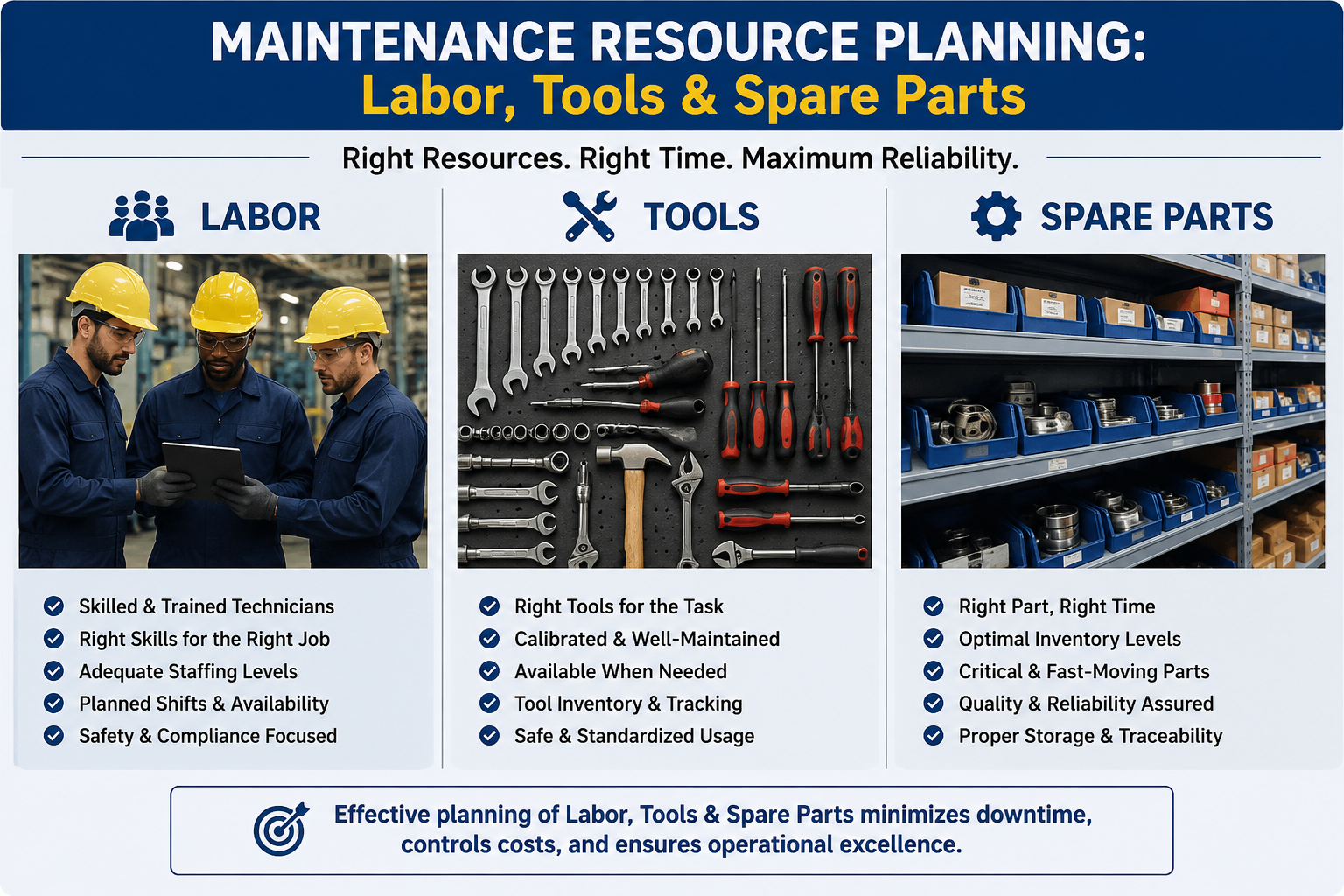
Organizations should start with a focused pilot program, measure the results, learn from the experience, and gradually expand the system to additional assets.
The key principle is:
Monitor what matters, detect deterioration early, and take the right maintenance action before failure occurs.
Predictive maintenance is most effective when technology, data, reliability engineering, and maintenance execution work together.
When implemented correctly, it can help organizations reduce unplanned downtime, improve equipment reliability, optimize maintenance resources, and achieve better long-term asset performance.