
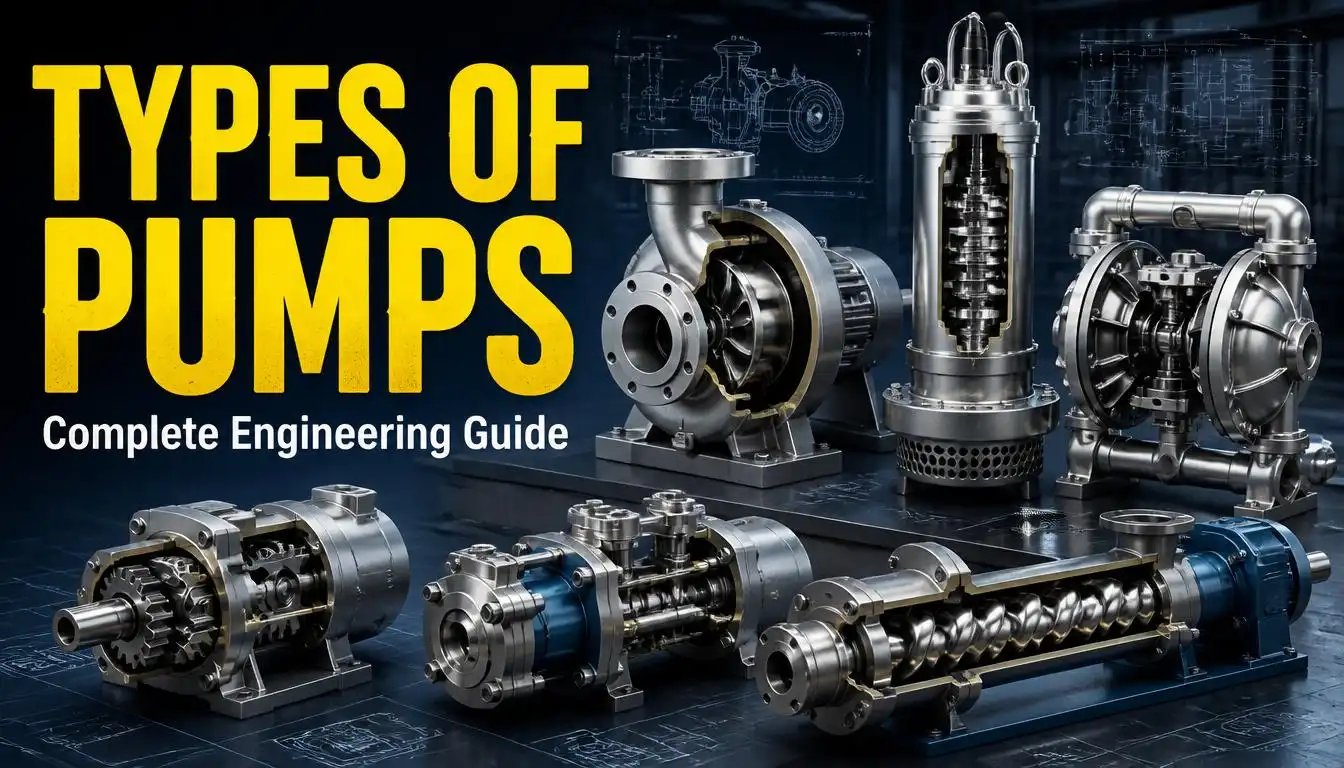
Pumps are among the most widely used mechanical devices on the planet. From moving water into your home to transporting crude oil across continents, pumps quietly power almost every industrial process and household utility. Yet, with so many types of pumps available, choosing the right one for a specific application can feel overwhelming.
In this guide, we’ll break down every major pump type, explain how they work, and help you understand which one suits your application — whether you’re an engineering student, a plant operator, or a homeowner researching a replacement pump.
What Is a Pump?
A pump is a mechanical device that moves fluids (liquids or gases) by mechanical action, typically converting electrical or mechanical energy into hydraulic energy. Pumps work by creating a pressure difference that pushes fluid from a lower-pressure region to a higher-pressure one.
Pumps are broadly classified based on how they move fluid, which brings us to the two main categories.
How Many Types of Pumps Are There?
At the broadest level, there are two main types of pumps:
- Positive Displacement Pumps – move a fixed volume of fluid with each cycle
- Dynamic (Kinetic) Pumps – impart velocity to the fluid, which is then converted into pressure
Within these two categories, there are dozens of sub-types, which is why searches like “how many types of pump” often return varying answers depending on classification depth. Let’s explore each in detail.
What Are the 4 Types of Pumps?
If you’re looking for a simplified answer to “what are the 4 types of pumps,” most engineers group them as:
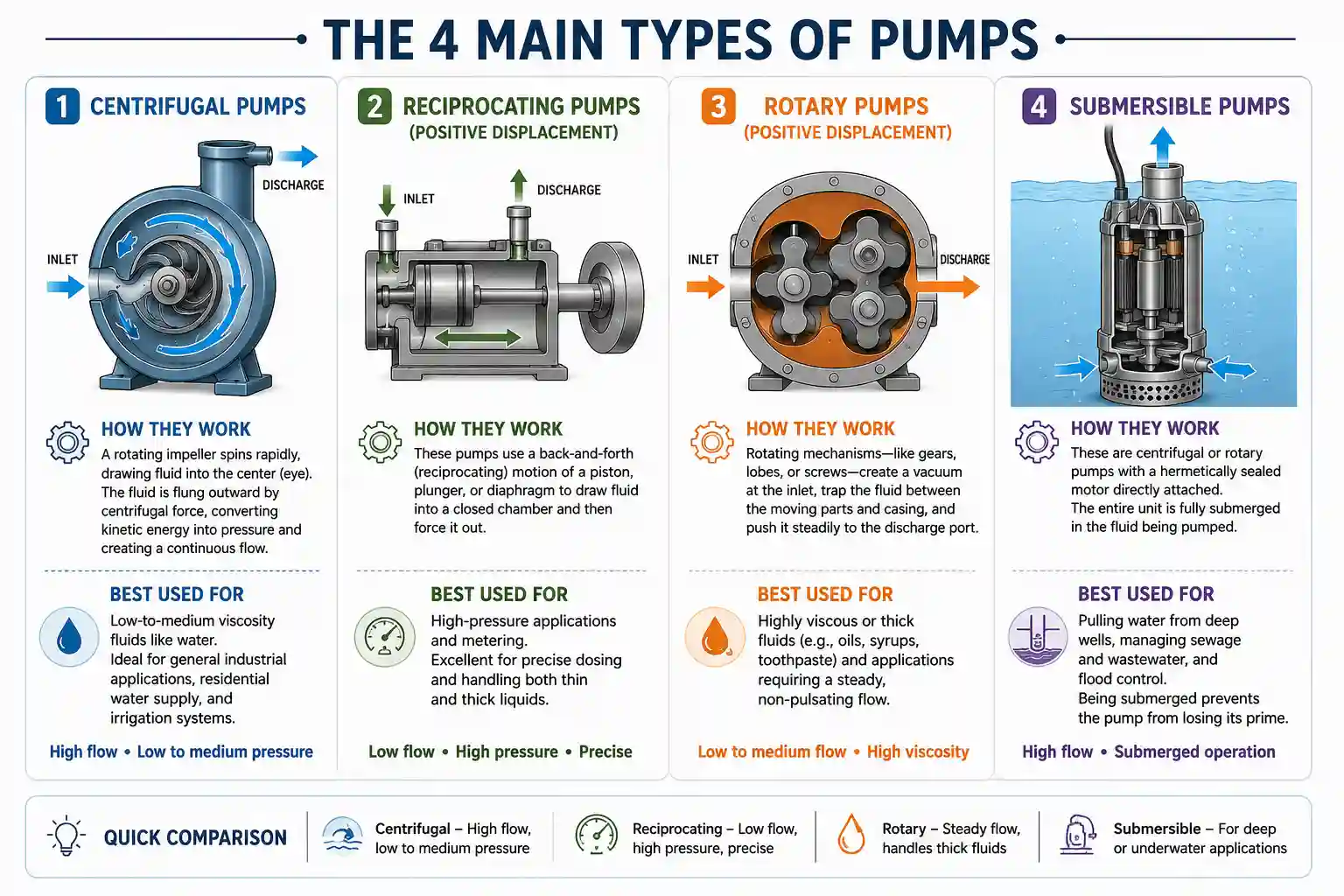
- Centrifugal Pumps – most common dynamic pump type
- Reciprocating Pumps – piston/plunger based positive displacement
- Rotary Pumps – gear, screw, or vane based positive displacement
- Special-Purpose Pumps – submersible, diaphragm, peristaltic, etc.
Now let’s go deeper into each category.
1. Positive Displacement Pumps
Positive displacement (PD) pumps trap a fixed amount of fluid and force it through the discharge pipe. They deliver a constant flow rate regardless of pressure changes, making them ideal for high-viscosity fluids and metering applications.
Common Positive Displacement Pump Types:
- Reciprocating Pumps – Piston, plunger, and diaphragm pumps that use back-and-forth motion
- Rotary Pumps – Gear pumps, screw pumps, vane pumps, and lobe pumps
- Diaphragm Pumps – Use a flexing membrane to move fluid, common in chemical dosing
We’ve covered this category extensively in our detailed guide on positive displacement pump types and how it works, which includes working principles, diagrams, and real-world applications.
2. Dynamic (Centrifugal) Pumps
Dynamic pumps use a rotating impeller to add kinetic energy to the fluid, which is then converted into pressure energy as the fluid exits the pump casing.
Common Dynamic Pump Types:
- Centrifugal Pumps – The most widely used pump type globally, ideal for low-viscosity fluids at high flow rates
- Axial Flow Pumps – Move fluid parallel to the pump shaft, used in flood control and irrigation
- Mixed Flow Pumps – Combine radial and axial flow characteristics
- Peripheral Pumps – Used for low-flow, high-head applications
Centrifugal pumps are so common in industry that understanding their failure modes is essential. If you’re working with these pumps, you should also understand cavitation in centrifugal pumps and net positive suction head, two of the most critical concepts for safe and efficient operation.
Industrial Pump Types
In industrial settings, pump selection depends on fluid type, pressure requirements, temperature, and flow rate. Common industrial pump types include:
| Industry | Common Pump Type |
|---|---|
| Oil & Gas | Reciprocating, Screw, Centrifugal |
| Water Treatment | Centrifugal, Submersible |
| Chemical Processing | Diaphragm, Magnetic Drive |
| Food & Beverage | Peristaltic, Rotary Lobe |
| Power Plants | Boiler Feed, Circulating Pumps |
| Agriculture | Axial Flow, Submersible |
According to the U.S. Department of Energy’s pump systems guide, pumping systems account for nearly 20% of the world’s electrical energy demand — making correct pump selection critical for energy efficiency.
Pump Types Chart
Here’s a simplified pump types chart for quick reference:
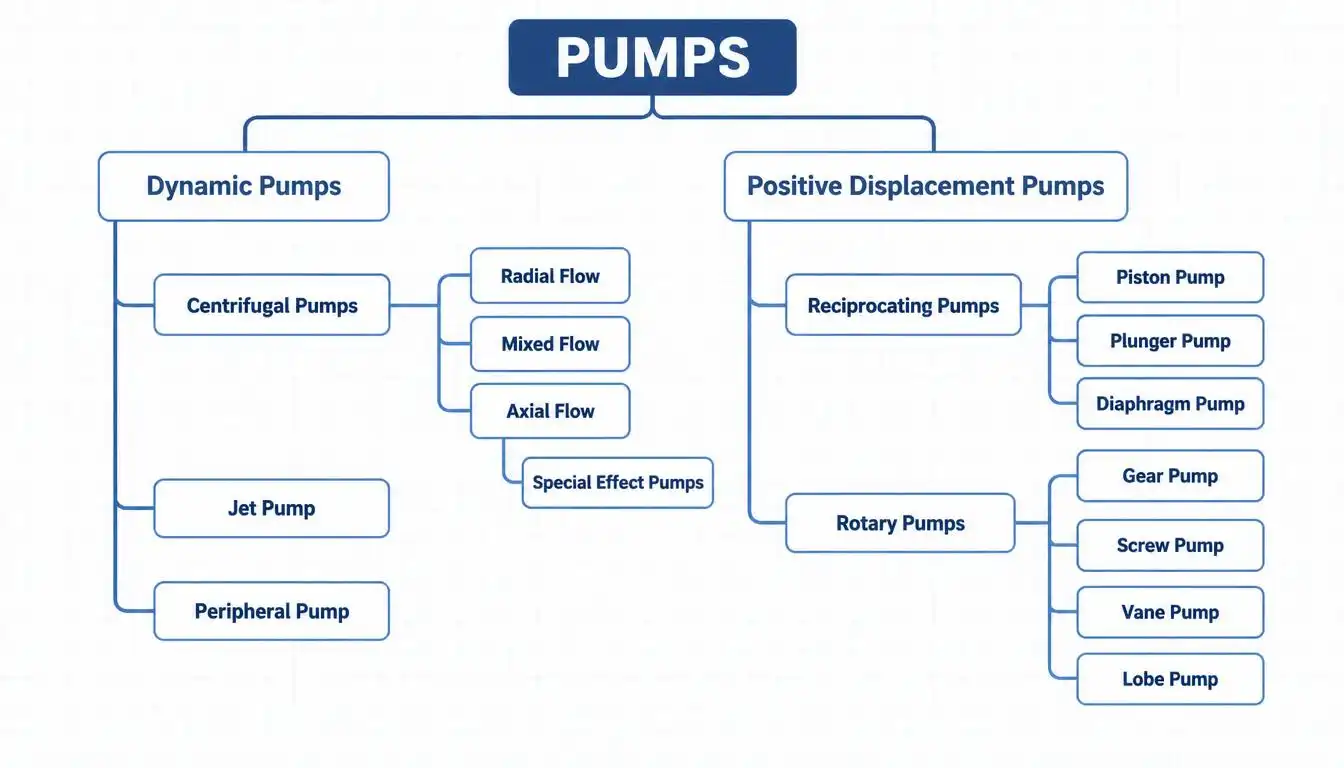
This classification aligns with standards published by the Hydraulic Institute, the leading authority on pump standards and best practices in North America.
Pump Motor Types
Every pump requires a motor to drive it, and pump motor types vary based on power source and control requirements:
- AC Induction Motors – Most common, used in centrifugal and rotary pumps
- DC Motors – Used in variable-speed and battery-operated applications
- Servo Motors – Provide precise speed and torque control, used in metering pumps
- Submersible Motors – Sealed motors designed to operate underwater in submersible pumps
Understanding motor pump types is essential when selecting types of motor pumps for specific flow and pressure requirements. For instance, variable frequency drives (VFDs) paired with AC motors are increasingly popular for energy savings, as noted by Engineering Toolbox’s pump motor resources.
Different Types of Pumps: A Quick Comparison
| Pump Type | Best For | Flow Behavior |
|---|---|---|
| Centrifugal | Low viscosity, high flow | Variable with pressure |
| Reciprocating | High pressure, metering | Constant/pulsating |
| Rotary (Gear/Screw) | High viscosity fluids | Constant |
| Diaphragm | Chemicals, slurries | Constant, pulsating |
| Submersible | Wells, sewage | Variable |
| Axial Flow | Large volume, low head | High flow, low pressure |
For a deeper technical comparison of pump classifications, Pumps & Systems Magazine offers ongoing industry analysis and case studies on pump selection.
Pumps vs Valves: Why Both Matter
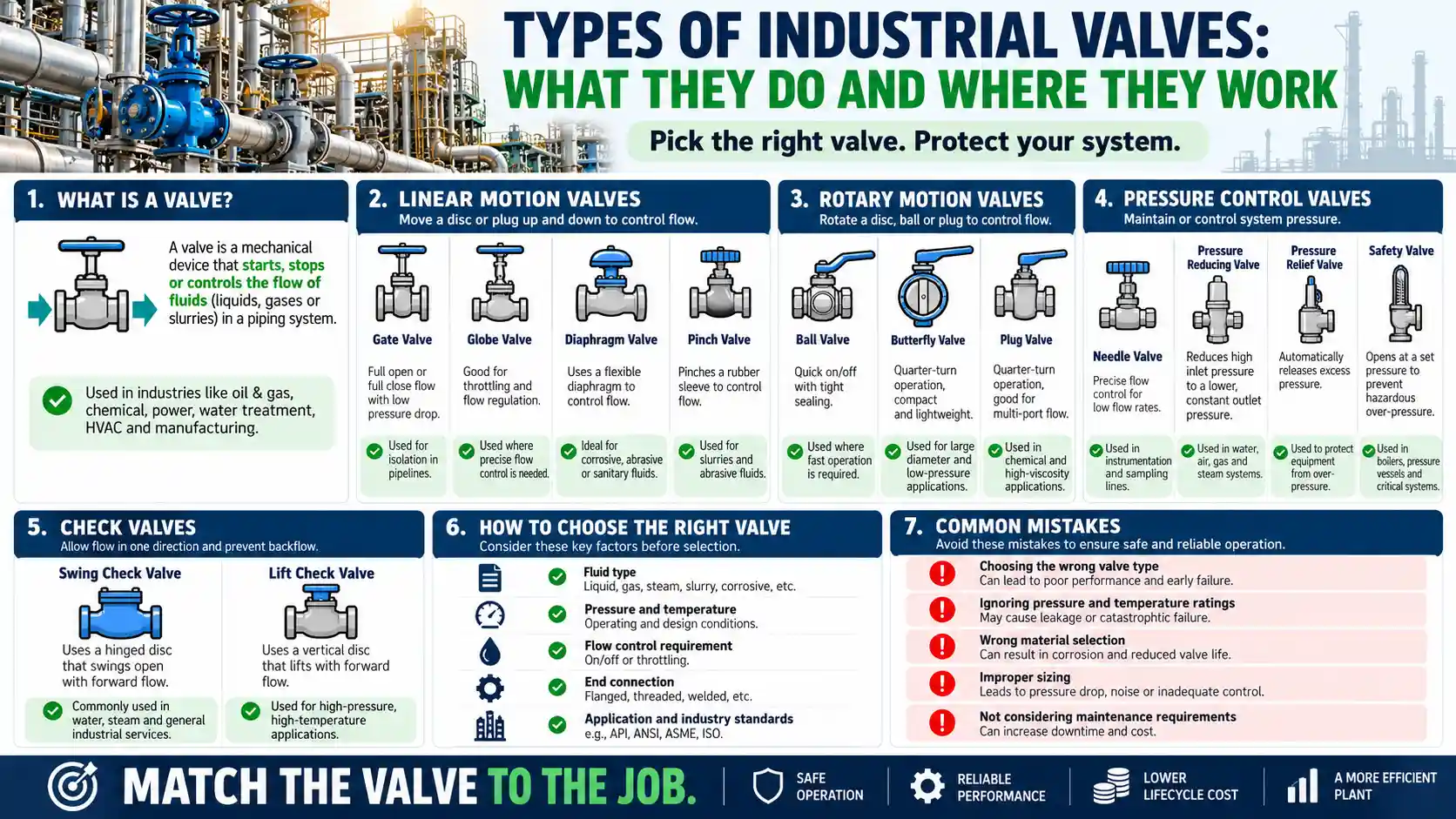
Pumps don’t work in isolation — they’re almost always paired with valves to control flow direction and pressure. If you’re designing a fluid system, it’s worth understanding types of valves alongside your pump selection, since valves regulate the flow that pumps generate. You may also find our guide on the globe valve working principle useful, along with our valve symbols guide for P&ID engineering drawings.
Similarly, pump reliability often depends on proper sealing. Poor sealing leads to leaks and efficiency losses, so reviewing our guide on types of mechanical seals can help you avoid common maintenance issues.
How to Choose the Right Pump Type
When selecting a pump, consider:
- Fluid properties – viscosity, corrosiveness, temperature
- Flow rate and pressure requirements
- Duty cycle – continuous vs. intermittent operation
- Energy efficiency – motor type and control options
- Maintenance access – ease of repair and part availability
The American Society of Mechanical Engineers (ASME) publishes standards (like ASME B73) that guide industrial pump design and selection criteria across sectors.
What are the 4 types of pumps?
The four broad categories are centrifugal, reciprocating, rotary, and special-purpose pumps (submersible, diaphragm, peristaltic).
How many types of pump are there in total?
While there are 2 main categories (positive displacement and dynamic), there are over 20 recognized sub-types across various industries.
What’s the difference between pump types and pump motor types?
Pump types refer to how fluid is moved (mechanism), while motor types refer to the power source driving the pump (AC, DC, servo, submersible motors).
Which pump type is most commonly used in industry?
Centrifugal pumps are the most widely used due to their simplicity, efficiency, and suitability for a broad range of flow rates.
Conclusion
Understanding the different types of pumps — from positive displacement to dynamic, and their respective motor systems — is essential for selecting the right equipment for any application. Whether you’re managing an industrial process or maintaining a home water system, matching the pump type to your fluid and flow requirements will save energy, reduce maintenance costs, and extend equipment life.
For related reading, explore our guides on positive displacement pump types and how it works, cavitation in centrifugal pumps, and types of valves to build a complete understanding of fluid handling systems.

2 thoughts on “Different Types of Pumps Used in Industry & Home Every Day”