Equipment availability is one of the most important performance indicators in maintenance and reliability engineering. In manufacturing plants, power stations, oil and gas facilities, mining operations, process industries, and other industrial environments, equipment must be available when production requires it.
A machine that frequently fails, takes too long to repair, or spends excessive time waiting for spare parts can significantly affect production performance.
This is why maintenance teams need to understand equipment availability, how it is calculated, what factors influence it, and how it can be improved.
In simple terms, equipment availability answers an important question:
“How much of the required time is this equipment actually ready to perform its intended function?”
Improving availability is not simply about repairing equipment faster. It requires a combination of reliability improvement, effective maintenance planning, spare-parts management, equipment design, condition monitoring, and operational discipline.
What Is Equipment Availability?
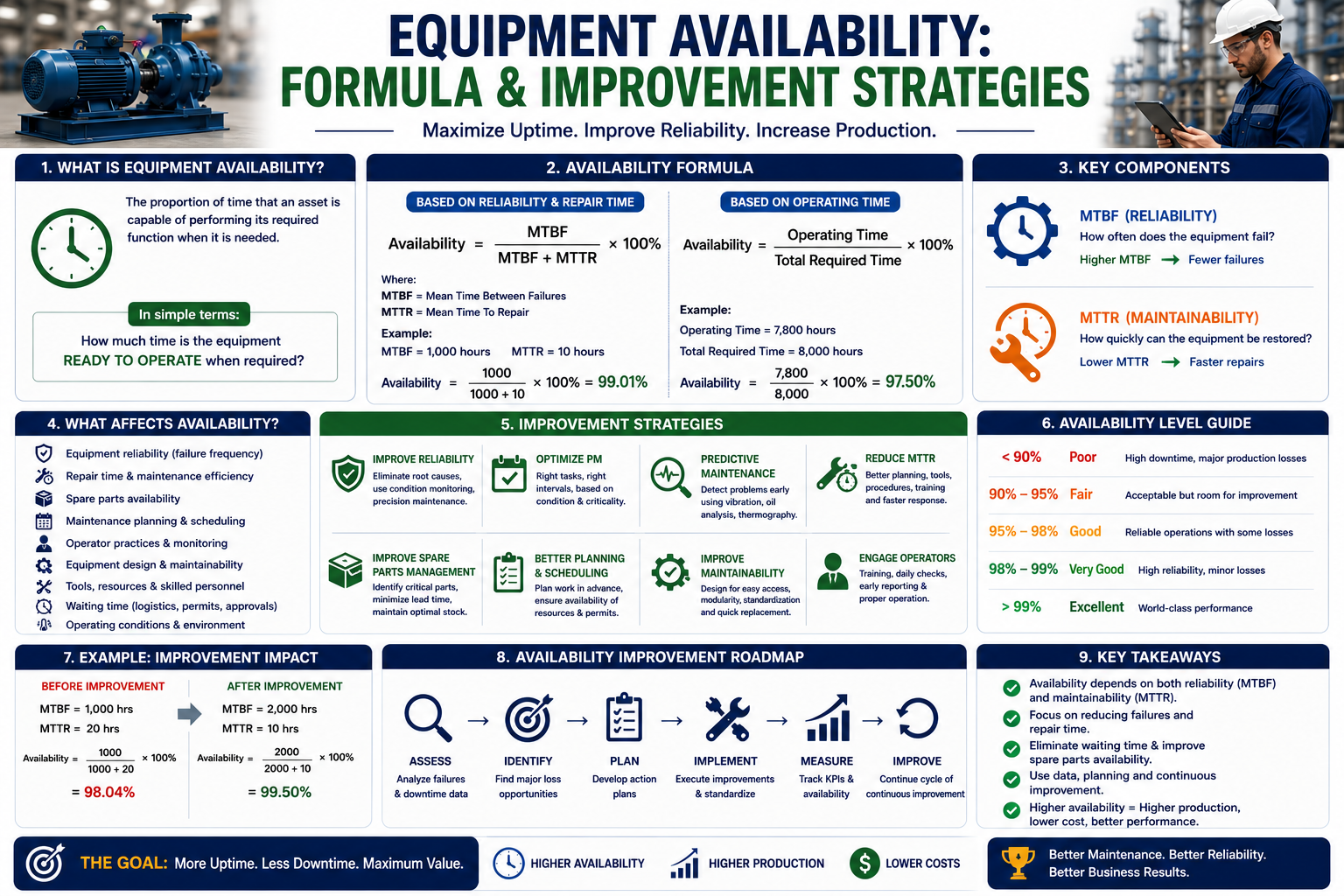
Equipment availability is the proportion of time that an asset is capable of performing its required function when it is needed.
Availability considers both equipment operating time and downtime.
Downtime can result from:
- Equipment failures
- Corrective maintenance
- Preventive maintenance
- Inspection activities
- Waiting for spare parts
- Waiting for technicians
- Lack of tools
- Operational delays
- Logistics problems
A highly available asset spends most of its required operating time ready for production.
For maintenance engineers, availability is important because it connects maintenance performance with operational performance.
Equipment Availability Formula
One commonly used availability formula based on reliability and repair time is:
Availability = MTBF ÷ (MTBF + MTTR) × 100
Where:
MTBF = Mean Time Between Failures
MTTR = Mean Time To Repair
For example, assume a machine has:
- MTBF = 1,000 hours
- MTTR = 10 hours
Then:
Availability = 1,000 ÷ (1,000 + 10) × 100
Availability ≈ 99.01%
This means the equipment is theoretically available for approximately 99% of the time under the assumptions represented by the formula.
However, real-world availability calculations can vary depending on which types of downtime are included.
Another Simple Availability Formula
Availability can also be calculated directly from operating and downtime information:
Availability = Operating Time ÷ Total Required Time × 100
For example, if a machine is required to operate for 8,000 hours and experiences 200 hours of downtime:
Availability = 7,800 ÷ 8,000 × 100
Availability = 97.5%
This approach is useful when analyzing actual operational performance.
Reliability vs Availability
Reliability and availability are closely related but are not the same.
Reliability measures how consistently equipment performs without failure.
Availability measures whether equipment is ready to operate when required.
For example, a machine may have high reliability because it rarely fails. However, if a failure requires several days to repair, its availability may still be negatively affected.
Likewise, equipment that fails frequently but can be repaired very quickly may achieve relatively high availability.
This is why maintenance teams should consider both MTBF and MTTR when improving availability.
The Role of MTBF
Mean Time Between Failures measures the average operating time between failures.
A simplified calculation is:
MTBF = Total Operating Time ÷ Number of Failures
Suppose equipment operates for 12,000 hours and experiences six failures.
MTBF = 12,000 ÷ 6 = 2,000 hours
If the organization can increase MTBF from 2,000 to 3,000 hours, equipment is failing less frequently.
Ways to improve MTBF include:
- Root Cause Analysis
- Precision maintenance
- Better lubrication
- Improved alignment
- Condition monitoring
- Equipment redesign
- Better operating practices
- Preventive maintenance optimization
Improving MTBF directly supports higher availability.
The Role of MTTR
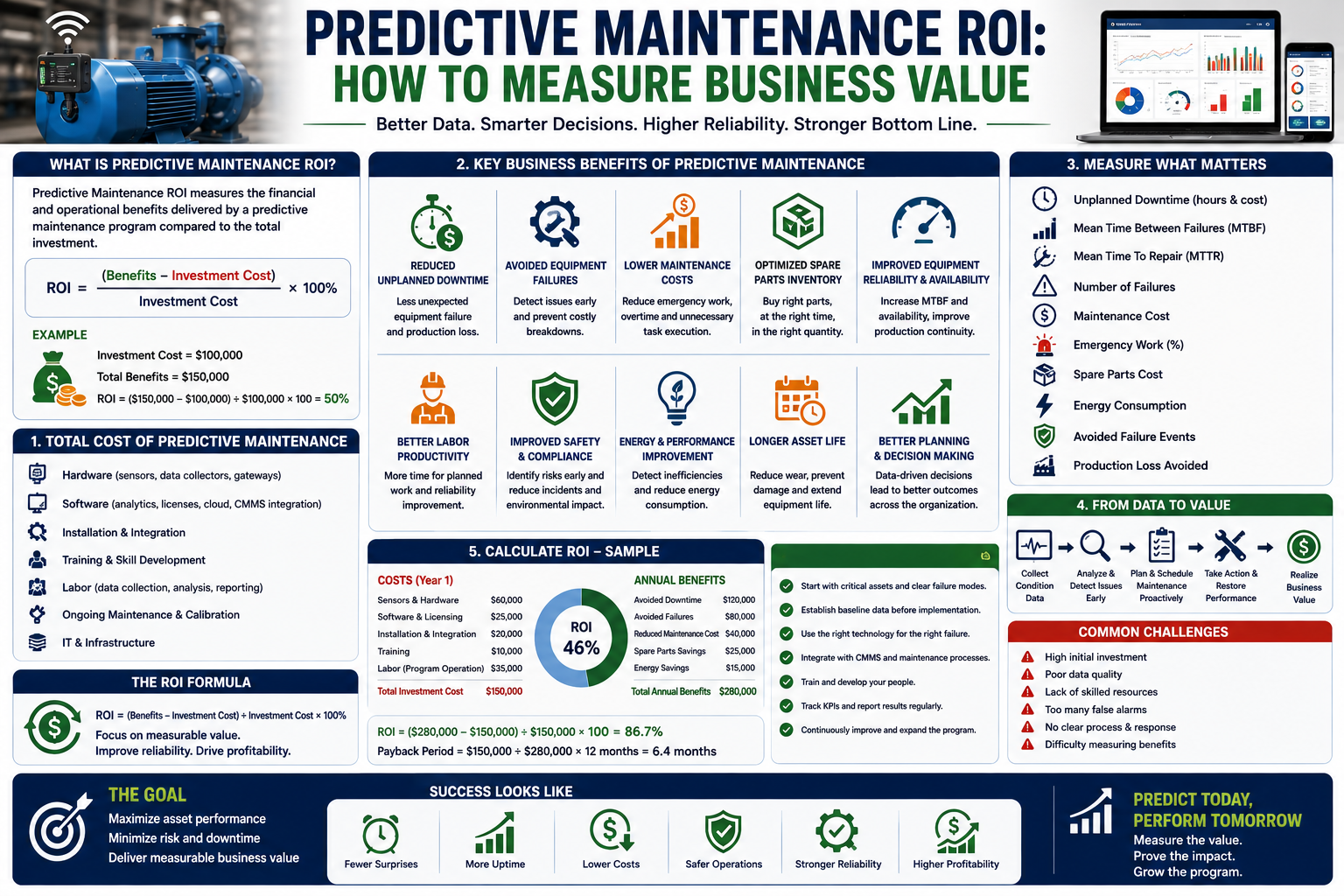
Mean Time To Repair measures how long it takes to restore equipment after a failure.
A simplified calculation is:
MTTR = Total Repair Time ÷ Number of Repairs
For example, if technicians spend 50 hours repairing five failures:
MTTR = 50 ÷ 5 = 10 hours
Reducing MTTR can significantly improve availability.
However, MTTR should be analyzed carefully. Total downtime may include more than hands-on repair time.
A technician may need only three hours to repair a pump, but the equipment may remain unavailable for 15 hours because the team was waiting for:
- Spare parts
- Isolation
- Permits
- Crane availability
- Specialist support
- Access
- Tools
Therefore, improving availability requires reducing both repair time and waiting time where appropriate.
1. Improve Equipment Reliability
The first strategy for improving availability is reducing the frequency of failures.
Maintenance teams should identify recurring failure modes and eliminate their root causes.
For example, if a pump repeatedly experiences bearing failures, simply replacing the bearing each time may not solve the problem.
The real cause could be:
- Misalignment
- Poor lubrication
- Excessive vibration
- Incorrect installation
- Contamination
- Excessive loading
Root Cause Analysis can identify the underlying problem and prevent repeated failures.
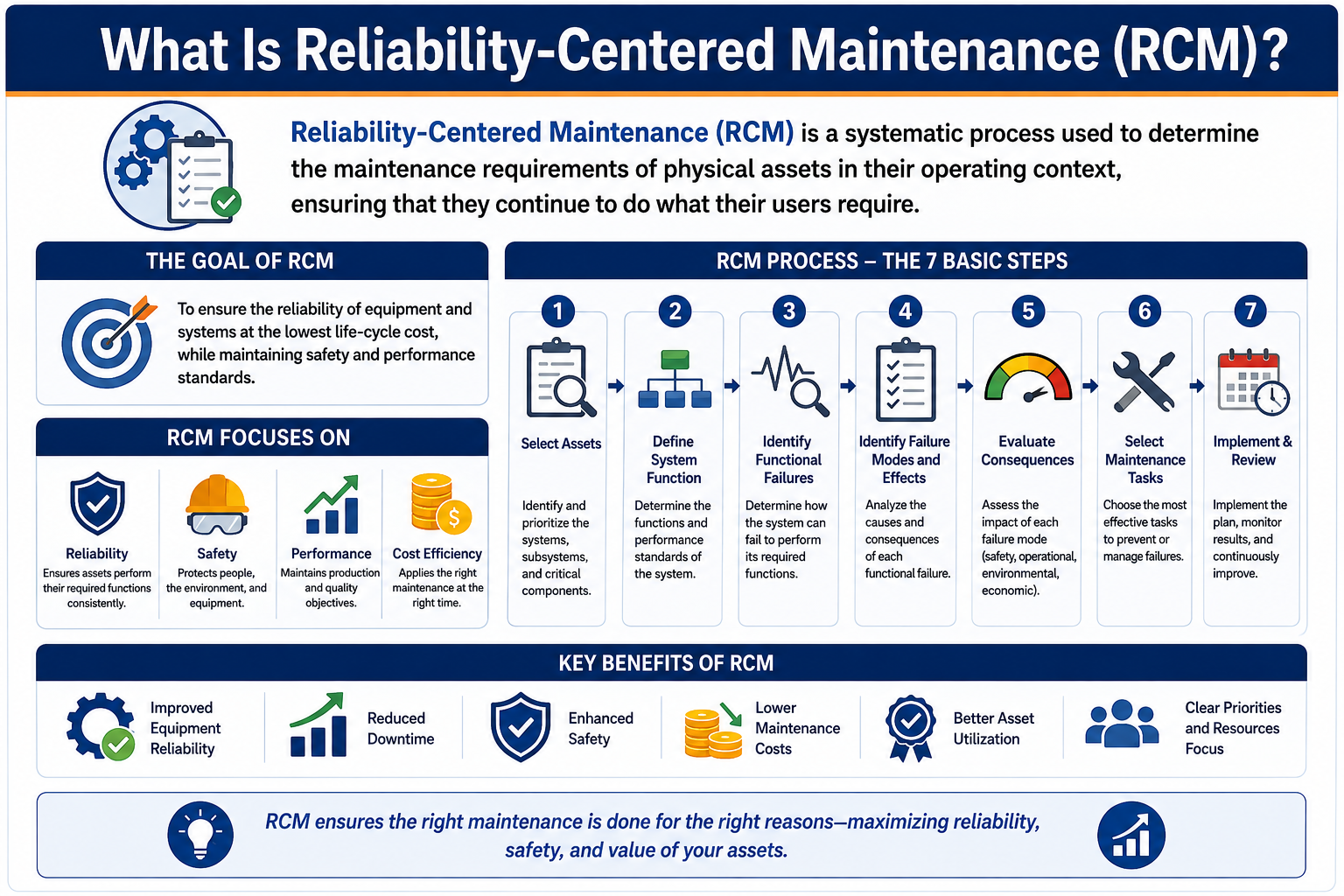
2. Optimize Preventive Maintenance
Preventive maintenance should be reviewed regularly.
Too little maintenance can increase failures.
Too much maintenance can increase labor costs, downtime, and the possibility of maintenance-induced failures.
A good PM program should focus on maintenance tasks that effectively manage specific failure modes.
Maintenance intervals should be based on:
- Equipment history
- Failure behavior
- Operating conditions
- Equipment criticality
- Manufacturer recommendations
- Condition-monitoring results
Optimized preventive maintenance can help maintain equipment reliability without creating unnecessary downtime.
3. Implement Predictive Maintenance
Predictive maintenance uses equipment condition information to identify developing problems before failure.
Common techniques include:
- Vibration analysis
- Infrared thermography
- Oil analysis
- Ultrasonic inspection
- Temperature monitoring
- Motor current analysis
- Pressure monitoring
For example, increasing vibration on a motor may indicate developing bearing deterioration.
If the problem is detected early, maintenance can be scheduled before catastrophic failure occurs.
This can reduce unplanned downtime and improve equipment availability.
4. Reduce Maintenance Response Time
Fast response is important when equipment does fail.
Maintenance departments can improve response time by establishing:
- Clear escalation procedures
- On-call arrangements
- Emergency response plans
- Accurate equipment documentation
- Accessible troubleshooting guides
- Properly trained technicians
The goal is to reduce the time between failure detection and the beginning of effective maintenance.
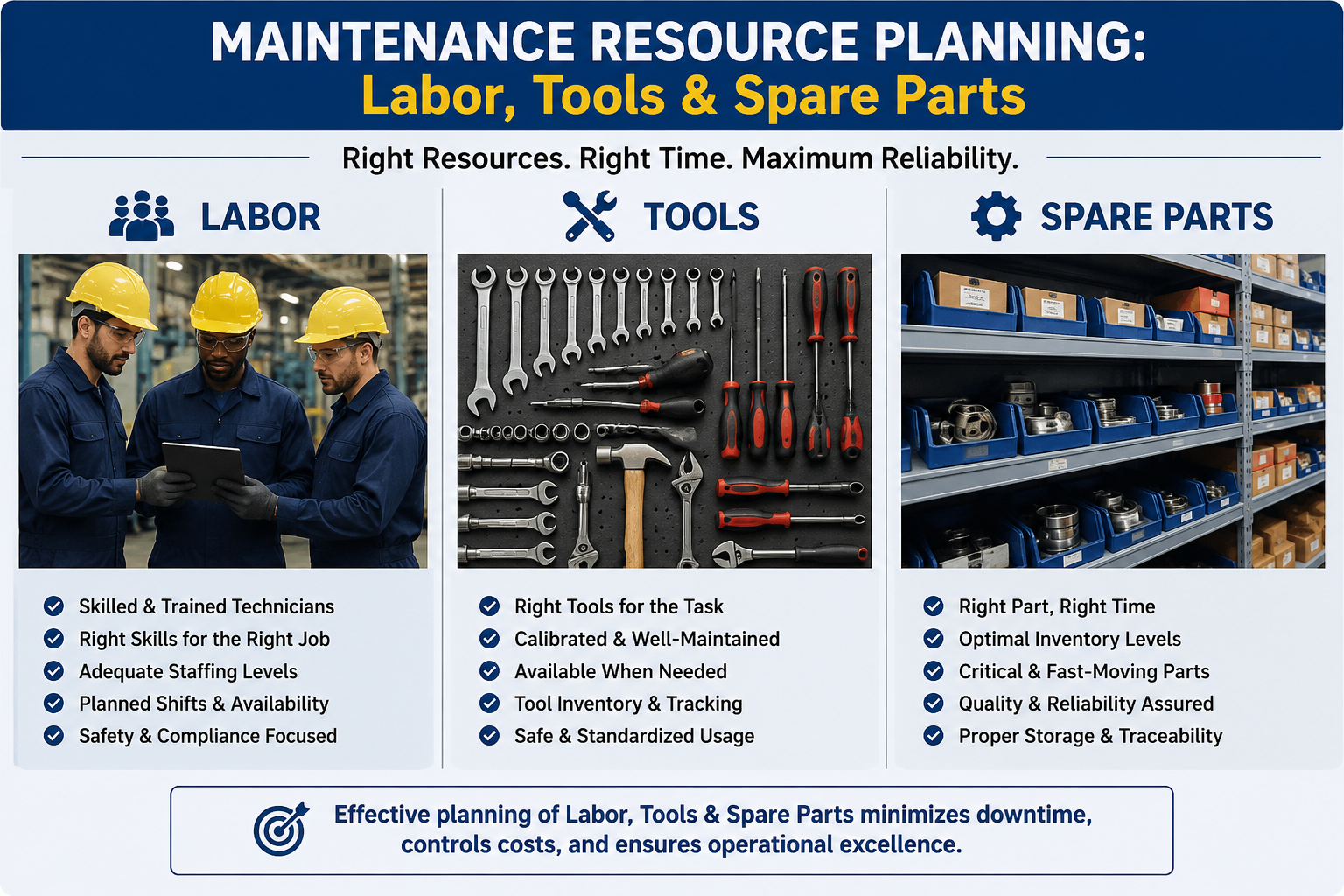
5. Improve Spare-Parts Management
Waiting for spare parts can significantly increase downtime.
Critical equipment should have appropriate spare-parts strategies.
Maintenance teams should identify:
- Critical spare parts
- Long-lead-time components
- Frequently replaced parts
- Insurance spares
- Vendor availability
- Alternative suppliers
However, stocking every component is not economical.
Spare-parts decisions should consider equipment criticality, failure probability, lead time, cost, and consequences of downtime.
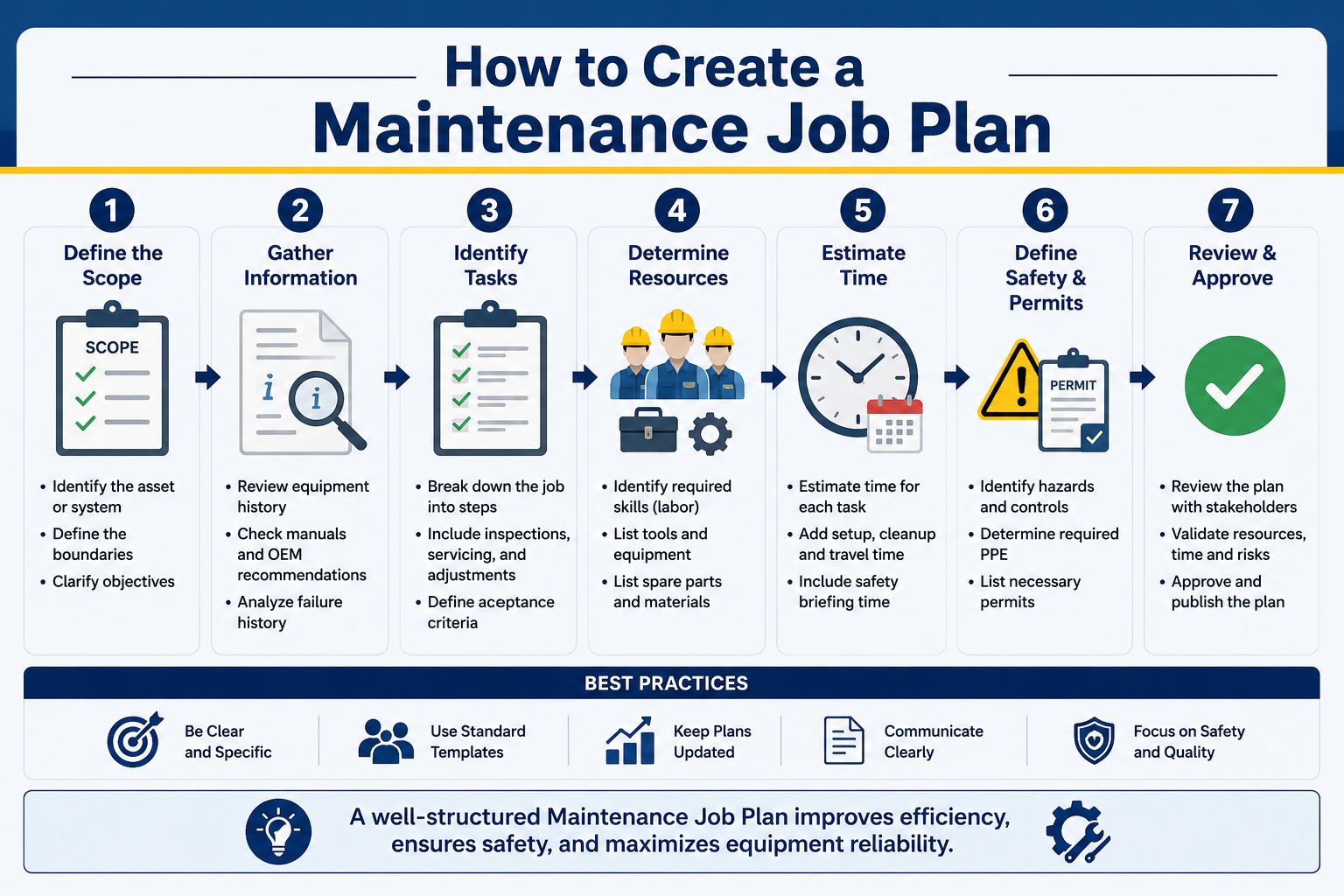
6. Improve Maintenance Planning and Scheduling
Good planning can significantly reduce maintenance duration.
Before starting a job, planners should ensure that:
- Required parts are available
- Tools are identified
- Procedures are available
- Labor requirements are known
- Safety requirements are defined
- Equipment isolation requirements are understood
- Special equipment is available
Planned maintenance is generally easier to execute efficiently than emergency maintenance.
7. Improve Maintainability
Equipment design has a major effect on availability.
Assets should be designed so that critical components can be inspected, removed, repaired, and replaced efficiently.
Maintainability improvements may include:
- Better access
- Modular components
- Standardized parts
- Quick-disconnect systems
- Improved diagnostic features
- Accessible lubrication points
- Better lifting arrangements
Maintainability should be considered during equipment selection and engineering design.
8. Reduce Maintenance-Induced Failures
Maintenance activities can sometimes introduce new problems.
Examples include:
- Incorrect installation
- Incorrect torque
- Poor alignment
- Contamination
- Incorrect lubrication
- Damaged seals
- Incorrect electrical connections
Precision maintenance practices can reduce these risks.
Technicians should use appropriate procedures, tools, measurements, and verification methods.
9. Improve Operator Practices
Operators have an important role in equipment availability.
Operators are often the first people to notice:
- Unusual noise
- Excessive vibration
- Temperature changes
- Leaks
- Pressure changes
- Abnormal equipment behavior
Operator rounds and basic condition checks can help identify developing problems early.
Operators should also be trained to operate equipment within its intended limits.
Poor operating practices can accelerate equipment deterioration.
10. Use CMMS Data
A Computerized Maintenance Management System (CMMS) can help maintenance teams analyze equipment availability.
Useful information includes:
- Failure history
- Downtime
- Repair duration
- PM history
- Spare-parts usage
- Labor hours
- Work-order history
- Failure codes
This data can help identify assets with consistently poor availability.
For example, if one pump repeatedly experiences long downtime because spare parts are unavailable, the problem may not be the pump itself—it may be the spare-parts strategy.
11. Conduct Root Cause Analysis
When equipment experiences repeated failures, maintenance teams should investigate the underlying causes.
Useful methods include:
- 5 Whys
- Fishbone diagrams
- Fault Tree Analysis
- Failure Mode and Effects Analysis
- Cause-and-effect analysis
Root Cause Analysis shifts the organization from:
“Repair the equipment again.”
to:
“Why does this equipment keep failing?”
Eliminating recurring failure mechanisms is one of the most effective ways to improve long-term availability.
12. Track Availability KPIs
Availability improvement requires measurement.
Important KPIs include:
Equipment Availability
Measures the percentage of required time equipment is ready for operation.
MTBF
Measures average operating time between failures.
MTTR
Measures average repair time.
Unplanned Downtime
Tracks unexpected equipment downtime.
Planned vs Unplanned Work
Shows whether maintenance is becoming more proactive.
Schedule Compliance
Measures whether planned maintenance activities are completed as scheduled.
Repeat Failure Rate
Identifies equipment that continues to experience the same problems.
Practical Example of Availability Improvement
Consider a production machine with:
MTBF = 1,000 hours
MTTR = 20 hours
Its approximate availability is:
1,000 ÷ (1,000 + 20) × 100 ≈ 98.04%
The maintenance team introduces two improvement initiatives.
First, Root Cause Analysis and precision maintenance increase MTBF to 2,000 hours.
Second, better planning and spare-parts availability reduce MTTR to 10 hours.
New availability becomes:
2,000 ÷ (2,000 + 10) × 100 ≈ 99.50%
The improvement demonstrates the combined effect of fewer failures and faster repairs.
Availability Improvement Requires a System Approach
It is important to understand that availability is not solely the responsibility of the maintenance department.
Production, operations, engineering, procurement, stores, safety, and management can all influence equipment availability.
For example:
Maintenance improves repair quality.
Operations improves equipment operation.
Engineering improves equipment design.
Procurement supports spare-parts availability.
Planning prepares maintenance work.
Stores ensures critical parts are available.
Management provides resources and establishes priorities.
Improving availability therefore requires cross-functional collaboration.
Common Mistakes When Improving Availability
Organizations should avoid focusing only on repair speed.
Other common mistakes include:
- Ignoring recurring failures
- Measuring availability without defining the calculation method
- Treating planned downtime and unplanned downtime identically
- Ignoring spare-parts delays
- Performing excessive preventive maintenance
- Failing to analyze failure causes
- Tracking KPIs without taking corrective action
- Focusing on individual equipment instead of system performance
Availability should always be analyzed in its operational context.