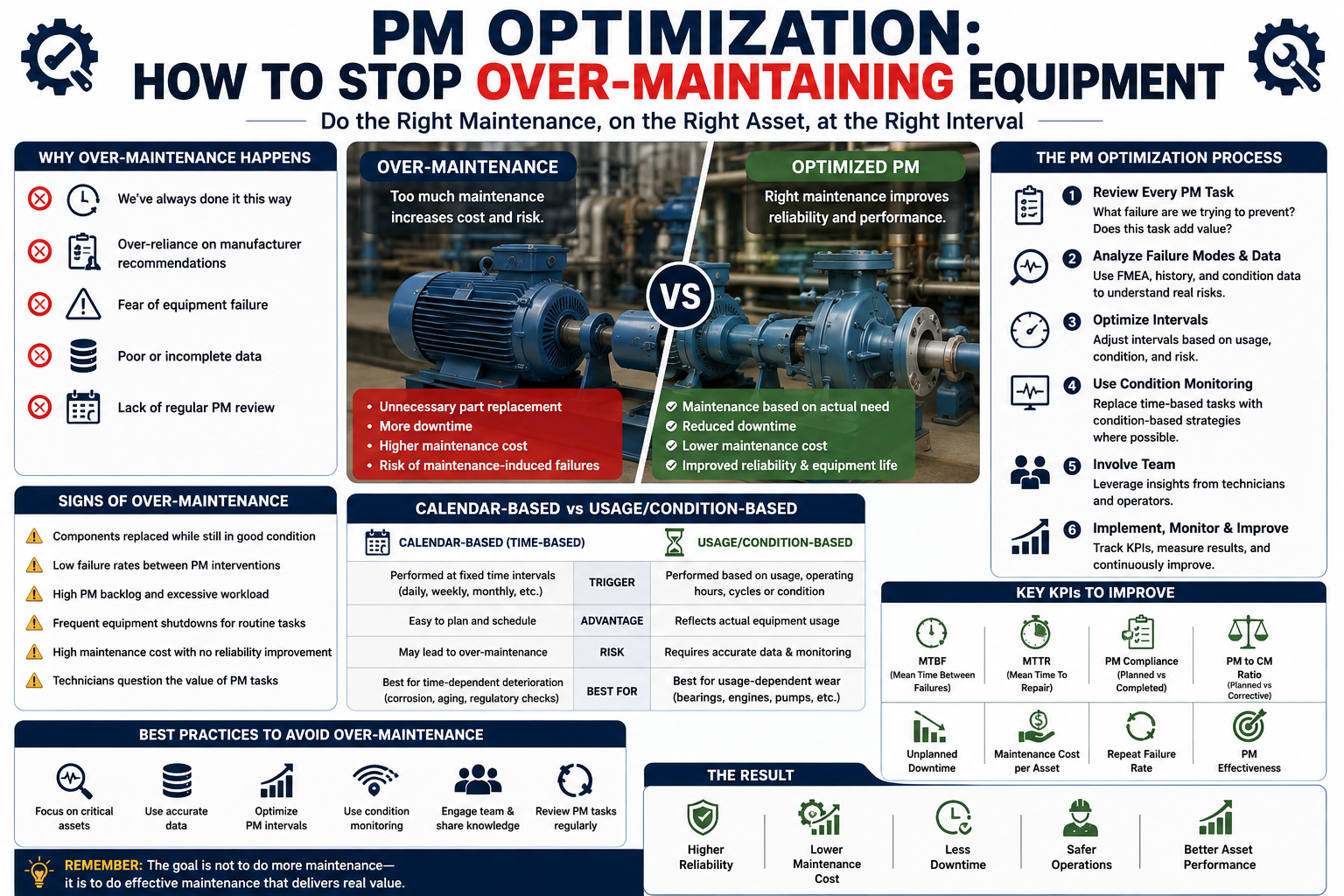
Preventive Maintenance (PM) is one of the most important components of an effective maintenance program. Regular inspections, lubrication, testing, adjustments, and component replacements can help reduce equipment failures and improve reliability.
However, preventive maintenance can also create a problem when it is not properly optimized.
Many maintenance departments perform too much maintenance simply because a task has always been included in the maintenance schedule. Components may be replaced while they are still in good condition, equipment may be opened unnecessarily, and technicians may spend valuable time completing low-value maintenance tasks.
This situation is known as over-maintenance.
Over-maintenance increases labor costs, spare-parts consumption, equipment downtime, and the risk of maintenance-induced failures. The solution is not to eliminate preventive maintenance but to optimize it based on reliability, risk, equipment condition, and actual operating experience.
This guide explains how maintenance engineers can optimize PM programs and stop over-maintaining equipment.
What Is Preventive Maintenance Optimization?
Preventive Maintenance optimization is the process of reviewing and improving maintenance tasks, intervals, procedures, and frequencies to ensure that maintenance is performed only when it provides meaningful reliability, safety, or operational value.
The objective is simple:
Do the right maintenance, on the right asset, at the right interval.
An effective PM program should reduce the probability or consequences of equipment failure without creating unnecessary maintenance work.
Optimization may involve:
- Removing unnecessary PM tasks
- Extending maintenance intervals
- Shortening intervals where evidence supports it
- Replacing time-based tasks with condition-based tasks
- Changing intrusive inspections to non-intrusive inspections
- Improving maintenance procedures
- Eliminating duplicate tasks
- Using equipment failure data
- Reviewing manufacturer recommendations
The goal is not to reduce the number of work orders simply for the sake of reducing work.
The goal is to improve maintenance effectiveness.
Why Over-Maintenance Happens
Over-maintenance can develop gradually.
A maintenance task may initially be created for a valid reason. Over time, however, operating conditions may change, equipment may be upgraded, or better maintenance technologies may become available.
Yet the original PM task remains in the system.
Several factors contribute to over-maintenance.
1. “We’ve Always Done It This Way”
Historical maintenance practices are often carried forward without questioning whether they are still necessary.
2. Excessive Dependence on Manufacturer Recommendations
Manufacturer recommendations are useful starting points, but they may be conservative and may not reflect actual operating conditions.
The maintenance department should compare recommendations with equipment history and operating experience.
3. Fear of Equipment Failure
Maintenance teams may believe that performing more maintenance automatically increases reliability.
In reality, excessive intervention can sometimes introduce new failure opportunities.
4. Poor Maintenance Data
Without accurate failure and maintenance history, engineers may have difficulty determining whether a PM task is actually effective.
5. Lack of PM Review
Preventive-maintenance programs should evolve over time. If tasks are never reviewed, ineffective activities can remain in place for years.
Signs That Your Equipment Is Being Over-Maintained
Several indicators can suggest that a PM program needs optimization.
Frequent Unnecessary Component Replacement
If components are consistently replaced in good condition, the replacement interval may be too short.
Low Failure Rates Between PM Interventions
If a component rarely fails but is replaced frequently, the organization may be spending money to prevent a failure that is unlikely to occur.
High Preventive-Maintenance Backlog
An excessive number of PM work orders can overwhelm the maintenance department.
Excessive Equipment Shutdowns
If equipment is frequently taken offline for maintenance without measurable reliability benefits, the maintenance strategy should be reviewed.
High Maintenance Costs Without Improved Reliability
If maintenance spending increases while equipment reliability remains unchanged, the PM program may contain low-value tasks.
Technicians Questioning PM Tasks
Experienced technicians often identify maintenance activities that provide little practical value. Their feedback should be considered during PM optimization.
Step 1: Build an Accurate Asset List
PM optimization begins with accurate asset information.
Every important asset should have:
- Equipment identification
- Location
- Equipment type
- Manufacturer
- Model
- Operating conditions
- Criticality
- Failure history
- Existing PM tasks
An accurate asset hierarchy makes it easier to evaluate which maintenance tasks belong to which equipment.
Step 2: Determine Equipment Criticality
Not every asset requires the same level of preventive maintenance.
Criticality analysis should consider:
- Safety consequences
- Production impact
- Environmental consequences
- Quality impact
- Repair cost
- Replacement cost
- Availability of standby equipment
- Failure frequency
A critical compressor may justify advanced condition monitoring, while a low-value auxiliary fan may be suitable for simple corrective maintenance.
Maintenance resources should be allocated according to risk and consequence.
Step 3: Review Every PM Task
One of the most effective PM optimization methods is to review each task individually.
Ask:
What failure are we trying to prevent?
Then ask:
Does this task actually reduce the probability or consequence of that failure?
If there is no clear connection between the task and a failure mode, the task should be questioned.
For example:
PM Task: Replace bearing every six months.
Ask:
- Why six months?
- What failure mechanism is being addressed?
- How often do bearings actually fail?
- Are bearings showing deterioration before failure?
- Can condition monitoring identify deterioration?
- What does historical data show?
This approach prevents maintenance tasks from becoming routine activities without a clear reliability purpose.
Step 4: Analyze Failure Modes
PM optimization should be based on understanding how equipment fails.
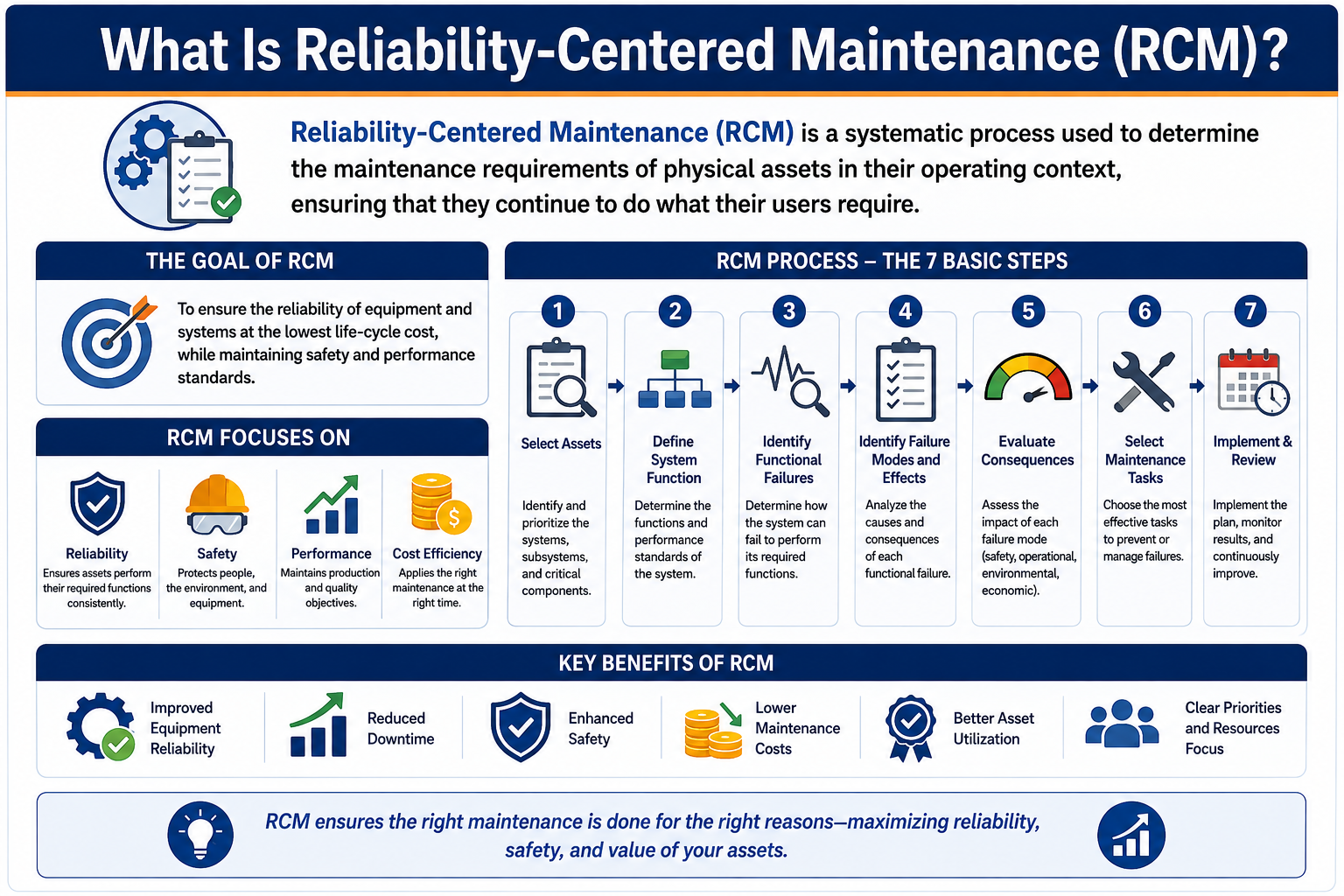
Tools such as Failure Mode and Effects Analysis (FMEA) and Reliability-Centered Maintenance (RCM) can help identify:
- Failure modes
- Failure causes
- Failure effects
- Failure consequences
- Existing controls
- Appropriate maintenance tasks
A maintenance task should have a clear relationship with a specific failure mode or equipment requirement.
Step 5: Use Actual Equipment Data
Historical data is one of the most valuable resources for PM optimization.
Review:
- Failure dates
- Component replacement dates
- Operating hours
- Maintenance intervals
- Failure causes
- Inspection results
- Repair costs
- Repeat failures
Suppose a component is replaced every 12 months but historical data shows that most components operate reliably for 24 to 30 months.
This may indicate an opportunity to review and potentially extend the PM interval.
However, interval changes should be based on engineering analysis and risk—not simply on cost reduction.
Step 6: Consider Condition-Based Maintenance
Some scheduled maintenance tasks can be replaced with condition-based maintenance.
Instead of replacing a component at a fixed interval, maintenance teams can monitor its condition.
Common techniques include:
- Vibration analysis
- Oil analysis
- Infrared thermography
- Ultrasonic inspection
- Temperature monitoring
- Pressure monitoring
- Electrical testing
For example, instead of automatically replacing a bearing every year, vibration monitoring may be used to identify developing bearing deterioration.
This can allow the component to remain in service while it is still performing effectively.
Step 7: Optimize Maintenance Intervals
Maintenance intervals should be based on evidence.
Possible changes include:
Daily → Weekly
Monthly → Quarterly
Every 500 hours → Every 1,000 hours
However, interval changes should consider equipment criticality, failure behavior, operating environment, safety requirements, and historical data.
The objective is to find the interval where the risk of failure and maintenance cost are appropriately balanced.
Step 8: Eliminate Duplicate PM Tasks
Another common source of over-maintenance is duplication.
For example, one work order may require an operator to inspect a pump weekly, while another maintenance work order requires a technician to perform the same inspection monthly.
If the tasks overlap without adding value, the PM program can be simplified.
A PM audit should identify:
- Duplicate inspections
- Duplicate lubrication tasks
- Repeated measurements
- Overlapping checklists
- Unnecessary documentation
Simplifying the PM program can free technicians to focus on higher-value work.
Step 9: Reduce Intrusive Maintenance
Opening equipment creates opportunities for contamination, incorrect assembly, damaged seals, incorrect torque, and other problems.
Where possible, consider replacing intrusive maintenance with non-intrusive inspection or condition monitoring.
For example, rather than dismantling a gearbox regularly, vibration and oil analysis may provide information about its condition without unnecessary disassembly.
This principle can reduce both labor and maintenance-induced failures.
Step 10: Involve Maintenance Technicians and Operators
PM optimization should not be performed only from an office.
Technicians and operators have practical knowledge of equipment behavior.
They can identify:
- Tasks that provide little value
- Tasks that are difficult to perform
- Repeated equipment problems
- Poorly designed inspection points
- Incorrect maintenance frequencies
- Opportunities to improve procedures
Their feedback should be included in PM reviews.
Use CMMS Data for PM Optimization
A Computerized Maintenance Management System (CMMS) can provide valuable information for optimizing preventive maintenance.
A CMMS can help track:
- PM compliance
- Equipment failure history
- Maintenance costs
- Work-order duration
- Spare-parts usage
- Equipment downtime
- Repeat failures
- PM backlog
Engineers can use this information to identify maintenance tasks that consume significant resources without producing measurable reliability improvements.
Important KPIs for PM Optimization
The success of PM optimization should be measured using appropriate KPIs.
Useful indicators include:
Preventive-Maintenance Compliance
Measures whether scheduled PM tasks are completed on time.
PM-to-Corrective Maintenance Ratio
Shows the balance between planned maintenance and corrective work.
Unplanned Downtime
A reduction can indicate improved maintenance effectiveness.
MTBF
An increase in Mean Time Between Failures can indicate improved reliability.
Maintenance Cost per Asset
Helps determine whether maintenance resources are being used efficiently.
Repeat Failure Rate
Shows whether equipment continues to experience the same problems.
PM Effectiveness
Organizations should evaluate whether individual PM tasks actually prevent failures or identify meaningful deterioration.
Avoid the Mistake of Cutting PM Blindly
PM optimization does not mean simply deleting maintenance tasks.
Reducing maintenance without understanding failure risks can create serious problems.
For example, eliminating inspections on critical equipment may reduce short-term maintenance costs but increase the probability of unexpected failure.
The correct approach is:
Analyze → Optimize → Implement → Monitor → Improve
Every significant change should be evaluated against equipment reliability and risk.
Example of PM Optimization
Consider an industrial pump with a preventive task requiring bearing replacement every 12 months.
After reviewing five years of maintenance history, the reliability team discovers:
- Bearings rarely fail before 24 months.
- Most failures are associated with contamination.
- Vibration monitoring can identify bearing deterioration.
- Annual bearing replacement creates several hours of downtime.
- Some replacements have resulted in installation-related problems.
The maintenance strategy could be changed from:
Replace bearing every 12 months
to:
Monitor bearing condition using vibration analysis and inspect lubrication condition periodically. Replace the bearing when condition data indicates deterioration or when inspection identifies a defined failure condition.
This change can reduce unnecessary component replacement while maintaining reliability control.
Benefits of PM Optimization
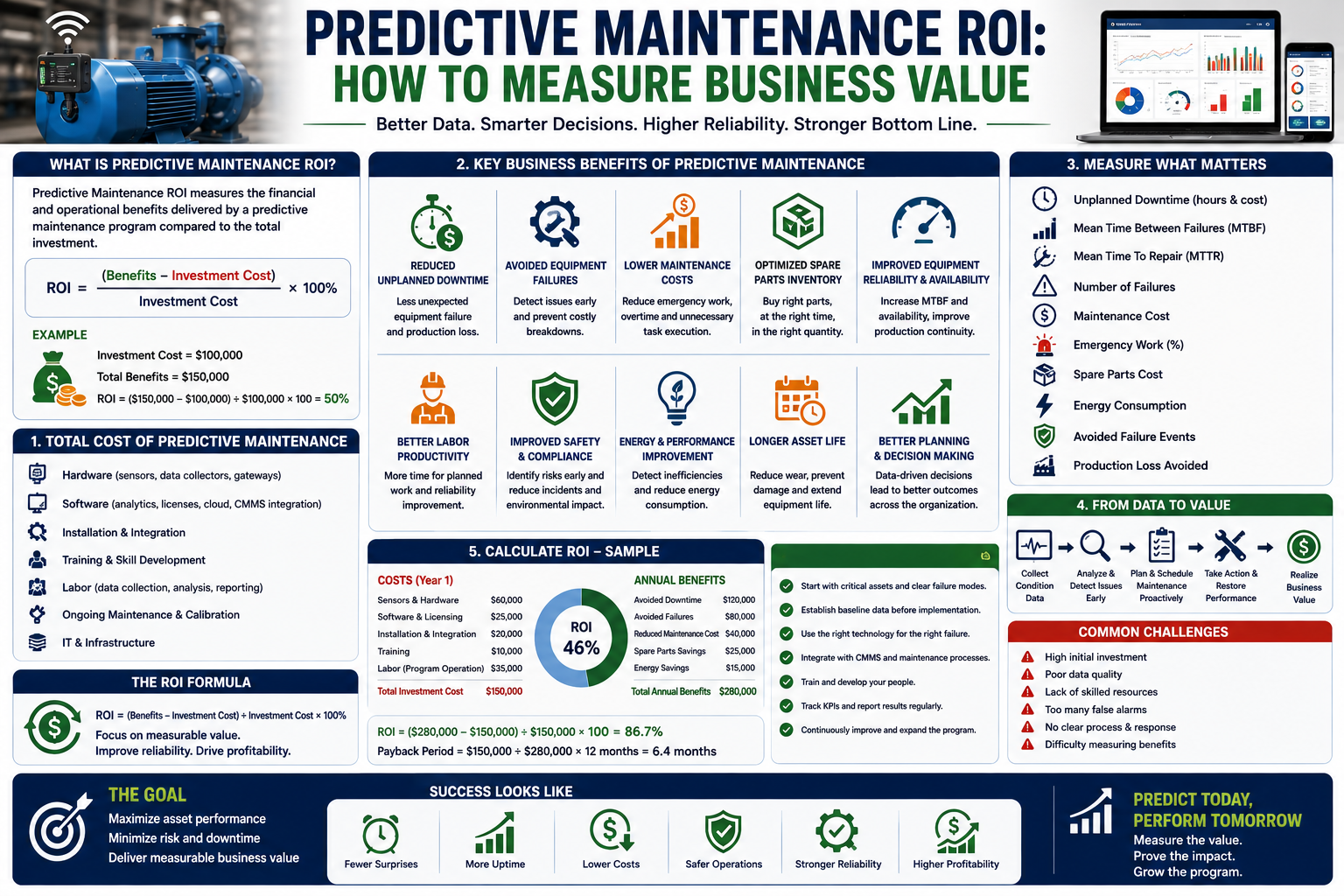
A properly optimized PM program can provide significant benefits:
- Reduced maintenance costs
- Less unnecessary equipment downtime
- Lower spare-parts consumption
- Reduced maintenance workload
- Fewer maintenance-induced failures
- Better technician productivity
- Improved equipment availability
- Improved reliability
- More effective use of condition monitoring
- Better maintenance planning
Most importantly, PM optimization allows maintenance teams to focus their resources on work that genuinely protects equipment performance.