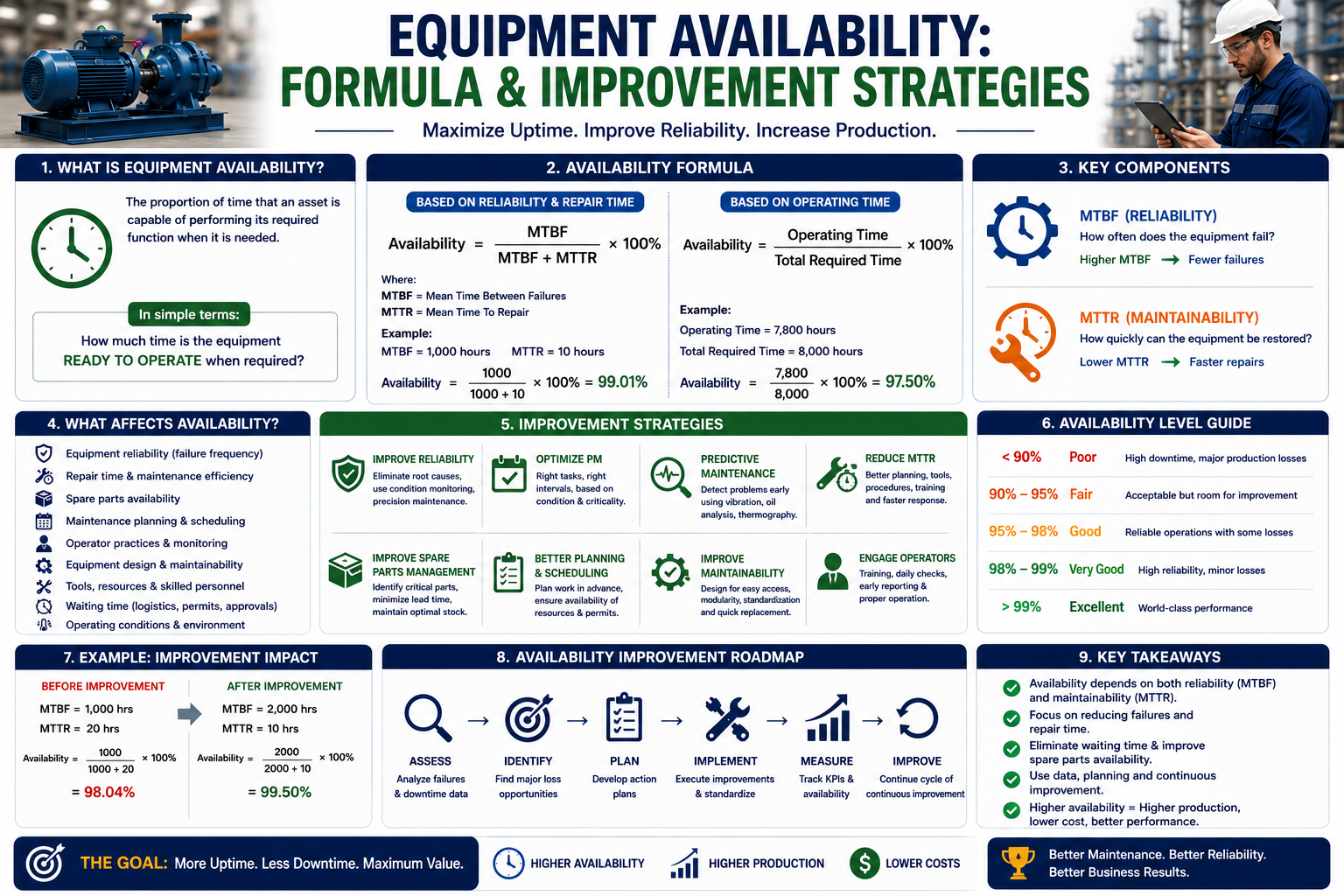
Equipment reliability is a critical factor in industrial operations. Manufacturing plants, oil and gas facilities, power plants, mining operations, processing industries, and other industrial organizations depend on reliable equipment to maintain production, quality, safety, and profitability.
When equipment reliability is poor, organizations experience frequent breakdowns, emergency maintenance, production losses, increased spare-parts consumption, and higher maintenance costs.
Equipment rarely becomes unreliable because of one single reason. In many cases, failures result from a combination of design problems, poor installation, incorrect operation, inadequate maintenance, environmental conditions, and human factors.
Understanding the common causes of equipment reliability problems is therefore essential for maintenance and reliability engineers who want to move from reactive maintenance toward proactive asset management.
What Is Equipment Reliability?
Equipment reliability is the ability of an asset to perform its required function for a specified period under specified operating conditions without failure.
In simple terms:
Reliable equipment works as expected for as long as it is required to operate.
Reliability can be affected by factors such as:
- Equipment design
- Installation quality
- Operating conditions
- Maintenance practices
- Lubrication
- Alignment
- Component quality
- Environmental conditions
- Human factors
- Maintenance strategy
When these factors are poorly controlled, equipment failure becomes more likely.
1. Poor Equipment Design
The first reliability problem can occur before equipment even reaches the plant.
Poor equipment design may result in:
- Excessive mechanical stress
- Insufficient cooling
- Poor component access
- Inadequate lubrication arrangements
- Undersized components
- Excessive vibration
- Difficult maintenance
- Poor material selection
An equipment design may technically perform its intended function but still be difficult to maintain or unreliable under actual operating conditions.
For critical assets, reliability and maintainability should therefore be considered during the engineering and procurement stages.
A cheaper piece of equipment may have a much higher lifecycle cost if it experiences frequent failures.
2. Incorrect Installation
Even high-quality equipment can become unreliable when it is installed incorrectly.
Common installation problems include:
- Shaft misalignment
- Incorrect torque
- Improper foundation
- Incorrect pipe installation
- Poor electrical connections
- Contamination
- Incorrect bearing installation
- Improper coupling installation
For rotating machinery, precision installation is particularly important.
For example, poor shaft alignment can create excessive forces that affect bearings, couplings, seals, and other components.
The equipment may operate initially, but the underlying installation problem can gradually accelerate deterioration.
3. Poor Lubrication
Lubrication is one of the most important factors affecting mechanical equipment reliability.
Insufficient lubrication can increase:
- Friction
- Heat
- Wear
- Surface damage
- Bearing failure
However, over-lubrication can also cause problems.
Excessive grease can increase bearing temperature and create other mechanical issues.
Reliability problems can therefore result from:
- Incorrect lubricant
- Incorrect quantity
- Incorrect lubrication frequency
- Contaminated lubricant
- Mixing incompatible lubricants
- Poor storage and handling
- Inadequate lubrication procedures
A strong lubrication-management program should specify the correct lubricant, quantity, application method, and interval for each critical component.
4. Misalignment
Misalignment is a common cause of rotating-equipment problems.
Shafts may become misaligned because of:
- Incorrect installation
- Foundation movement
- Thermal growth
- Pipe strain
- Loose components
- Equipment movement
Misalignment can increase vibration and loading on bearings, couplings, seals, and shafts.
Laser alignment and other precision-maintenance techniques can help maintenance teams achieve more accurate equipment alignment.
Correct alignment should also be verified after installation and whenever significant equipment modifications are made.
5. Mechanical Imbalance
Rotating components can develop imbalance because of:
- Uneven material distribution
- Wear
- Deposits
- Corrosion
- Damaged components
- Incorrect repairs
Imbalance creates centrifugal forces that can increase vibration and mechanical stress.
Fans, pumps, motors, turbines, compressors, and other rotating machines can be affected.
Vibration analysis can help identify abnormal vibration patterns associated with imbalance.
6. Operating Equipment Outside Its Design Limits
Equipment is designed to operate within certain conditions.
Reliability problems can occur when equipment is consistently subjected to:
- Excessive loads
- High temperatures
- Excessive pressure
- Incorrect speed
- Poor-quality feed
- Frequent starts and stops
- Cavitation
- Overloading
For example, operating a pump far outside its intended operating range can increase vibration, hydraulic stress, and component wear.
Maintenance engineers should work closely with operations teams to ensure equipment is operated within appropriate limits.
7. Poor Preventive Maintenance
Preventive maintenance can help control specific failure modes, but poorly designed PM programs can create reliability problems.
A PM program may be ineffective when:
- Tasks do not address actual failure modes
- Maintenance intervals are inappropriate
- Inspections are poorly performed
- Procedures are outdated
- Critical tasks are frequently deferred
- Maintenance is based entirely on generic schedules
Preventive maintenance should be periodically reviewed using equipment history, failure data, condition-monitoring results, and reliability analysis.
The objective should not be to perform more maintenance.
The objective should be to perform the right maintenance at the right time.
8. Over-Maintenance
More maintenance does not automatically mean greater reliability.
Excessive maintenance can introduce new problems through:
- Incorrect reassembly
- Contamination
- Improper installation
- Incorrect lubrication
- Damaged components
- Human error
For example, repeatedly opening a healthy piece of equipment for unnecessary inspection can create opportunities for maintenance-induced failures.
PM optimization should therefore focus on tasks that provide genuine reliability value.
9. Poor Condition Monitoring
Condition monitoring can provide early warning of developing equipment problems.
However, reliability can suffer when condition monitoring is:
- Not performed on critical assets
- Performed at inappropriate intervals
- Using unsuitable technology
- Based on poor-quality measurements
- Not properly analyzed
- Not connected to maintenance decisions
A vibration sensor, for example, is useful only when the data is collected correctly and someone has the capability to interpret the results.
Condition monitoring should always be linked to a defined response strategy.
10. Contamination
Contamination is a major cause of equipment deterioration.
Common contaminants include:
- Dust
- Dirt
- Water
- Chemicals
- Metal particles
- Process materials
Contamination can damage bearings, hydraulic systems, gears, seals, lubricants, and other components.
Proper sealing, filtration, housekeeping, lubricant handling, and contamination-control procedures can significantly improve equipment reliability.
11. Poor Spare-Parts Quality
Using incorrect or low-quality replacement parts can create recurring reliability problems.
Problems may result from:
- Incorrect specifications
- Counterfeit components
- Poor storage
- Improper handling
- Incorrect material selection
- Using incompatible parts
Critical components should be purchased according to appropriate engineering specifications.
Spare parts should also be stored correctly to prevent deterioration before installation.
12. Human Error
People play an important role in equipment reliability.
Human errors can occur during:
- Operation
- Installation
- Maintenance
- Inspection
- Lubrication
- Troubleshooting
- Equipment startup
Examples include using the wrong lubricant, failing to tighten a component correctly, ignoring an abnormal condition, or incorrectly interpreting a measurement.
The solution should not simply be to blame individuals.
Organizations should examine whether procedures, training, equipment design, communication, and working conditions contributed to the error.
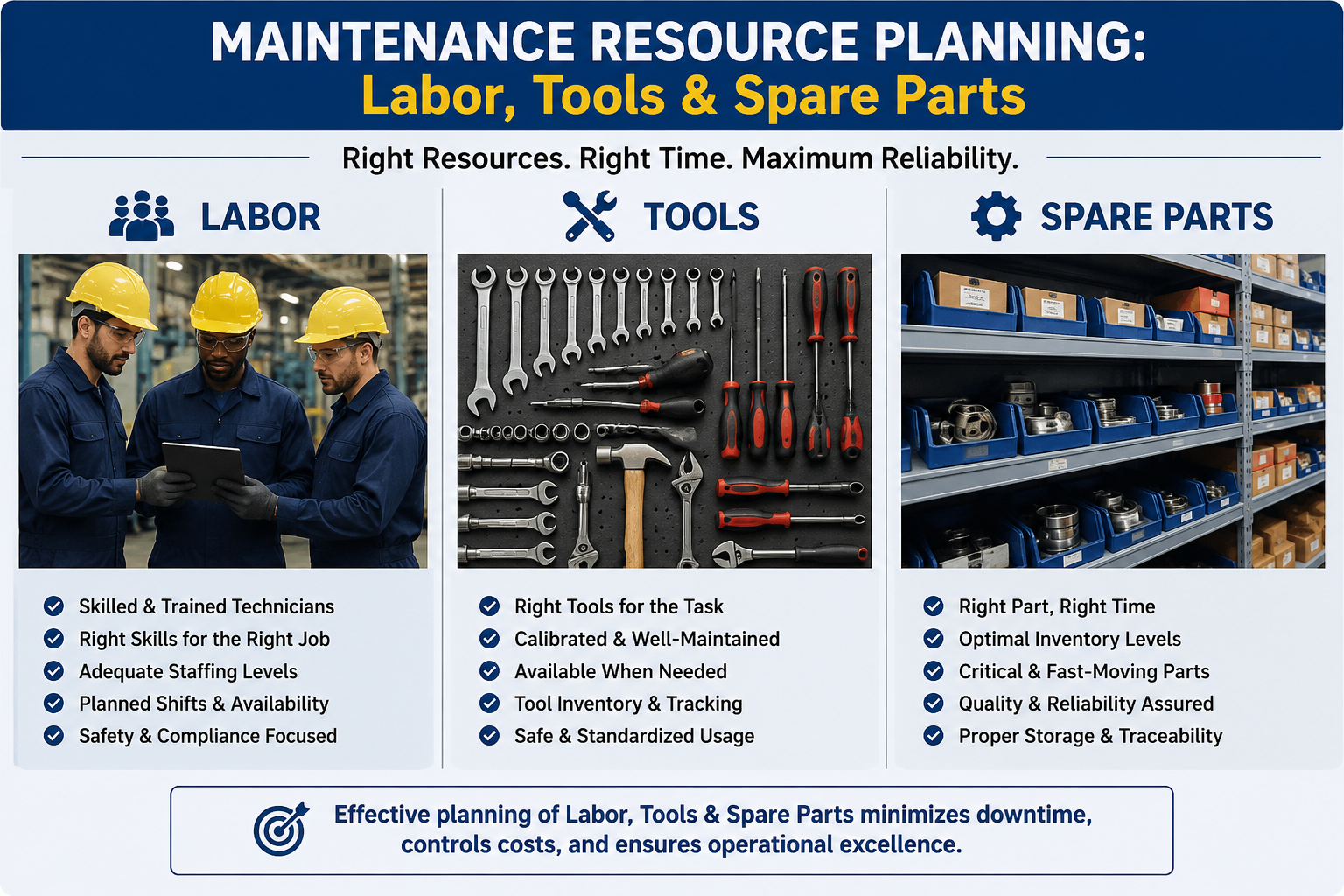
13. Poor Maintenance Planning
Emergency maintenance often takes longer and costs more than well-planned work.
Poor planning can result in:
- Missing spare parts
- Incorrect tools
- Unavailable technicians
- Incomplete procedures
- Extended downtime
- Safety delays
Effective maintenance planning ensures that required resources are prepared before work begins.
Better planning can reduce Mean Time To Repair (MTTR) and improve equipment availability.
You may also like: Positive Displacement Pump: How It Works & Its Types
14. Inadequate Failure Analysis
Organizations that repeatedly repair equipment without investigating the underlying cause may develop a cycle of recurring failures.
For example:
Bearing fails → Bearing replaced → Machine runs → Bearing fails again
A reliability-focused organization asks:
Why did the bearing fail?
Possible causes could include:
- Misalignment
- Lubrication problems
- Contamination
- Excessive loading
- Installation errors
- Shaft damage
Root Cause Analysis can help identify and eliminate these underlying causes.
15. Poor Maintenance Data
Good reliability decisions require good data.
If maintenance records do not accurately capture:
- Failure modes
- Failure causes
- Repair time
- Downtime
- Component information
- Maintenance actions
then engineers may struggle to identify meaningful trends.
A CMMS can help organize equipment history, but the quality of the output depends heavily on the quality of the information entered.
16. Environmental Conditions
Equipment may become unreliable when environmental conditions exceed its intended operating range.
Examples include:
- High humidity
- Extreme temperatures
- Dust
- Corrosive atmospheres
- Water exposure
- Chemical contamination
- Excessive vibration
Environmental protection may require improved enclosures, ventilation, filtration, cooling, sealing, or corrosion protection.
How to Improve Equipment Reliability
Organizations can address reliability problems through a structured strategy.
Important actions include:
Perform Asset Criticality Analysis
Identify equipment where failure has the greatest safety, production, environmental, or financial consequences.
Analyze Failure Modes
Understand how critical equipment can fail and what causes those failures.
Use Root Cause Analysis
Investigate significant and recurring failures rather than repeatedly repairing symptoms.
Improve Precision Maintenance
Focus on alignment, balancing, lubrication, installation, and measurement quality.
Implement Condition Monitoring
Use appropriate technologies to identify deterioration before functional failure.
Optimize Preventive Maintenance
Ensure maintenance tasks are technically justified and performed at suitable intervals.
Improve Maintenance Planning
Prepare parts, tools, labor, procedures, and safety requirements before work begins.
Strengthen Operator Training
Help operators identify abnormal conditions and operate equipment correctly.
Improve Data Quality
Use accurate failure codes, work-order information, equipment history, and downtime records.
Reliability Problems Should Be Treated as System Problems
One of the most important principles of modern reliability engineering is that equipment failure is not always caused by the equipment itself.
A recurring failure may originate from:
Design → Procurement → Installation → Operation → Maintenance → Environment
Therefore, reliability improvement requires a cross-functional approach.
Maintenance engineers should work with operations, engineering, procurement, stores, safety, and management to identify the factors influencing equipment performance