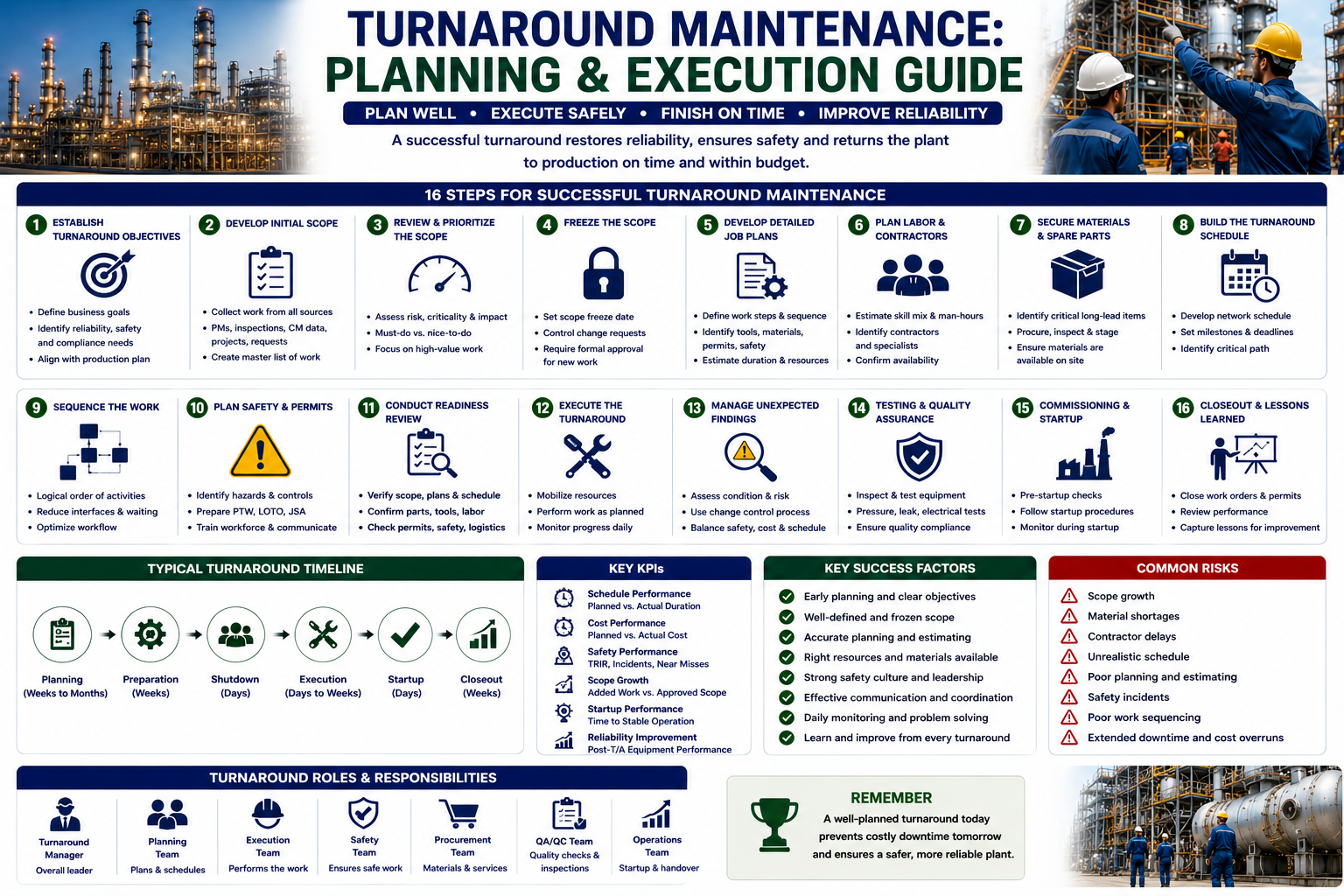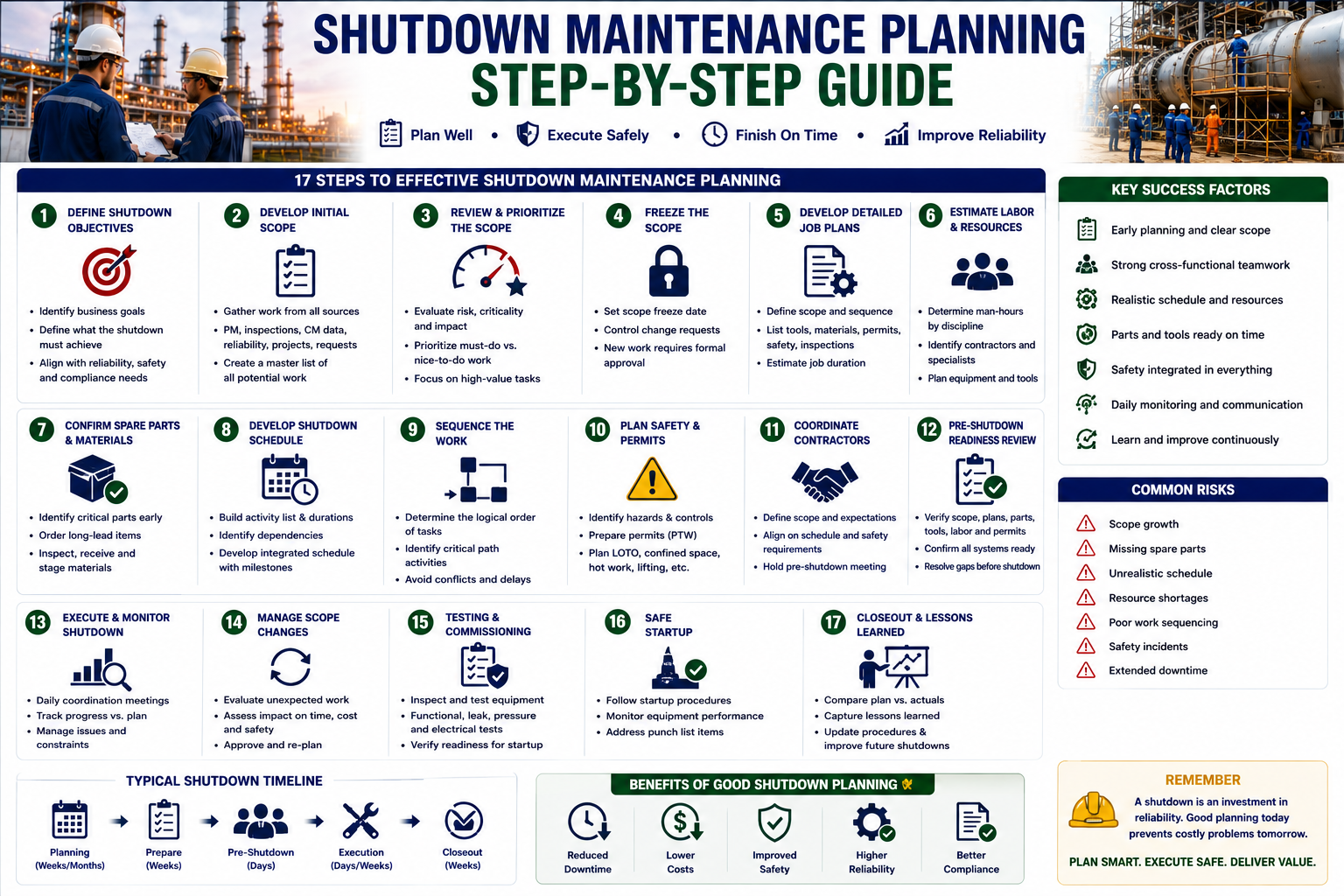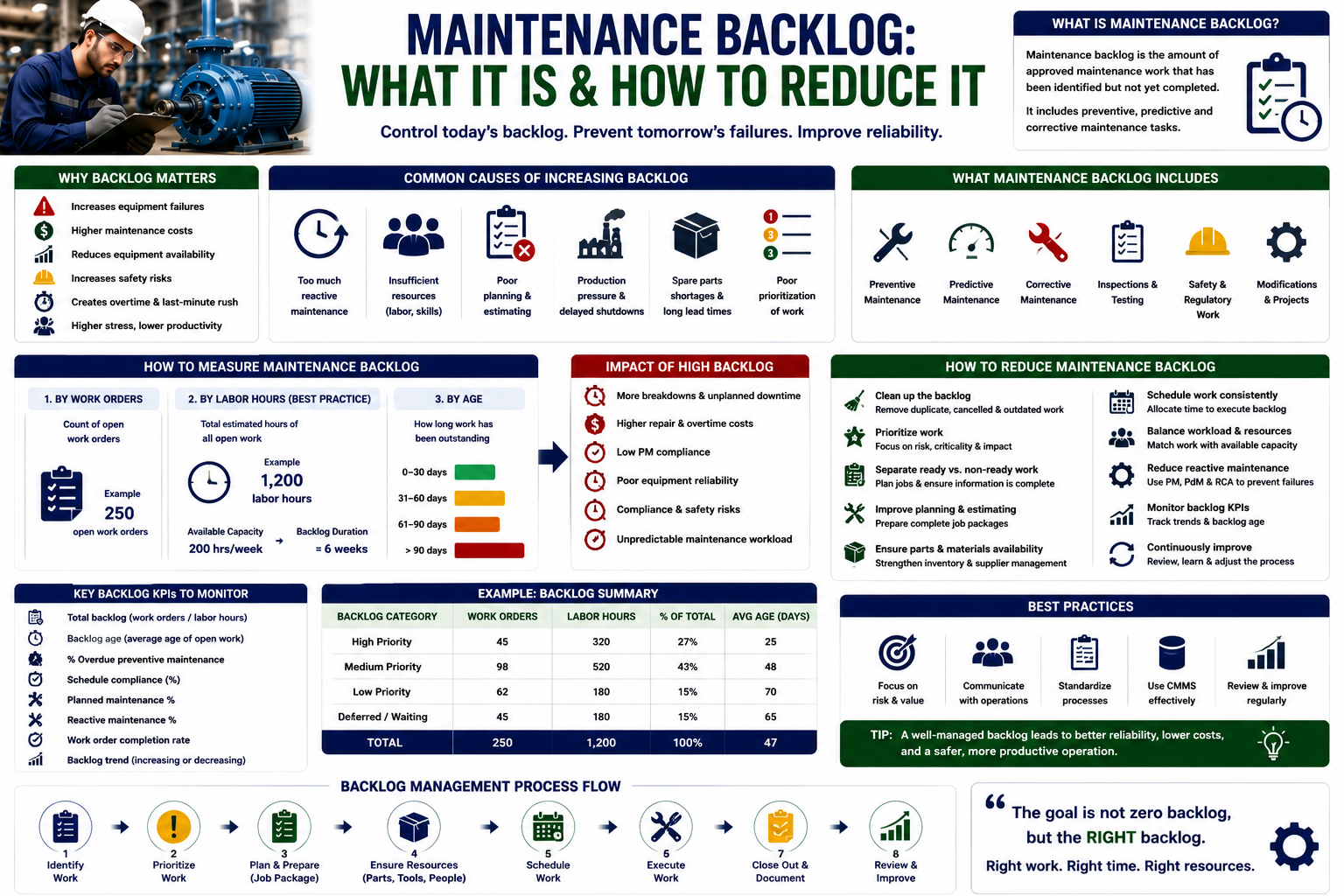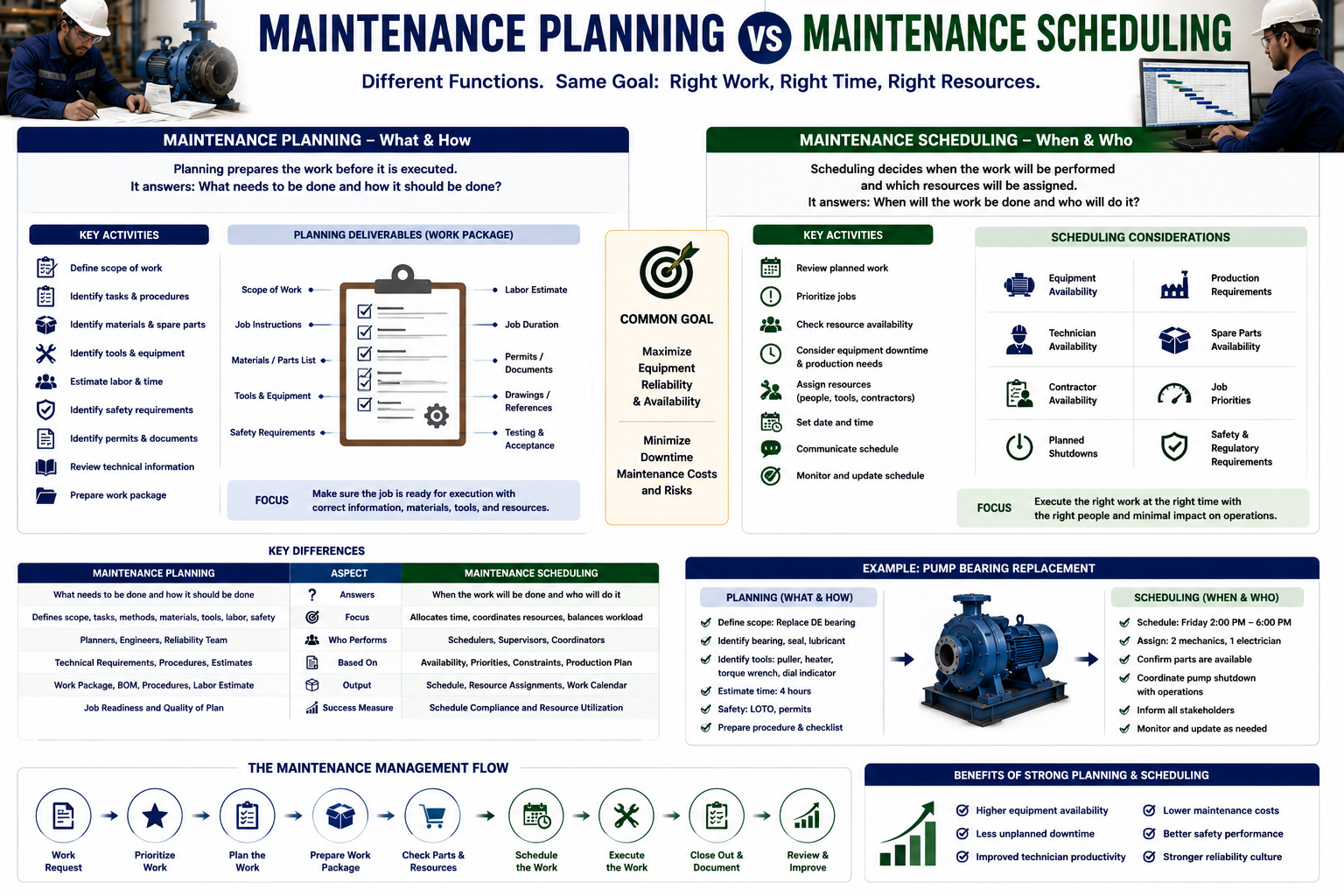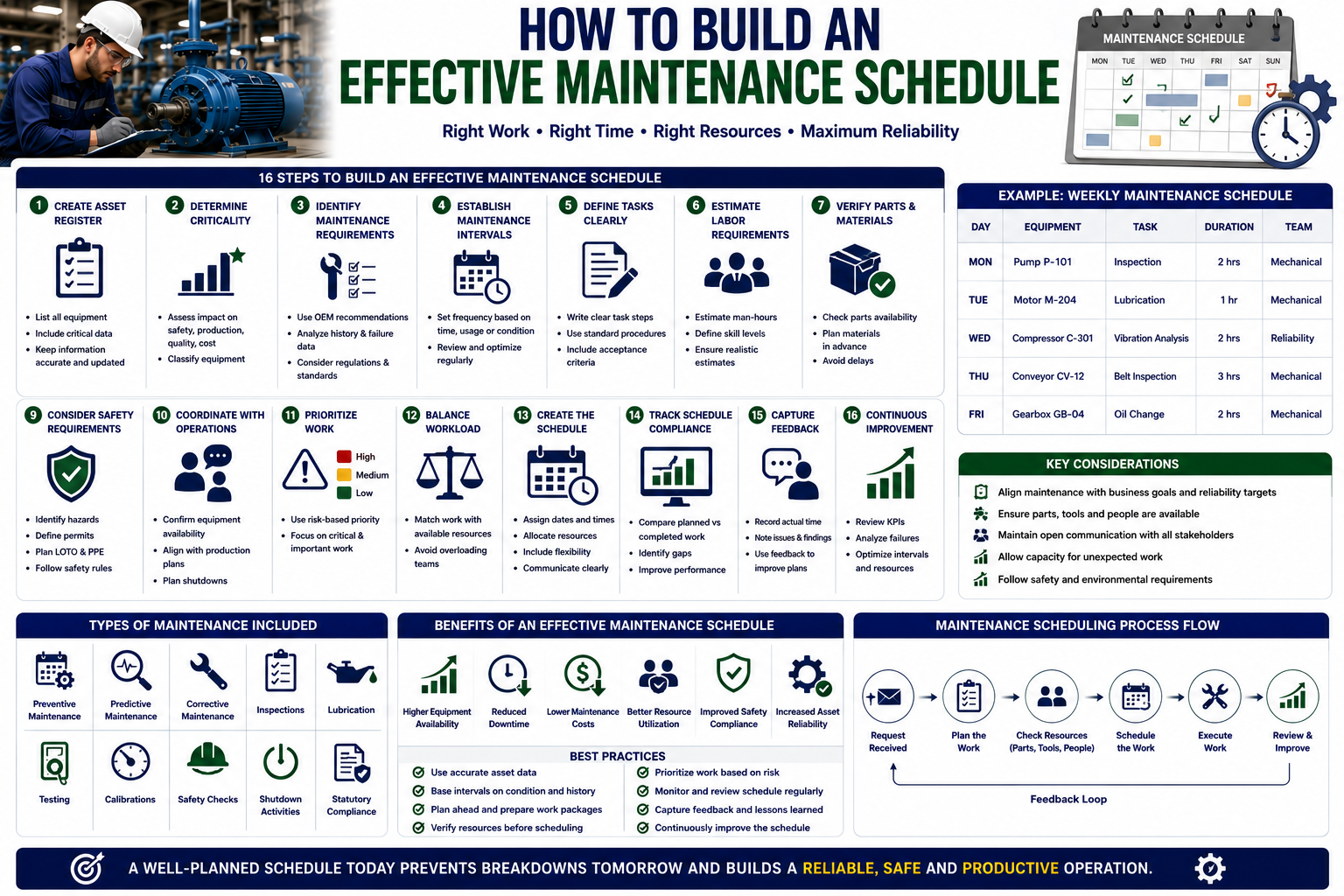
An effective maintenance schedule is one of the foundations of reliable asset management. Industrial equipment requires regular inspections, servicing, lubrication, calibration, testing, and repairs to remain safe and productive.
However, having a maintenance program does not automatically mean that maintenance work is being managed effectively.
Without a structured schedule, maintenance teams may spend too much time responding to emergencies, technicians may be overloaded, critical tasks may be delayed, and preventive maintenance can become inconsistent.
A well-designed maintenance schedule helps organizations ensure that the right maintenance work is performed at the right time by the right people with the right resources.
This guide explains how to build an effective maintenance schedule and how to improve it over time.
What Is a Maintenance Schedule?
A maintenance schedule is a structured plan that identifies which maintenance activities need to be performed, when they should be performed, who will perform them, and what resources are required.
A maintenance schedule can include:
- Preventive maintenance
- Predictive maintenance
- Inspections
- Lubrication
- Calibration
- Safety checks
- Corrective maintenance
- Statutory inspections
- Shutdown activities
- Equipment testing
Schedules can be developed daily, weekly, monthly, quarterly, or annually depending on the type of equipment and maintenance requirements.
The purpose is not simply to create a list of tasks.
The goal is to coordinate maintenance activities with equipment requirements, production plans, available resources, and business priorities.
Why an Effective Maintenance Schedule Matters
Poor scheduling can create several problems.
Technicians may arrive at equipment that is still operating.
Critical spare parts may not be available.
Too many jobs may be assigned to the same maintenance team.
Important preventive-maintenance tasks may be postponed because emergency work consumes available labor.
An effective schedule helps reduce these problems by providing structure and visibility.
Benefits can include:
- Reduced unplanned downtime
- Improved equipment availability
- Better technician productivity
- Lower maintenance costs
- Improved preventive-maintenance compliance
- Better resource utilization
- Improved coordination with operations
- Better safety performance
Step 1: Create an Accurate Asset Register
Before creating a maintenance schedule, an organization needs to know what equipment it owns and operates.
An asset register should contain information such as:
- Equipment identification number
- Equipment description
- Location
- Manufacturer
- Model
- Criticality
- Operating function
- Maintenance requirements
- Recommended service intervals
Assets should be organized logically so maintenance teams can easily identify the equipment associated with each maintenance task.
Without an accurate asset register, it is difficult to create a reliable maintenance schedule.
Step 2: Determine Equipment Criticality
Not every asset deserves the same maintenance priority.
A critical production compressor may have a much greater impact on the business than a non-critical workshop fan.
Asset criticality can consider:
- Safety consequences
- Environmental consequences
- Production impact
- Quality impact
- Repair cost
- Replacement time
- Availability of spare equipment
High-criticality equipment may require more frequent inspections and condition monitoring.
Criticality analysis helps maintenance teams focus limited resources where they can produce the greatest benefit.
Step 3: Identify Maintenance Requirements
The next step is to determine what maintenance each asset requires.
Information may come from:
- Manufacturer recommendations
- Engineering standards
- Equipment history
- Failure analysis
- Reliability studies
- Regulatory requirements
- Condition-monitoring results
- Maintenance experience
Typical tasks include:
Inspection: Check equipment condition.
Lubrication: Apply or replace lubricant.
Cleaning: Remove contamination or deposits.
Adjustment: Restore equipment settings.
Replacement: Replace components approaching the end of their useful life.
Testing: Verify equipment performance.
Condition monitoring: Measure indicators such as vibration, temperature, pressure, or electrical condition.
Step 4: Establish Appropriate Maintenance Intervals
Each maintenance task should have an appropriate interval.
Intervals may be based on:
- Calendar time
- Operating hours
- Production cycles
- Equipment condition
- Number of starts
- Distance traveled
- Process conditions
For example:
Daily: Operator inspection
Weekly: Lubrication inspection
Monthly: Mechanical inspection
Quarterly: Detailed condition assessment
Annually: Major service
However, maintenance intervals should not be selected automatically.
If equipment history shows that a component consistently lasts much longer than the existing PM interval, the organization may be over-maintaining the asset.
Conversely, repeated failures before the scheduled maintenance interval may indicate that the interval is too long.
Step 5: Define Maintenance Tasks Clearly
Every scheduled task should have a clear description.
Avoid vague instructions such as:
“Check pump.”
A better instruction is:
“Inspect pump coupling for wear, check for abnormal vibration, inspect seal condition, verify lubrication, and record operating temperature.”
Clear task descriptions help technicians understand exactly what is expected.
You may also like: Positive Displacement Pump: How It Works & Its Types
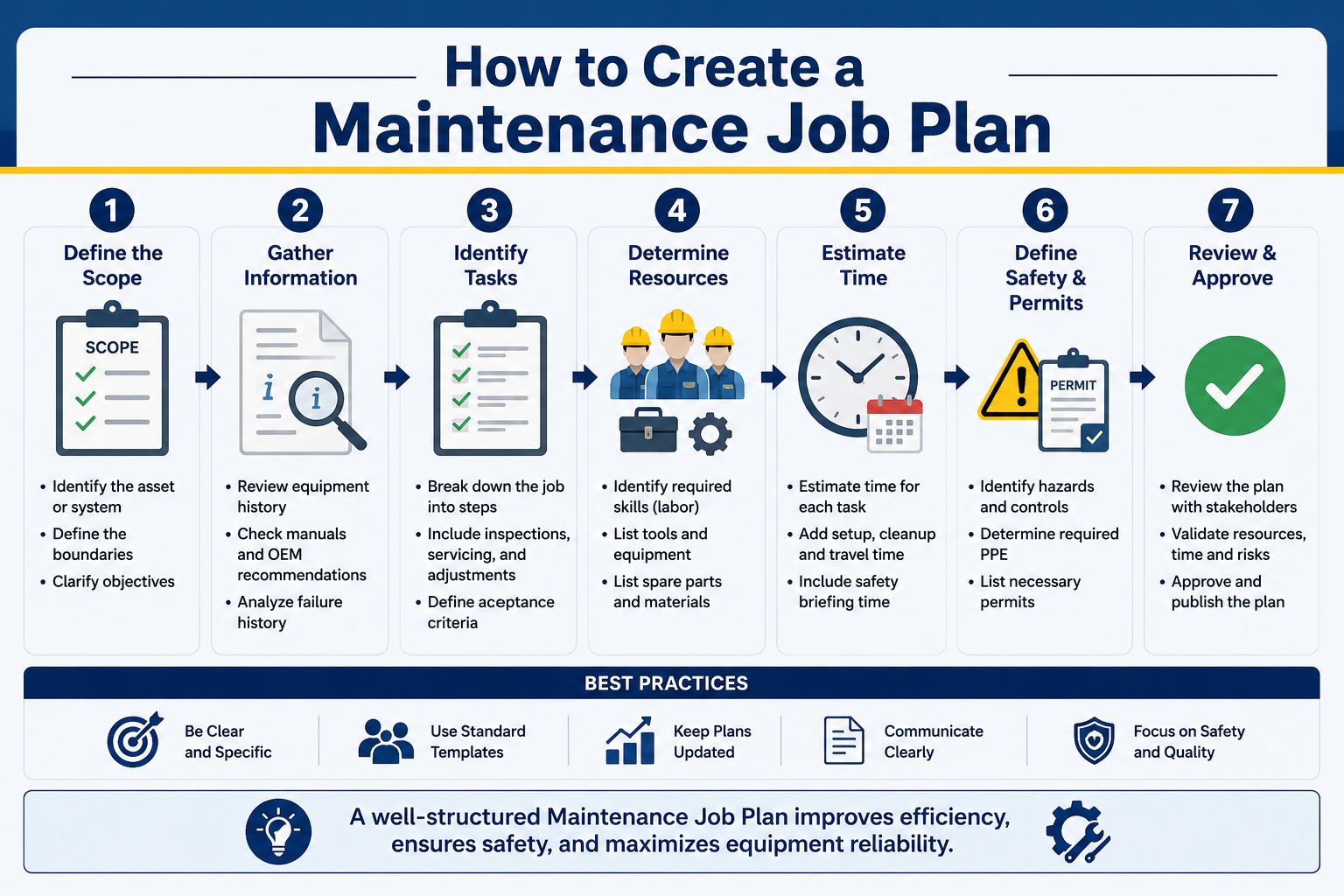
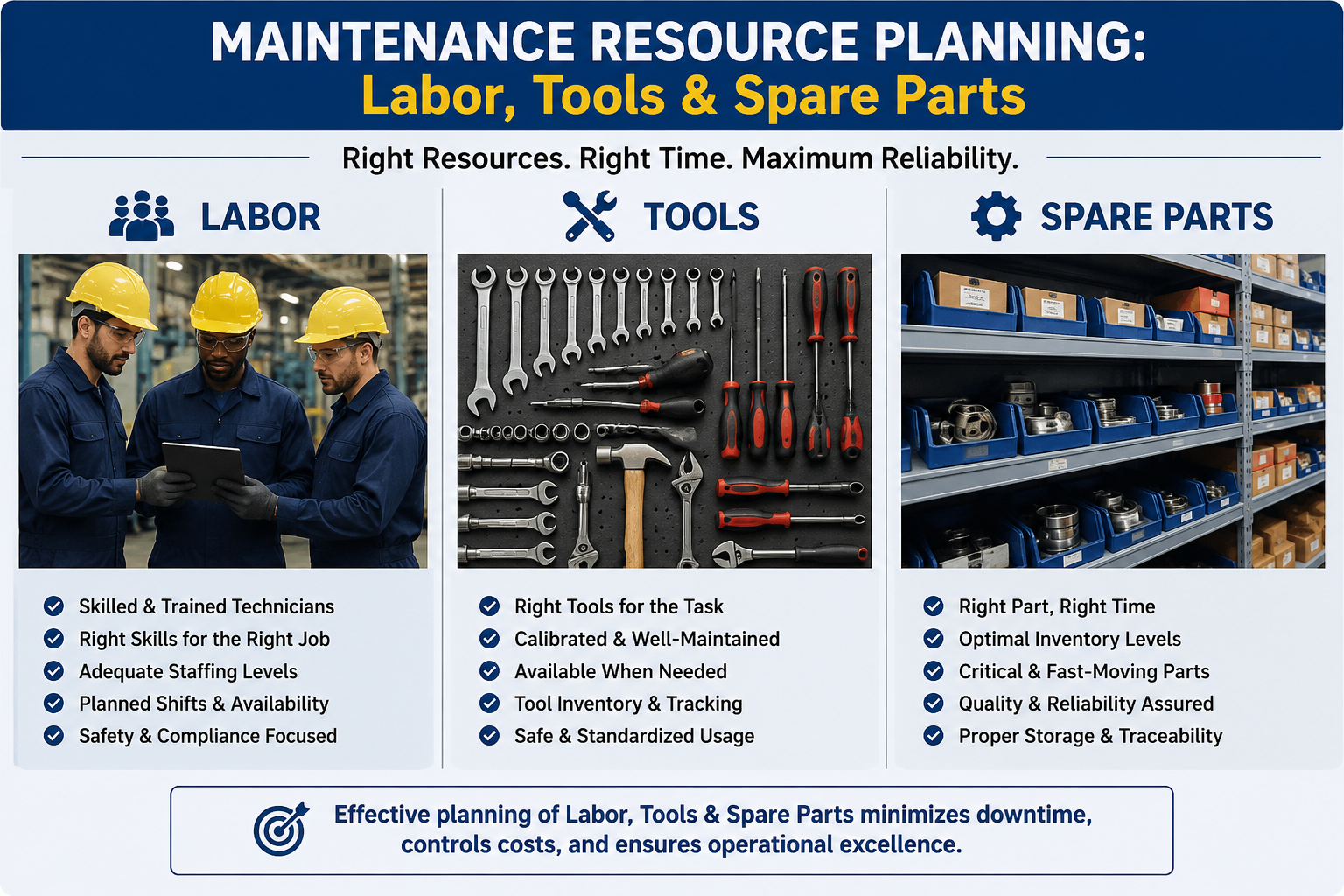
Step 6: Estimate Labor Requirements
Each maintenance task should have a realistic labor estimate.
For example:
Pump inspection — 1 technician — 1 hour
Motor bearing replacement — 2 technicians — 4 hours
Gearbox overhaul — 3 technicians — 16 hours
Labor estimates allow planners and schedulers to determine how much work can realistically be completed within a given period.
Unrealistic estimates can result in overloaded schedules and poor schedule compliance.
Step 7: Verify Spare Parts and Materials
A maintenance job should not be scheduled if critical parts are unavailable.
Before scheduling work, verify:
- Spare-part availability
- Lubricants
- Consumables
- Gaskets
- Seals
- Fasteners
- Cleaning materials
- Replacement components
For critical assets, appropriate spare-parts strategies should be established to reduce the risk of extended downtime.
Step 8: Identify Required Tools and Equipment
Some maintenance activities require specialized tools.
Examples include:
- Torque tools
- Laser alignment equipment
- Bearing heaters
- Pullers
- Lifting equipment
- Vibration analyzers
- Electrical test equipment
- Calibration equipment
The required tools should be identified during planning rather than discovered when the technician arrives at the machine.
Step 9: Consider Safety Requirements
Safety must be built into the maintenance schedule.
Depending on the task, requirements may include:
- Lockout/Tagout
- Equipment isolation
- Work permits
- Gas testing
- Confined-space controls
- Electrical isolation
- Working-at-height controls
- Lifting plans
- Personal protective equipment
Maintenance work should never be scheduled purely around production convenience if required safety controls cannot be implemented.
Step 10: Coordinate With Operations
Maintenance and production must work together.
A machine may be scheduled for maintenance, but operations may need it for an important production campaign.
Before finalizing the schedule, confirm:
- Equipment availability
- Production requirements
- Shutdown windows
- Process conditions
- Alternative equipment availability
Good communication prevents unnecessary conflicts.
Step 11: Prioritize Maintenance Work
Not every maintenance job has equal urgency.
A practical priority system can categorize work as:
Emergency
Immediate action required because of serious safety, environmental, or production consequences.
High Priority
Work that should be completed quickly to prevent significant deterioration or failure.
Medium Priority
Important maintenance that can be scheduled within an appropriate planning window.
Low Priority
Work that can be completed when resources are available without significant risk.
Priorities should be based on risk rather than simply who submits the work request first.
Step 12: Balance the Workload
An effective schedule should match planned work with available resources.
If a maintenance team has 100 labor hours available but the schedule contains 180 hours of work, the schedule is unrealistic.
Schedulers should consider:
- Number of technicians
- Skill levels
- Working hours
- Planned leave
- Contractors
- Emergency workload
- Specialized skills
A realistic schedule is more valuable than an impressive-looking schedule that cannot be completed.
Step 13: Create a Weekly Maintenance Schedule
Many organizations use weekly schedules because they provide enough detail for execution while still allowing flexibility.
A weekly schedule might include:
| Day | Equipment | Task | Duration | Assigned Team |
|---|---|---|---|---|
| Monday | Pump P-101 | Inspection | 2 hrs | Mechanical |
| Tuesday | Motor M-204 | Lubrication | 1 hr | Mechanical |
| Wednesday | Compressor C-301 | Vibration analysis | 2 hrs | Reliability |
| Thursday | Conveyor CV-12 | Belt inspection | 3 hrs | Mechanical |
| Friday | Gearbox GB-04 | Oil change | 2 hrs | Mechanical |
The actual schedule should reflect site-specific priorities, resources, and equipment requirements.
Step 14: Include Flexibility
Maintenance schedules should not be so rigid that unexpected conditions make them impossible to execute.
Industrial environments frequently experience:
- Equipment breakdowns
- Production changes
- Material delays
- Weather disruptions
- Safety issues
- Emergency work
A good schedule should include some capacity for unexpected work.
Overloading the entire available maintenance capacity with planned work leaves no room for genuine emergencies.
Step 15: Track Schedule Compliance
After the schedule is completed, compare planned work with actual work.
Schedule compliance can be expressed as:
Schedule Compliance (%) = Completed Scheduled Work ÷ Total Scheduled Work × 100
For example, if 40 scheduled jobs were planned and 34 were completed:
Schedule Compliance = 34 ÷ 40 × 100 = 85%
Low compliance may indicate:
- Excessive emergency work
- Poor planning
- Unrealistic labor estimates
- Parts shortages
- Production conflicts
- Poor prioritization
The purpose of measuring compliance is to identify opportunities for improvement—not to punish maintenance personnel.
Step 16: Capture Feedback
Technicians should provide feedback after completing maintenance work.
Useful feedback includes:
- Actual job duration
- Parts used
- Additional defects discovered
- Procedure problems
- Safety concerns
- Equipment condition
- Recommendations
This information can improve future schedules and job plans.
For example, if a task consistently takes four hours instead of the scheduled two hours, the labor estimate should be reviewed.
Using a CMMS to Build Maintenance Schedules
A Computerized Maintenance Management System (CMMS) can significantly simplify maintenance scheduling.
A CMMS can help manage:
- Preventive-maintenance schedules
- Work orders
- Equipment history
- Labor availability
- Spare parts
- Job plans
- Maintenance priorities
- Due dates
- Work completion
Automated reminders can also help ensure that recurring maintenance tasks are not forgotten.
However, technology alone does not create an effective maintenance schedule.
The quality of the schedule still depends on accurate asset information, realistic job plans, good prioritization, and disciplined execution.
Common Maintenance Scheduling Mistakes
Scheduling Too Much Work
An overloaded schedule creates unrealistic expectations.
Ignoring Equipment Criticality
Low-value work can consume resources needed for critical assets.
Scheduling Without Parts
Technicians cannot complete jobs without required materials.
Poor Communication
Production and maintenance conflicts can cause scheduled work to be cancelled.
Ignoring Emergency Work
Some capacity should be available for unexpected failures.
Using Outdated Maintenance Intervals
Maintenance frequencies should be reviewed using equipment history and condition data.
Failing to Measure Results
Without performance measurement, it is difficult to know whether scheduling practices are improving.
Best Practices for an Effective Maintenance Schedule
To build a strong maintenance scheduling process:
- Maintain an accurate asset register.
- Classify equipment by criticality.
- Define clear maintenance tasks.
- Use appropriate maintenance intervals.
- Verify parts and tools before scheduling.
- Estimate labor realistically.
- Coordinate with production.
- Prioritize work according to risk.
- Balance workload against available resources.
- Include capacity for unexpected work.
- Track schedule compliance.
- Capture technician feedback.
- Review recurring failures.
- Continuously optimize the schedule.