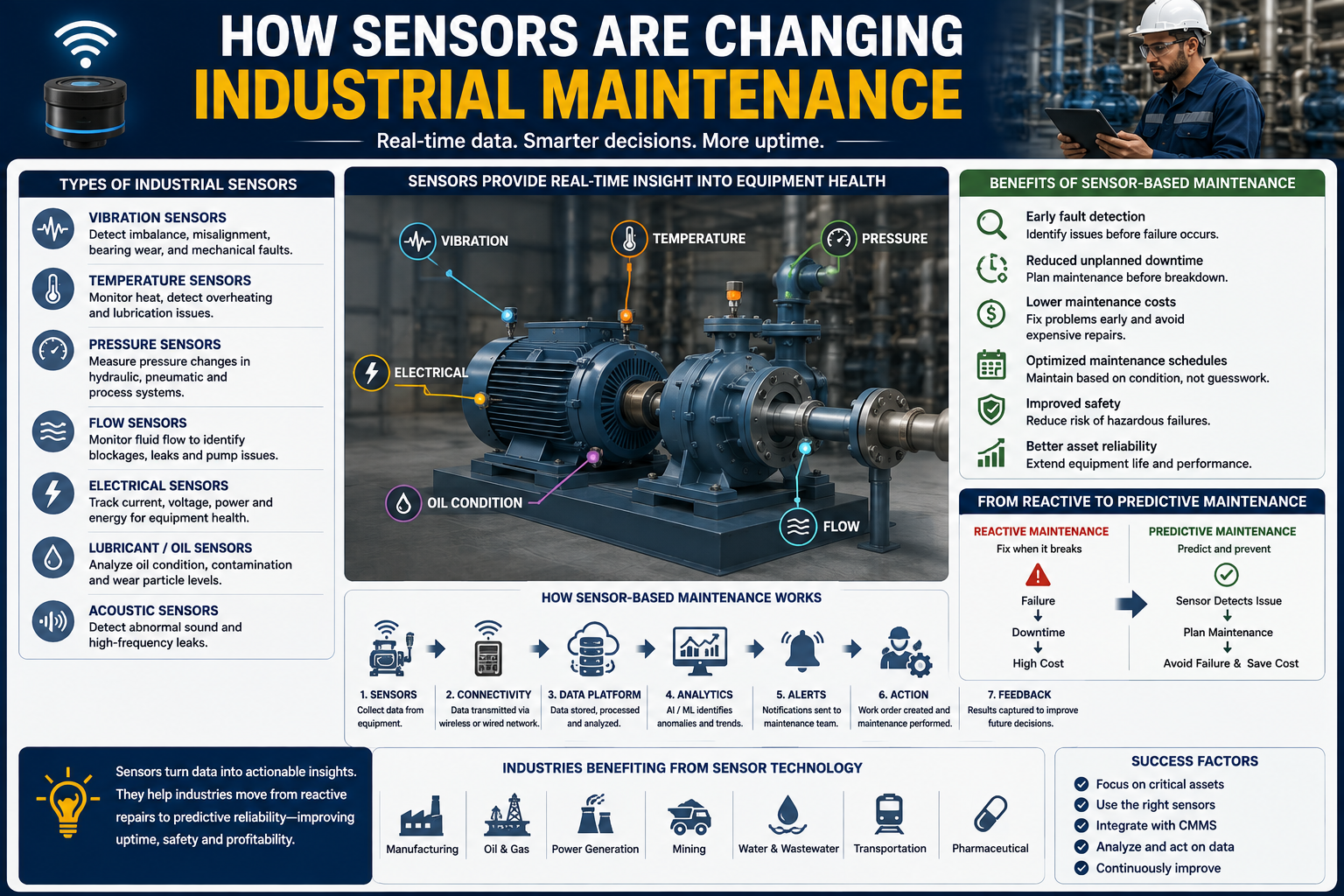
Industrial maintenance is changing rapidly as factories, plants, and other industrial facilities adopt smarter technologies. Traditional maintenance often depends on scheduled inspections, technician experience, and responding to equipment failures. While these methods remain important, modern industries are increasingly using sensors, connected devices, automation, and real-time data to understand equipment condition.
Sensors are becoming an important part of modern maintenance because they allow organizations to continuously monitor machines and identify abnormal conditions before they develop into serious failures.
Instead of asking only, “When did this machine last receive maintenance?”, maintenance teams can increasingly ask, “What condition is this machine in right now?”
This shift is helping organizations move from reactive maintenance toward predictive and proactive maintenance.
What Are Industrial Maintenance Sensors?
Industrial maintenance sensors are devices that measure physical or operational conditions within equipment and systems.
Depending on the application, sensors can measure:
- Temperature
- Vibration
- Pressure
- Flow
- Speed
- Position
- Humidity
- Electrical current
- Voltage
- Energy consumption
- Lubricant condition
- Acoustic signals
The sensor collects information and sends it to a monitoring system, PLC, SCADA platform, CMMS, cloud platform, or analytics system.
Maintenance engineers can then use this information to identify abnormal behavior and make better maintenance decisions.
Why Sensors Are Important in Modern Maintenance
Traditional maintenance methods often provide only periodic information.
For example, a technician might inspect a motor once every month.
But equipment operates continuously between inspections.
A developing problem could appear shortly after the inspection and remain undetected until the next scheduled visit—or until the equipment fails.
Sensors change this approach by providing continuous or frequent equipment information.
For example:
Normal vibration → Increasing vibration → Abnormal condition → Maintenance alert → Planned repair
Instead of waiting for a catastrophic failure, the maintenance team can investigate the problem while there is still time to plan the repair.
1. Vibration Sensors for Rotating Equipment
Vibration sensors are among the most widely used technologies in predictive maintenance.
They are particularly useful for:
- Motors
- Pumps
- Compressors
- Fans
- Gearboxes
- Turbines
- Conveyors
Abnormal vibration can indicate problems such as:
- Bearing deterioration
- Misalignment
- Imbalance
- Looseness
- Gear defects
- Mechanical resonance
For example, if vibration levels on a pump gradually increase, a maintenance engineer can investigate the cause before the pump experiences a major failure.
This allows maintenance to be planned around production requirements instead of reacting to an emergency breakdown.
2. Temperature Sensors
Temperature is another important indicator of equipment health.
Abnormally high temperatures can indicate:
- Bearing problems
- Poor lubrication
- Electrical resistance
- Overloading
- Cooling-system problems
- Friction
- Process abnormalities
Temperature sensors can be installed on motors, bearings, electrical panels, pumps, compressors, transformers, and other equipment.
Continuous temperature monitoring can identify changes that may not be visible during routine inspections.
3. Pressure Sensors
Pressure sensors are particularly important in systems involving fluids and gases.
They can monitor:
- Hydraulic systems
- Pneumatic systems
- Pumps
- Compressors
- Boilers
- Process equipment
- Pipelines
Unexpected pressure changes can indicate leakage, blockage, pump problems, valve problems, or process abnormalities.
Monitoring pressure continuously provides maintenance and operations teams with additional information for troubleshooting.
4. Flow Sensors
Flow measurement is important for pumps, cooling systems, process lines, and water systems.
A reduction in flow can indicate:
- Blockage
- Pump degradation
- Valve problems
- Leakage
- Filter restriction
- Process changes
When flow data is combined with pressure and vibration information, engineers can obtain a more complete picture of equipment performance.
5. Electrical Sensors
Electrical monitoring can provide valuable information about motors and electrical systems.
Sensors can measure:
- Current
- Voltage
- Power
- Frequency
- Energy consumption
Changes in electrical behavior may indicate motor overload, imbalance, insulation problems, mechanical loading, or other abnormalities.
Energy monitoring can also help identify equipment operating inefficiently.
6. Sensors and Predictive Maintenance
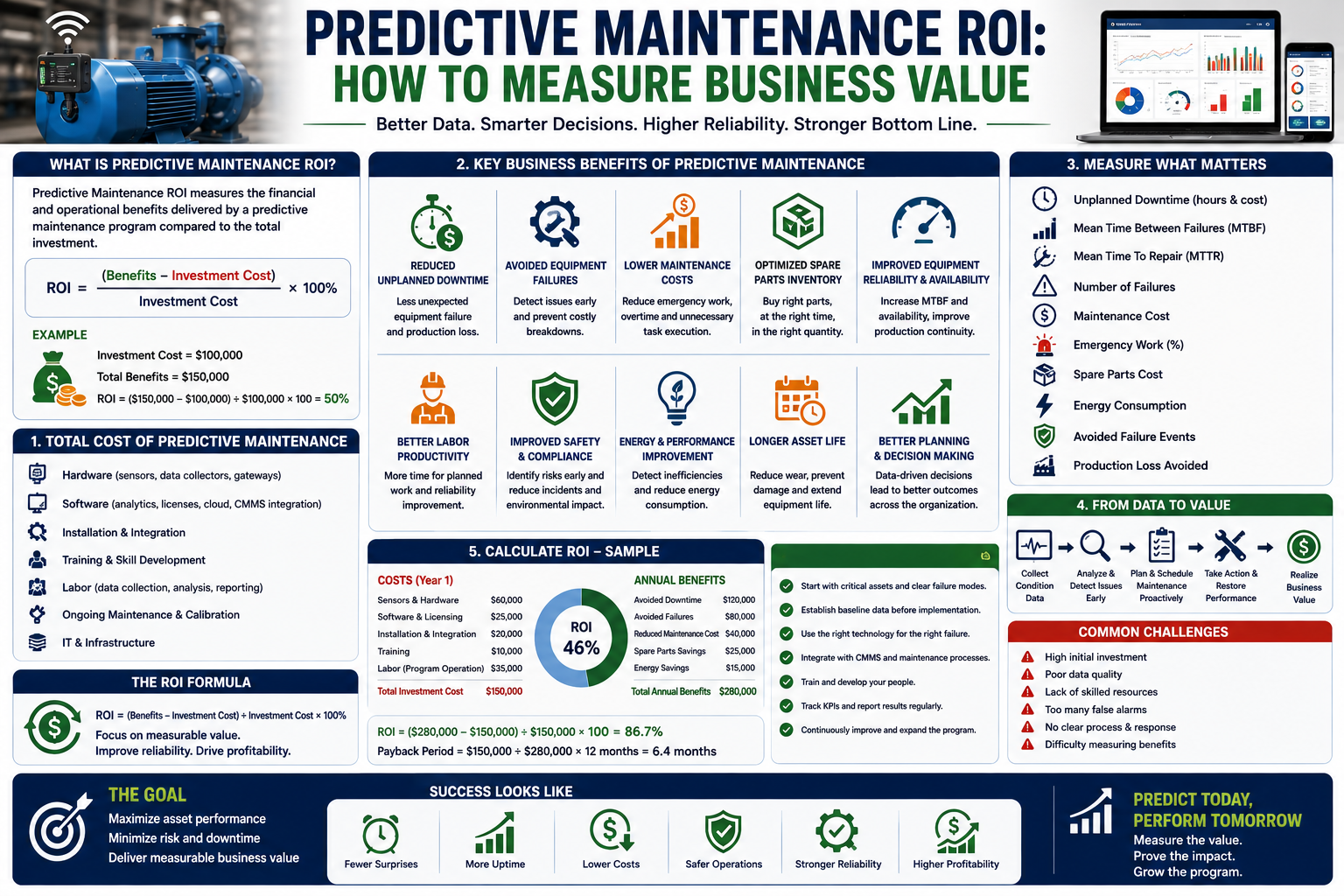
One of the biggest impacts of sensors is their ability to support predictive maintenance.
Predictive maintenance uses equipment condition information to identify developing failures and determine when maintenance may be required.
For example:
Sensor detects abnormal vibration → Analytics identifies developing bearing problem → Maintenance team receives alert → Spare part is ordered → Repair is scheduled during planned downtime
This is very different from:
Bearing fails → Production stops → Emergency maintenance begins
Predictive maintenance therefore provides organizations with more time to prepare.
7. Sensors Enable Condition-Based Maintenance
Sensors also support condition-based maintenance.
Instead of replacing a component simply because it has reached a predetermined maintenance interval, the organization can monitor its actual condition.
For example, a bearing may traditionally be replaced every 12 months.
With condition monitoring, the bearing could remain in service while its condition remains acceptable and be replaced when data indicates significant deterioration.
This can reduce unnecessary maintenance and spare-parts consumption.
However, condition-based strategies should be applied only when the failure mode is detectable and the monitoring method provides useful information.
8. Connecting Sensors to CMMS Systems
Sensors become even more valuable when their information is integrated with a Computerized Maintenance Management System (CMMS) or other maintenance-management platform.
For example:
Sensor data → Condition alert → Maintenance notification → Work order → Technician inspection → Repair → Equipment history
This creates a connection between equipment condition and maintenance execution.
Instead of relying entirely on manual reporting, maintenance teams can receive information automatically when predefined conditions occur.
9. The Role of IoT in Industrial Maintenance
The Industrial Internet of Things (IIoT) connects sensors, equipment, software, and communication systems.
A typical IIoT maintenance architecture may include:
Machine → Sensor → Network → Data Platform → Analytics → Alert → Maintenance Action
This allows organizations to collect equipment information across an entire facility.
Maintenance engineers can potentially monitor hundreds or thousands of assets without manually inspecting every machine at the same frequency.
10. Artificial Intelligence and Sensor Data
Sensors generate large amounts of information.
Artificial intelligence and machine learning can help analyze this information and identify patterns that may be difficult to detect manually.
For example, an analytics system may identify that a combination of:
- Increasing vibration
- Rising temperature
- Increased motor current
has historically been associated with a particular equipment failure.
The system can alert engineers so they can investigate.
However, AI should support engineering judgment rather than replace it.
A sensor alert should normally lead to inspection and engineering evaluation before a major maintenance decision is made.
11. Benefits of Sensor-Based Maintenance
Sensor-based maintenance can provide several benefits.
Early Problem Detection
Developing failures can be identified before catastrophic breakdown.
Reduced Unplanned Downtime
Maintenance can often be scheduled before equipment failure.
Better Maintenance Planning
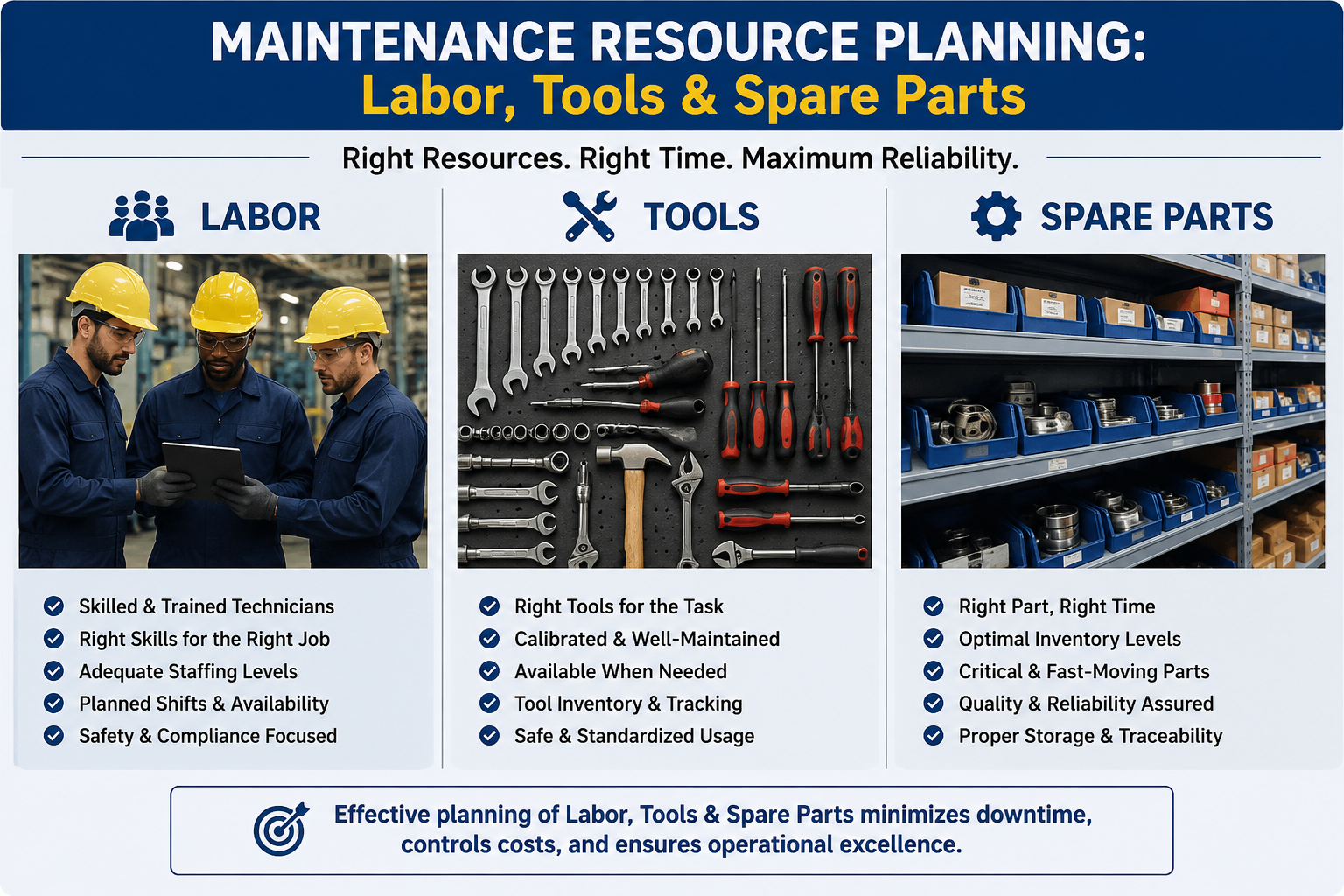
Maintenance teams have more time to arrange labor, tools, spare parts, and permits.
Reduced Over-Maintenance
Equipment does not necessarily need to be serviced simply because a calendar date has arrived.
Improved Equipment Reliability
Continuous condition information can help engineers identify deterioration earlier.
Better Asset Visibility
Maintenance teams can understand equipment condition across larger numbers of assets.
Improved Safety
Early detection of abnormal conditions can reduce the risk associated with certain equipment failures.
12. Challenges of Using Sensors
Although sensors provide significant benefits, implementation also has challenges.
Initial Investment
Sensors, communication systems, software, installation, and integration can require investment.
Data Management
Large sensor networks can generate enormous amounts of data.
Organizations need systems capable of storing, processing, and interpreting useful information.
Sensor Reliability
A faulty sensor can generate false alarms or fail to detect an actual problem.
Sensors themselves therefore require appropriate inspection and maintenance.
Technical Skills
Maintenance teams may need training in instrumentation, data analysis, condition monitoring, networking, and reliability engineering.
Cybersecurity
Connected industrial systems must be properly protected against unauthorized access and other cybersecurity risks.
13. Sensors Do Not Replace Maintenance Engineers
It is important to understand that sensors are tools, not complete maintenance solutions.
A sensor can tell you that vibration is increasing.
It may not automatically explain why the vibration is increasing.
A maintenance engineer may need to investigate:
- Alignment
- Balance
- Bearing condition
- Foundation condition
- Operating load
- Installation quality
- Lubrication
Engineering knowledge remains essential.
The future of maintenance will therefore combine sensor technology with human expertise.
14. How to Start Using Sensors
Organizations do not need to install sensors on every piece of equipment immediately.
A better approach is to begin with critical assets.
Step 1: Identify Critical Equipment
Focus on assets where failure has significant production, safety, environmental, or financial consequences.
Step 2: Identify Important Failure Modes
Determine which failures can be detected using measurable parameters.
Step 3: Select the Appropriate Sensor
Choose vibration, temperature, pressure, flow, electrical, or other sensors based on the failure mechanism.
Step 4: Establish Baseline Conditions
Determine what normal equipment behavior looks like.
Step 5: Define Alarm Limits
Set appropriate thresholds or analytical rules.
Step 6: Connect the Data
Integrate sensor information with monitoring, analytics, or maintenance systems where appropriate.
Step 7: Create a Maintenance Response
An alarm is useful only if the organization knows what action to take.
15. The Future of Sensor-Based Industrial Maintenance
The use of sensors is expected to continue expanding as industrial organizations become more connected and data-driven.
Future maintenance systems may combine:
- Wireless sensors
- Edge computing
- Cloud analytics
- Artificial intelligence
- Machine learning
- Digital twins
- Automated inspections
- Mobile maintenance applications
- Real-time asset dashboards
The result will be increasingly intelligent maintenance systems capable of detecting abnormal conditions, prioritizing risks, and supporting maintenance decisions.
However, successful organizations will focus not simply on collecting more data but on turning data into useful maintenance actions.