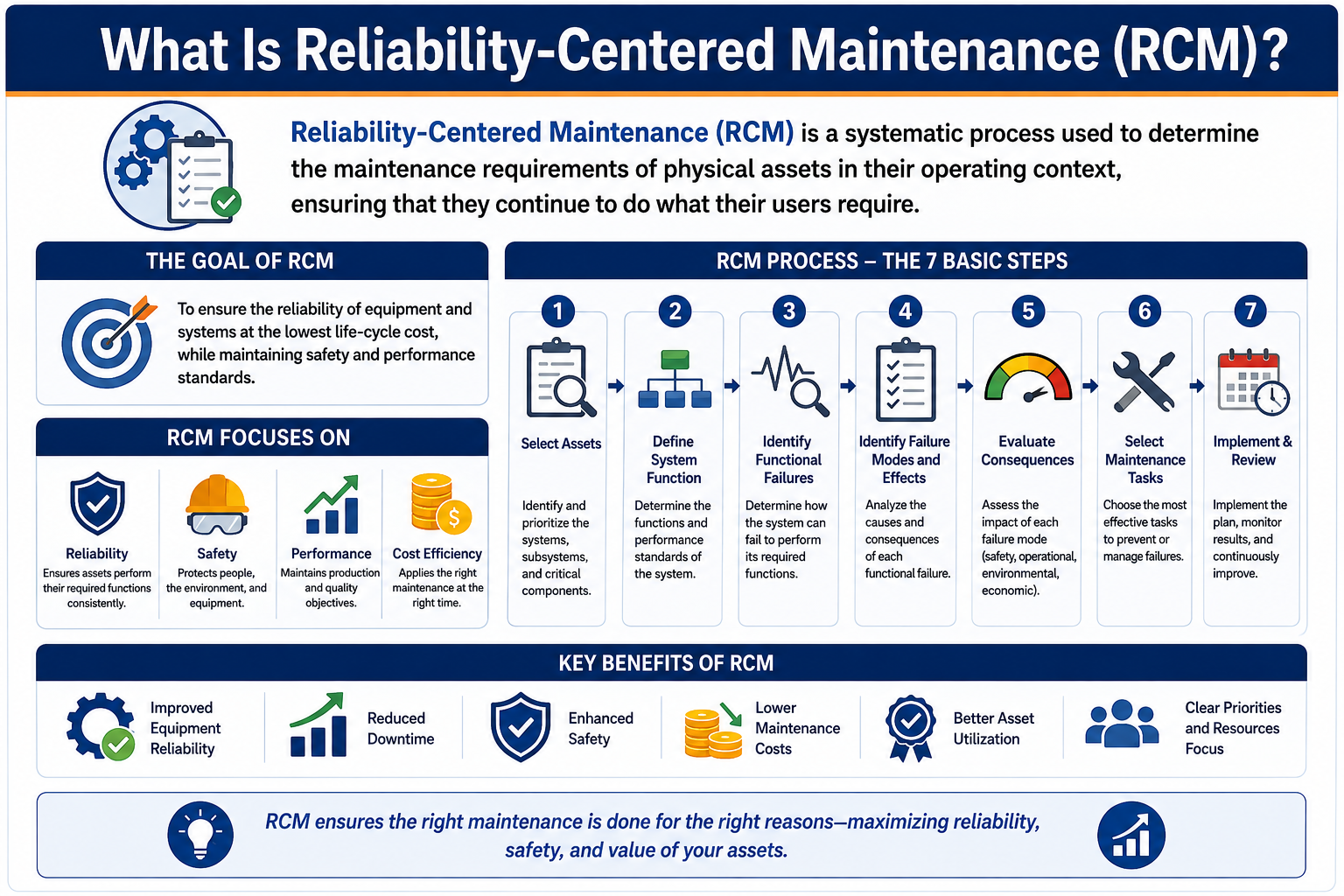
Reliability-Centered Maintenance (RCM) is one of the most important methodologies used by modern maintenance and reliability teams to determine what maintenance should be performed, why it should be performed, and when it should be performed.
Many organizations assume that increasing preventive maintenance will automatically improve equipment reliability. However, excessive or poorly selected maintenance can increase costs without reducing failures. Reliability-Centered Maintenance takes a different approach by focusing maintenance activities on the functions, failure modes, consequences, and risks associated with each asset.
RCM helps organizations develop maintenance strategies that balance reliability, safety, cost, performance, and operational requirements.
This guide explains what RCM is, its principles, the RCM process, its benefits, and how organizations can successfully implement it.
What Is Reliability-Centered Maintenance?
Reliability-Centered Maintenance (RCM) is a structured process used to determine the most appropriate maintenance strategy for an asset based on its functions, potential failures, failure consequences, and operational context.
The fundamental question behind RCM is:
“What must we do to ensure that this asset continues to perform its required functions?”
Instead of automatically assigning preventive maintenance to every component, RCM evaluates whether a maintenance task is technically appropriate and economically justified.
Possible outcomes may include:
- Preventive maintenance
- Predictive maintenance
- Condition monitoring
- Functional testing
- Planned component replacement
- Failure-finding tasks
- Run-to-failure
- Redesign or engineering modification
The objective is to select the most effective maintenance strategy for each failure mode.
Why Is RCM Important?
Traditional maintenance programs often rely heavily on fixed maintenance intervals.
For example:
“Replace the bearing every 12 months.”
But what if the bearing could reliably operate for several years?
Replacing it unnecessarily creates:
- Additional labor
- Spare-parts consumption
- Equipment intervention
- Maintenance cost
- Potential installation errors
RCM asks whether the maintenance task actually reduces the risk of failure.
This risk-based approach can help organizations avoid both under-maintenance and over-maintenance.
The Main Principles of RCM
RCM is based on several fundamental principles.
1. Focus on Functions
RCM begins by identifying what the asset is expected to do.
For example, a centrifugal pump may have the primary function:
“Transfer process fluid at the required flow rate and pressure.”
The analysis should also consider supporting functions such as:
- Containment
- Lubrication
- Cooling
- Monitoring
- Safety protection
Understanding functions is essential because reliability means more than simply keeping equipment physically intact.
2. Identify Functional Failures
A functional failure occurs when an asset is unable to perform its required function at the required performance level.
For example, a pump may experience functional failure when:
- It cannot deliver the required flow.
- Discharge pressure falls below the required level.
- It leaks process fluid.
- It cannot start.
- It operates outside acceptable performance limits.
Functional failures define what the maintenance program needs to prevent or control.
3. Identify Failure Modes
The next step is identifying the specific ways the asset can fail.
For a pump, failure modes could include:
- Bearing failure
- Mechanical seal failure
- Impeller damage
- Coupling failure
- Motor failure
- Shaft damage
- Blocked suction
- Lubrication failure
Failure-mode identification helps maintenance teams understand what can cause each functional failure.
4. Analyze Failure Consequences
Not every failure has the same consequence.
RCM evaluates what happens when each failure occurs.
Consequences may include:
Safety Consequences
Could the failure injure personnel or create a hazardous situation?
Environmental Consequences
Could the failure cause a spill, emission, or environmental release?
Operational Consequences
Could the failure stop production or reduce output?
Non-Operational Consequences
Could the failure increase maintenance or repair costs without directly affecting production?
Understanding consequences helps determine how much maintenance effort is justified.
The RCM Decision Process
Once failure modes and consequences are understood, maintenance teams determine what should be done about each failure.
Possible strategies include:
Preventive Maintenance
Tasks performed at predetermined intervals.
Examples:
- Lubrication
- Inspection
- Replacement
- Adjustment
- Cleaning
Preventive maintenance is appropriate when an effective age-related or usage-related maintenance task exists.
Predictive Maintenance
Equipment condition is monitored to identify developing problems.
Examples include:
- Vibration analysis
- Infrared thermography
- Oil analysis
- Ultrasonic inspection
- Motor-current analysis
Predictive maintenance can be particularly useful when failures provide detectable warning signs.
Functional Testing
Functional testing verifies whether a hidden or protective function still works.
Examples include testing:
- Emergency shutdown systems
- Fire protection systems
- Relief systems
- Backup equipment
- Safety interlocks
These systems may not operate regularly, so their availability cannot be confirmed simply by observing normal operation.
Run-to-Failure
Some failures are acceptable when the consequences are low and preventive maintenance is not technically or economically justified.
For example, a low-cost, non-critical component may be allowed to operate until failure, provided replacement is straightforward and there are no unacceptable safety or production consequences.
Redesign
Sometimes maintenance is not the best solution.
If a particular failure occurs repeatedly and no effective maintenance task can control it, engineering modification may be necessary.
The Seven Basic RCM Questions
A traditional RCM analysis is commonly structured around seven questions:
1. What Are the Asset’s Functions?
Define what the equipment must do.
2. In What Ways Can It Fail?
Identify functional failures.
3. What Causes Each Failure?
Identify failure modes.
4. What Happens When the Failure Occurs?
Describe failure effects.
5. Why Does the Failure Matter?
Evaluate the consequences.
6. What Can Be Done to Predict or Prevent the Failure?
Select appropriate maintenance tasks.
7. What Should Be Done If No Suitable Task Exists?
Consider run-to-failure, redesign, additional monitoring, or other risk controls.
These questions provide a structured framework for developing an effective maintenance strategy.
RCM vs Preventive Maintenance
RCM and preventive maintenance are not the same thing.
Preventive maintenance is a maintenance strategy involving scheduled tasks intended to prevent or reduce failures.
RCM is a decision-making methodology used to determine which maintenance strategy is appropriate.
For example, an RCM analysis may conclude that:
- Component A requires preventive replacement.
- Component B should be monitored using vibration analysis.
- Component C requires periodic functional testing.
- Component D can safely run to failure.
Therefore, RCM can actually reduce unnecessary preventive maintenance by ensuring that maintenance tasks are justified by failure behavior and consequences.
Benefits of Reliability-Centered Maintenance
A properly implemented RCM program can provide several benefits.
Improved Equipment Reliability
Maintenance activities are focused on actual failure mechanisms.
Reduced Unplanned Downtime
Potential failures can be identified and controlled before they cause major disruptions.
Lower Maintenance Costs
Unnecessary maintenance tasks can be eliminated or optimized.
Improved Safety
Safety-critical failure modes receive appropriate attention.
Better Spare-Parts Management
Maintenance requirements become more clearly connected to actual failure risks.
Improved Maintenance Planning
Teams gain a better understanding of what work is required and why.
Better Asset Management
RCM connects maintenance decisions with asset criticality and business objectives.
RCM and Failure Mode and Effects Analysis (FMEA)
RCM is closely related to Failure Mode and Effects Analysis (FMEA).
FMEA identifies:
- Failure modes
- Failure causes
- Failure effects
- Failure consequences
RCM takes this information further by asking:
“What maintenance strategy should we use to manage this failure mode?”
Therefore, FMEA can be an important input to an RCM analysis.
How to Implement RCM
Organizations should avoid trying to perform RCM on every asset simultaneously.
A practical implementation can follow these steps:
Step 1: Select Critical Assets
Start with equipment that has significant safety, environmental, production, or financial consequences.
Step 2: Build the Analysis Team
Include people with knowledge of:
- Operations
- Maintenance
- Reliability
- Engineering
- Safety
Technician and operator experience can be particularly valuable.
Step 3: Define Asset Functions
Clearly document required performance.
Step 4: Identify Functional Failures
Determine how the equipment can fail to perform its functions.
Step 5: Identify Failure Modes
Determine the causes of each functional failure.
Step 6: Analyze Consequences
Evaluate safety, environmental, operational, and maintenance consequences.
Step 7: Select Maintenance Tasks
Choose preventive, predictive, testing, run-to-failure, or redesign strategies.
Step 8: Document the Strategy
Convert recommendations into maintenance plans and procedures.
Step 9: Implement and Monitor
Track whether the new strategy is actually improving performance.
Step 10: Review and Update
RCM should be reviewed when equipment, operating conditions, or failure patterns change.
Common RCM Implementation Challenges
RCM can provide significant value, but implementation requires discipline.
Common challenges include:
- Lack of reliable failure data
- Poor asset information
- Inadequate team involvement
- Excessively complicated analysis
- Poorly defined functions
- Focusing only on preventive maintenance
- Failure to implement recommendations
- Lack of management support
Another common problem is conducting an RCM analysis but failing to convert its recommendations into actual maintenance work orders, procedures, and schedules.
An RCM study only creates value when its recommendations are implemented.
Best Practices for RCM
Organizations can improve RCM results by:
- Start with critical assets.
- Build a multidisciplinary team.
- Define asset functions clearly.
- Use actual failure data whenever available.
- Focus on failure consequences.
- Avoid unnecessary preventive maintenance.
- Consider predictive technologies.
- Include operator knowledge.
- Document decisions clearly.
- Implement recommendations in the CMMS.
- Monitor maintenance and reliability KPIs.
- Review the strategy periodically.
Key RCM Performance Indicators
Organizations can evaluate RCM effectiveness using metrics such as:
- Unplanned downtime
- Mean Time Between Failures (MTBF)
- Mean Time To Repair (MTTR)
- Equipment availability
- Preventive-maintenance compliance
- Reactive maintenance percentage
- Maintenance cost
- Repeat failure rate
- Number of critical failure events
The most important question is whether the maintenance strategy is reducing unacceptable risk and improving asset performance.