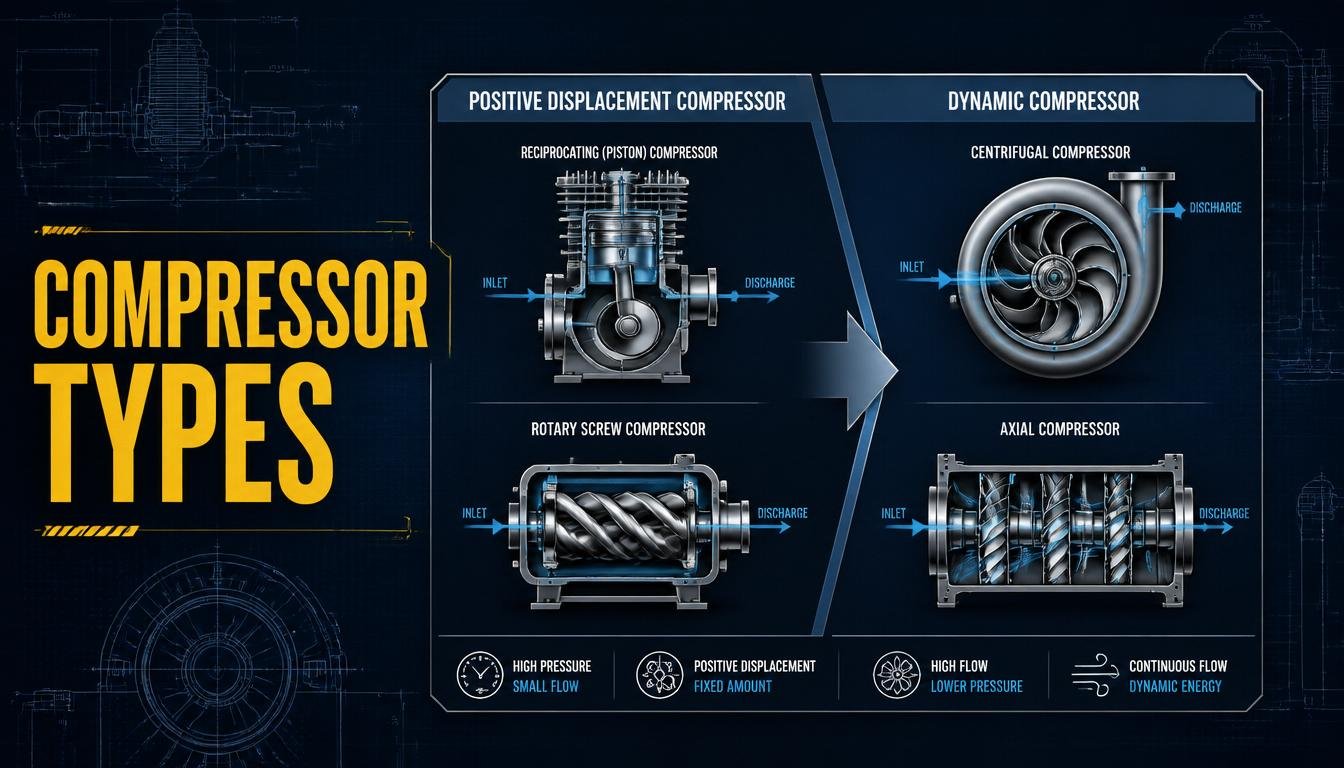
Selecting the correct equipment starts with understanding the different compressor types available on the market today. From small workshop units to massive refinery machines, every compressor falls into one of two engineering families, and knowing the difference determines whether your system runs efficiently or wastes energy year after year. This guide walks through every major type of air compressor, compares them side by side, and helps you decide which one fits your application — covering reciprocating compressors, rotary compressors, centrifugal compressors, and axial compressors in detail.
How Compressors Work: The Two Core Principles
Every compressor increases gas pressure using one of two methods: physically shrinking the space the gas occupies, or accelerating the gas and converting that speed into pressure. The first approach defines positive displacement compressors, and the second defines dynamic compressors. Almost all industrial, commercial, and automotive compressors are built around one of these two principles, so understanding them is the foundation for everything else in this guide.
Positive Displacement Compressors
A positive displacement compressor pulls in a set volume of gas through its inlet, then mechanically forces that gas toward the outlet by reducing the available space. Because the gas cannot escape at the same rate it enters, pressure rises steadily and predictably. This category tends to deliver a constant output volume even as downstream pressure changes, which is why it remains the backbone of general industrial compressed-air systems.
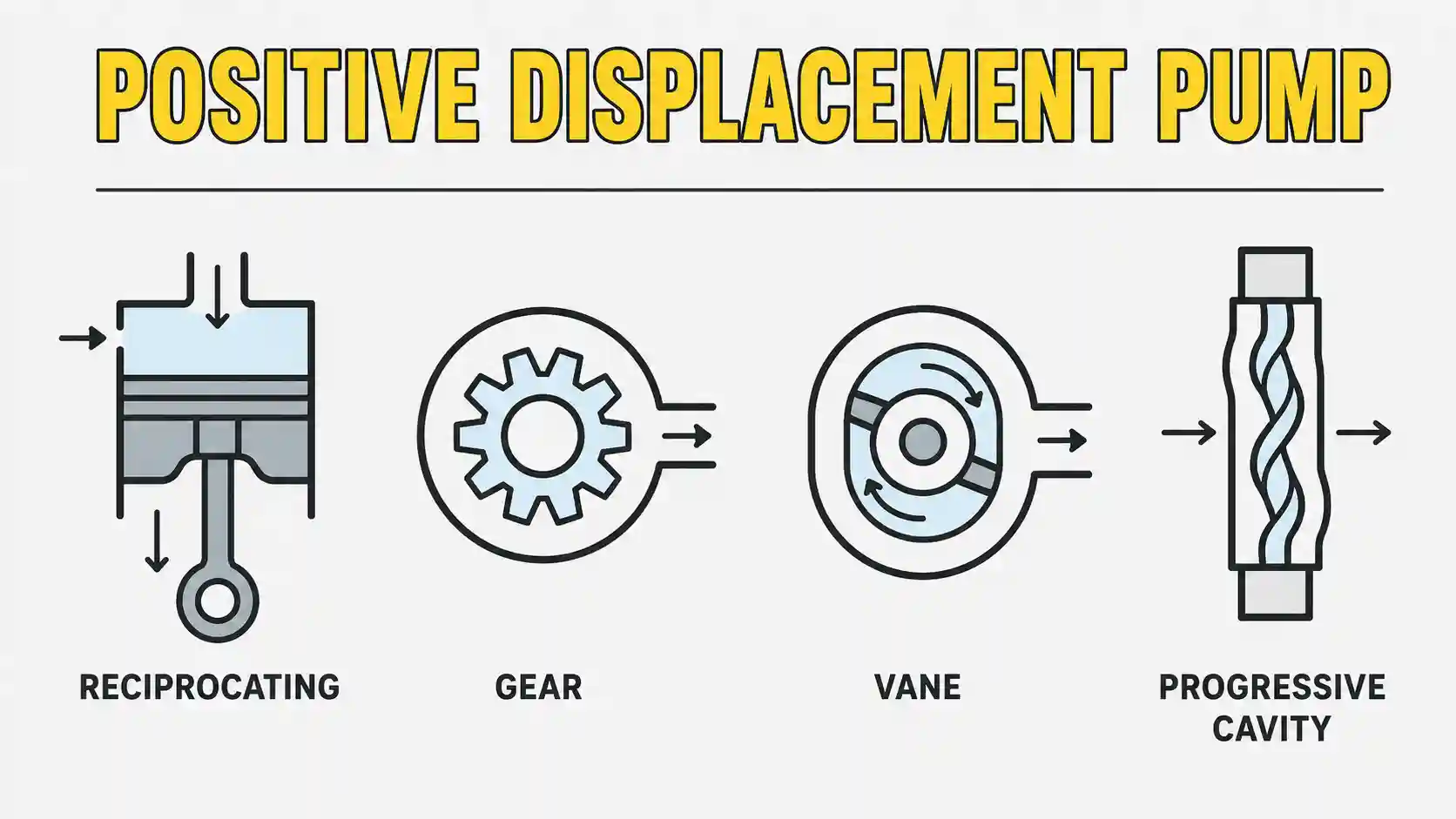
Reciprocating Compressors
Reciprocating compressors rely on pistons driven by a crankshaft and are available in stationary or portable form, single-stage or multi-stage configurations, powered by electric motors or combustion engines. Small units between 5 and 30 horsepower show up constantly in automotive shops for intermittent duty, while heavy industrial versions exceeding 1,000 horsepower handle demanding petroleum applications with discharge pressures climbing past 18,000 psi. Multi-stage, double-acting reciprocating machines are often regarded as the most efficient option for high-pressure air, though they cost more upfront than comparable rotary alternatives. A related design, the linear compressor, uses a piston that also acts as the rotor of a linear motor, allowing it to compress refrigerant, hydrogen, or natural gas across a wide range of capacities.
Diaphragm Compressors
Also known as membrane compressors, diaphragm compressors are a variant of the reciprocating compressor that compresses gas through the back-and-forth flexing of a rod-driven membrane rather than a piston. Only the diaphragm and the compression chamber ever contact the process gas, which keeps the gas stream free of contamination. Stiff metal diaphragms handle high pressures but flex only slightly, while rubber or silicone diaphragms flex deeply yet suit only lower-pressure work before wearing out.
Single-Acting and Double-Acting Compressors Compared
Reciprocating machines are further divided by how the piston performs compression. The table below highlights the key differences.
| Category | Single-Acting Compressor | Double-Acting Compressor |
|---|---|---|
| Piston operation | Compresses gas using one end of the piston | Compresses gas using both ends of the piston |
| Best suited for | Light, intermittent-duty tasks | Continuous, 100% duty-cycle operation |
| Reliability | Moderate | Known as the “workhorse” of the compressor family |
| Pressure capability | Lower-pressure ranges | High-pressure, multistage industrial service |
| Efficiency driver | Simpler stroke cycle | Dual compression with inter-cooling |
Rotary Compressors
Rotary compressors make up the rest of the positive displacement family and share a key advantage over reciprocating designs: they have no valves, weigh less, and generate far less vibration, easing foundation requirements. The rotary screw compressor uses two meshing helical rotors to produce compressed air continuously, and its clean, quiet, highly reliable operation has made it the standard for modern industrial air systems. The rotary vane compressor, one of the oldest compressor designs alongside the piston type, uses blades sliding within slots of an offset rotor to create shrinking gas pockets. The scroll compressor compresses fluid between two interleaved spiral vanes, and its minimal clearance volume gives it excellent volumetric efficiency along with quiet, reliable performance that makes it a favorite in air conditioning and refrigeration. Liquid ring compressors use a rotating impeller inside a liquid-filled casing to compress gas and are trusted throughout the oil, gas, and petrochemical industries for handling toxic, explosive, or corrosive streams. The lobe-type rotary compressor traps atmospheric air between rotating lobes and a sealed casing, gradually building pressure as it delivers trapped air into a receiver.
Dynamic Compressors
Dynamic compressors take a completely different route to building pressure than positive displacement machines. Rather than trapping gas in a fixed space, they continuously increase the gas’s momentum as it passes through the machine, then convert that momentum into pressure. Atlas Copco’s engineering documentation notes that dynamic compressors respond very differently to pressure changes than displacement machines do.Compared to displacement compressors, a small change in the working pressure of dynamic compressors results in a large change in the flow rate. That characteristic makes dynamic compressors the natural choice for high-volume, continuous-flow operations rather than fixed-volume tasks, and it includes both centrifugal and axial designs. Atlas Copco
Centrifugal Compressors
A single-stage centrifugal compressor pairs one impeller with its inlet guide vane and diffuser; the diffuser converts gas velocity into pressure, which then rises further as the gas travels through the volute. Integrally geared centrifugal compressors expand on this design by arranging multiple pinion shafts, each fitted with one or two impellers, around a shared central bull gear. This layout lets engineers optimize shaft speed and impeller size independently for each stage, supports inter-stage cooling after every impeller discharge, and delivers high flow volumes with strong part-load efficiency in a relatively compact footprint.
Axial Compressors
Axial compressors compress gas using rows of fan-like airfoils arranged in alternating rotating and stationary pairs. The rotating blades accelerate the gas, while the stationary vanes decelerate and redirect the flow toward the next stage. Because axial and centrifugal compressor designs are almost always multi-staged with a gradually narrowing gas passage, they maintain an optimal Mach number from start to finish, making them ideal for applications needing very high flow rates in a compact, streamlined shape, such as jet engines and large gas turbines.
Positive Displacement vs. Dynamic Compressors: Pros and Cons
| Compressor Family | Pros | Cons |
|---|---|---|
| Positive Displacement (Reciprocating, Screw, Vane, Scroll) | Steady output volume regardless of pressure swings; strong efficiency at moderate flow rates; broad pressure range coverage | More moving parts and vibration in reciprocating designs; efficiency drops at very high flow volumes |
| Dynamic (Centrifugal, Axial) | Ideal for continuous, high-volume operation; smoother running with fewer wear parts; strong oil-free options | Flow and pressure output shift heavily with speed; weaker efficiency at low flow rates; typically higher initial investment |
Choosing the Right Compressor for Your Application
Picking the correct compressor comes down to matching your process requirements to the strengths of each family covered in the positive displacement and dynamic compressor sections above. Consider these factors before finalizing your decision:
- Target discharge pressure and required flow volume
- Duty cycle, from occasional workshop use to nonstop industrial operation
- Properties of the gas being compressed, including toxicity or corrosiveness
- Available space, budget, and ongoing maintenance resources
- Energy efficiency expectations, especially under part-load conditions
Carefully weighing these factors prevents oversizing or undersizing your system, both of which drive up energy costs and shorten equipment lifespan.
People Also Ask
What are the two main types of compressors? All compressors fall into either the positive displacement category or the dynamic category, depending on whether they trap and reduce gas volume or accelerate the gas to build pressure.
Which compressor is most efficient for industrial air systems? Rotary screw compressors are widely regarded as the most efficient and reliable choice for continuous industrial compressed-air needs.
Why are centrifugal compressors used in large-scale operations? Centrifugal compressors handle very high gas volumes with relatively low maintenance, making them well suited for power generation, refining, and large HVAC systems.
Final Thoughts
From reciprocating and rotary screw units to centrifugal and axial machines, every compressor type serves a distinct role depending on the pressure, flow, and duty-cycle demands of your operation. Positive displacement compressors continue to dominate steady, moderate-flow tasks, while dynamic compressors take over wherever continuous, high-volume performance is the priority. Reviewing the strengths, weaknesses, and real-world use cases above is the surest way to match your facility with the right equipment and avoid costly mismatches down the line.