Every centrifugal pump has an invisible limit that decides whether it runs smoothly for years or destroys itself within weeks. That limit is Net Positive Suction Head, or NPSH. Get it wrong, and you invite cavitation — the single most common cause of premature impeller damage, seal failure, and unexplained vibration in pumping systems.
This guide breaks down what NPSH actually means, how to calculate it, the difference between NPSHA and NPSHR, and the practical steps you can take to keep your centrifugal pump running well inside its safe operating window.
What Is Net Positive Suction Head in a Centrifugal Pump?
Net Positive Suction Head is the amount of pressure — expressed as a head of liquid, usually in meters or feet — available at the suction (inlet) of a centrifugal pump, over and above the vapor pressure of the fluid being pumped at that temperature.
In simpler terms, NPSH tells you how much “cushion” of pressure exists at the pump’s suction nozzle before the liquid starts to flash into vapor. Centrifugal pumps don’t create suction the way a positive displacement pump does; instead, they rely on atmospheric or static pressure pushing fluid into the eye of the impeller. If that incoming pressure gets too close to the liquid’s vapor pressure, tiny vapor bubbles begin to form right inside the impeller — and that’s where trouble starts.
Per the Wikipedia entry on Net Positive Suction Head, NPSH refers to one of two related quantities used in cavitation analysis: the head actually available in the system, and the head the pump needs to avoid cavitating.
NPSH Definition
Formally, NPSH is defined as the total suction head of liquid, measured at the pump suction nozzle and corrected to the pump centerline (or impeller eye), minus the vapor pressure of that liquid at the pumping temperature — all expressed in absolute terms.
Two things make this definition important:
- It is always expressed in absolute head, not gauge pressure, because vapor pressure itself is an absolute value.
- It depends heavily on fluid temperature, since vapor pressure rises sharply as temperature increases. The same system can have adequate NPSH pumping cold water and inadequate NPSH pumping the same water once it’s heated.
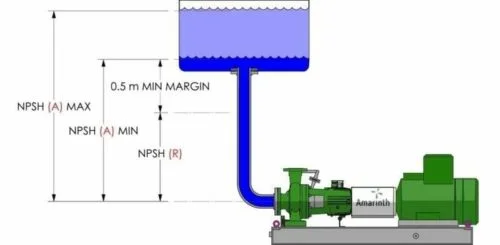
The Hydraulic Institute — the industry body that sets the reference standards most pump manufacturers design to — defines the required value of NPSH as the point at which cavitation causes a measurable drop in the pump’s developed head, typically 3%.
Why Is NPSH Important in Centrifugal Pumps?
NPSH matters because it is the single factor that determines whether a centrifugal pump cavitates. When pressure at the impeller eye drops below the liquid’s vapor pressure, the liquid boils locally — not from heat, but from a drop in pressure — and forms small vapor bubbles. As these bubbles travel through the impeller into a region of higher pressure, they collapse violently.
That collapse isn’t gentle. Each bubble implosion generates a localized micro-jet and shockwave strong enough to pit and erode metal surfaces over time. The practical consequences include:
- Impeller and volute erosion from repeated micro-jet impact
- Loud, grinding noise, often described as “pumping gravel”
- Excessive vibration, which shortens bearing and seal life
- Sudden loss of head and flow, sometimes severe enough to stall the pump
- Mechanical seal failure from heat and vibration
- Reduced efficiency and higher energy consumption
As explained in a detailed piece from Pumps & Systems on NPSH and cavitation, bubble formation actually begins well before any visible drop in pump head — meaning a pump can be cavitating internally long before an operator notices any performance change.
Because this damage accumulates silently, understanding and correctly calculating NPSH during the design stage is far cheaper than replacing a chewed-up impeller six months into operation.
Types of NPSH (NPSHA vs NPSHR)
There are two distinct values that engineers work with, and confusing them is one of the most common mistakes in pump sizing.
| Term | Full Name | What It Represents | Who Determines It |
|---|---|---|---|
| NPSHA | Net Positive Suction Head Available | The actual head available at the pump suction, based on your system’s layout, elevation, and losses | The system designer, based on piping and tank layout |
| NPSHR | Net Positive Suction Head Required | The minimum head the pump needs at its suction to avoid damaging cavitation | The pump manufacturer, from factory testing |
The golden rule of pump selection is simple: NPSHA must always be greater than NPSHR, with a safety margin built in. If NPSHA ever falls below NPSHR — even briefly, such as during a temperature spike or a partially closed suction valve — cavitation begins.
Per the technical reference on NPSH, NPSHA and NPSHR from Michael Smith Engineers, NPSHR is sometimes labeled NPSH3 or NPSH3%, referencing the industry-standard 3% head-drop test used to determine it, and on multistage pumps this test only considers the first stage.
What Is NPSHA?
NPSHA (Net Positive Suction Head Available) is a property of your piping system, not the pump itself. It answers the question: “How much usable pressure head is actually reaching the pump suction, after accounting for elevation, friction, and vapor pressure?”
NPSHA depends on:
- The pressure above the liquid surface at the source (atmospheric or vessel pressure)
- The static elevation difference between the liquid surface and the pump centerline
- Friction losses in the suction piping, fittings, and strainer
- The vapor pressure of the liquid at operating temperature
Because NPSHA is calculated from real, measurable system conditions, it changes whenever any of those conditions change — a partially clogged strainer, a hotter-than-design fluid, or a lower tank level can all silently erode your available margin.
Net Positive Suction Head Formula
The standard formula for NPSH Available is:
NPSHA = Ha + Hs − Hf − Hvp
Where:
- Ha = Absolute pressure on the surface of the liquid at the source (atmospheric pressure for an open tank, or absolute pressure for a closed/pressurized vessel), expressed as head
- Hs = Static suction head — positive if the liquid source is above the pump centerline (flooded suction), negative if the pump must lift the liquid (suction lift)
- Hf = Friction and entrance losses in the suction piping, fittings, valves, and strainer
- Hvp = Vapor pressure of the liquid at the pumping temperature, expressed as head
This is consistent with the working formula referenced across engineering literature, such as Enginist’s explainer on NPSHa vs NPSHr, which expresses it as atmospheric pressure plus static head minus friction losses minus vapor pressure head.
All terms must be expressed in the same units (typically meters or feet of the liquid being pumped) and referenced to the same datum — usually the pump suction centerline for horizontal pumps, or the impeller eye for vertical pumps.
How to Calculate Net Positive Suction Head
Calculating NPSHA is a straightforward, step-by-step process once you have the right data. Here’s a worked example.
Scenario: Water at 25°C is pumped from an open atmospheric tank whose surface sits 3 m above the pump centerline. Suction piping losses total 0.8 m. The installation is at sea level.
Step 1 — Atmospheric pressure head (Ha). At sea level, standard atmospheric pressure equals approximately 10.33 m of water.
Step 2 — Static suction head (Hs). Since the tank surface is above the pump, this is a flooded suction: Hs = +3 m.
Step 3 — Friction losses (Hf). Given as 0.8 m, based on pipe length, diameter, fittings, and flow velocity.
Step 4 — Vapor pressure head (Hvp). For water at 25°C, vapor pressure head is approximately 0.32 m.
Step 5 — Apply the formula.
NPSHA = 10.33 + 3 − 0.8 − 0.32 = 12.21 m
Step 6 — Compare against NPSHR. If the pump’s published NPSHR at the operating flow rate is 4.5 m, the margin is:
12.21 − 4.5 = 7.71 m, which is comfortably positive.
A safety margin of at least 0.5–1 m (or 10% of NPSHR, whichever is greater) above the bare minimum is generally recommended to allow for real-world variation in temperature, flow, and system wear.
Read More Like This: What is Surging in Pumps
Factors Affecting NPSH in Centrifugal Pumps
- Fluid temperature — higher temperature increases vapor pressure, which directly reduces NPSHA
- Elevation and altitude — lower atmospheric pressure at higher altitudes reduces the available head
- Suction pipe diameter and length — undersized or overly long suction piping increases friction losses
- Number of fittings, elbows, and valves — each adds resistance and reduces NPSHA
- Strainer or foot valve condition — a clogged or undersized strainer is a frequent, overlooked cause of NPSH loss
- Liquid level in the source tank — a falling tank level reduces static suction head over time
- Flow rate — NPSHR increases as flow rate increases, while NPSHA typically decreases, narrowing the margin at high flow
- Specific gravity and viscosity of the fluid — heavier or more viscous fluids change friction losses and head calculations
Because several of these factors move in the wrong direction simultaneously during real operation — a hot summer day, a low tank, and high demand, for instance — engineers typically design in a generous margin rather than sizing to the bare minimum.
Suction Head vs Net Positive Suction Head
| Aspect | Suction Head | Net Positive Suction Head (NPSH) |
|---|---|---|
| Definition | The elevation (or pressure) difference between the liquid source and the pump centerline | The absolute pressure margin above the liquid’s vapor pressure at the pump suction |
| Accounts for vapor pressure? | No | Yes |
| Purpose | Describes the physical layout of the suction side | Predicts whether cavitation will occur |
| Can be negative? | Yes (suction lift condition) | Should never be negative in a healthy system |
| Used for | Basic system layout and pump placement | Pump selection and cavitation prevention |
In short, suction head is one input used to calculate NPSH — but NPSH is the more complete, safety-critical figure because it factors in the fluid’s tendency to vaporize.
How to Increase NPSH in a Centrifugal Pump
- Raise the liquid source relative to the pump, or lower the pump itself, to increase static suction head.
- Shorten the suction piping run and minimize the number of elbows, valves, and fittings.
- Increase suction pipe diameter to lower velocity and friction losses — suction lines are typically sized for lower velocities than discharge lines.
- Keep strainers and foot valves clean and sized generously to avoid unnecessary pressure drop.
- Lower the pumped fluid’s temperature where process conditions allow, reducing vapor pressure.
- Pressurize the suction vessel, if it’s a closed tank, to add head at the source.
- Select a pump with a lower NPSHR — inducers, larger-eye impellers, or double-suction designs generally require less NPSH.
- Avoid throttling on the suction side, which only adds unnecessary friction loss exactly where you can least afford it.
Common NPSH Problems and Pump Cavitation
- Undersized suction piping installed to save cost, which increases friction losses beyond original design assumptions
- Long suction runs with excessive elbows, especially when piping was routed around obstacles without recalculating losses
- Clogged or undersized strainers that gradually restrict flow as debris accumulates
- Operating far right of the pump curve (high flow), where NPSHR rises sharply while NPSHA falls
- Falling tank or sump levels that reduce static suction head during operation, particularly on intermittent or batch processes
- Hot fluid services where vapor pressure was underestimated at the actual operating temperature rather than ambient temperature
- Air entrainment or vortexing at the suction inlet due to insufficient submergence, which mimics cavitation symptoms
Left unaddressed, any of these conditions can push a system into cavitation — the characteristic rattling noise, vibration, and gradual loss of discharge pressure. An impeller can visibly pit and erode within months, and mechanical seals often fail well before the impeller shows obvious damage. Routine monitoring of suction pressure, vibration, and noise is the most reliable way to catch a developing NPSH problem before it becomes a costly failure.
Frequently Asked Questions
1. What is net positive suction head in a centrifugal pump?
It is the amount of absolute pressure head available at the pump’s suction nozzle above the liquid’s vapor pressure, which determines whether the pump will cavitate.
2. How do you calculate NPSH in a centrifugal pump?
Use the formula NPSHA = Ha + Hs − Hf − Hvp, where each term accounts for atmospheric pressure, static suction head, friction losses, and the liquid’s vapor pressure, all expressed as head.
3. What is the difference between NPSHA and NPSHR?
NPSHA is the head actually available from the system layout, while NPSHR is the minimum head the specific pump needs to avoid cavitation, as determined by the manufacturer’s testing.
4. Why is NPSH important in centrifugal pumps?
It directly predicts cavitation risk. Insufficient NPSH causes vapor bubbles to form and collapse inside the pump, leading to noise, vibration, efficiency loss, and mechanical damage.
5. What causes low NPSH in a centrifugal pump?
Common causes include undersized or long suction piping, clogged strainers, high fluid temperature, low tank levels, high altitude, and operating at high flow rates beyond the pump’s efficient range.
6. How can I avoid cavitation in a centrifugal pump?
Ensure NPSHA comfortably exceeds NPSHR with an adequate safety margin, keep suction piping short and properly sized, maintain clean strainers, and avoid operating the pump far outside its best efficiency point.
7. What is the minimum NPSH margin required?
A common guideline is a margin of at least 0.5–1 m, or 10% of NPSHR, whichever is greater, though critical services such as hydrocarbons often call for higher margins per API and Hydraulic Institute recommendations.
8. Can NPSH be negative?
NPSHA should never be allowed to reach zero or go negative in practice — doing so guarantees severe, ongoing cavitation and rapid pump damage.
Sources: Wikipedia – Net Positive Suction Head · Pumps & Systems – NPSH & Cavitation · Michael Smith Engineers – NPSH, NPSHA & NPSHR · Enginist – NPSH Explained · RA Mueller – NPSH and Cavitation · U.S. DOE – Summary of Hydraulic Institute Standards