What Is Cavitation in Centrifugal Pump? Causes, Effects, Types & Prevention
If you work with rotating equipment, you’ve probably heard a centrifugal pump making a strange rattling or gravel-like noise and wondered what was going on inside it. In most cases, that sound points to one specific problem: cavitation. Cavitation in pump systems is one of the most common — and most damaging — issues faced in industrial maintenance, and understanding it is essential for anyone responsible for pump reliability.
In this guide, we’ll break down exactly what cavitation in a centrifugal pump is, why it happens, the different types of pump cavitation, its effects on equipment, and how to prevent it using proper NPSH management.
What Is Cavitation in Centrifugal Pump?
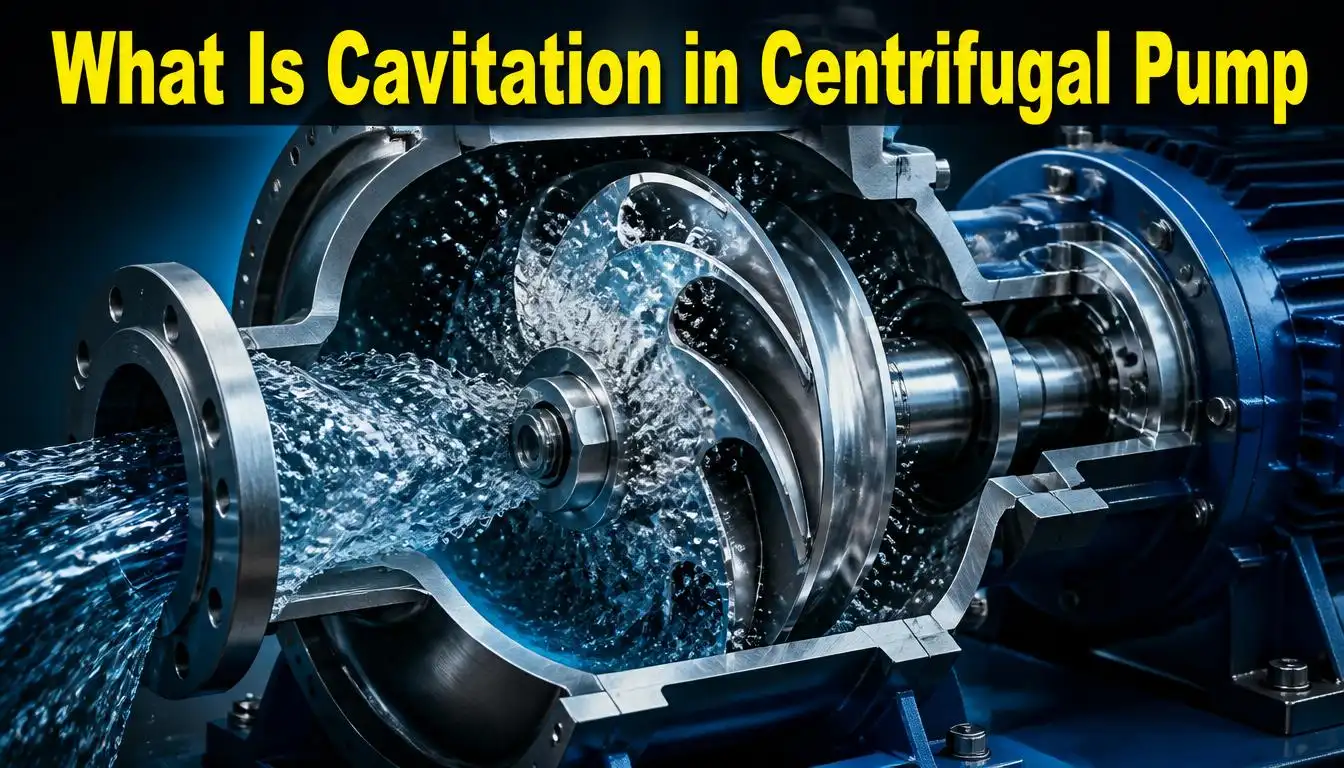
Cavitation in a centrifugal pump is a phenomenon where vapor bubbles form inside the liquid being pumped, then violently collapse as they move into a region of higher pressure. This happens when the local pressure of the liquid drops below its vapor pressure at the pump’s operating temperature, causing the liquid to momentarily flash into vapor.
These vapor bubbles form near the low-pressure area at the pump impeller’s eye (the suction side), then travel toward the higher-pressure discharge side, where they collapse almost instantly. This collapse releases intense localized shock waves — strong enough to erode metal, damage impellers, and reduce pump efficiency over time.
In short, pump cavitation is essentially the liquid “boiling” at normal temperature because of a pressure drop, not because of heat. For a deeper technical breakdown of the underlying physics, see Wikipedia’s overview of cavitation.
Cavitation Definition
To put it simply, the cavitation meaning in engineering refers to the formation and violent collapse of vapor-filled cavities (bubbles) within a liquid due to rapid changes in pressure. When engineers define cavitation, they typically describe it as a two-stage process: bubble formation (vaporization) followed by bubble collapse (implosion), both occurring within a flowing liquid system such as a pump, valve, or propeller.
This definition applies broadly across fluid mechanics, but it becomes especially critical in centrifugal pump cavitation, where the impeller’s rotational speed and suction conditions create the exact pressure swings needed for cavitation to occur.
How Does Pump Cavitation Occur?
Cavitation in a pump occurs in three basic stages:
- Pressure drop at the impeller eye — As liquid enters the impeller, its velocity increases and its pressure drops. If suction conditions are poor, this pressure can fall below the liquid’s vapor pressure.
- Vapor bubble formation — The liquid vaporizes locally, forming tiny vapor-filled bubbles or cavities within the flow stream.
- Bubble collapse (implosion) — As the bubbles move toward the pump’s higher-pressure discharge zone, they collapse suddenly. This implosion generates intense micro-jets and shockwaves that strike nearby surfaces, such as the impeller vanes and volute casing.
This cycle repeats continuously during cavitating conditions, which is why cavitation damage tends to worsen the longer a pump is allowed to run in this state.
Types of Cavitation in Centrifugal Pumps
Not all cavitation in pumps happens for the same reason. Broadly, there are two major types:
- Suction Cavitation — Occurs when the pump doesn’t receive enough flow or pressure at its suction side. This is the most common form of centrifugal pump cavitation, often caused by clogged strainers, low reservoir levels, or undersized suction piping.
- Discharge Cavitation — Happens when the pump’s discharge pressure is too high relative to the flow, often due to a mostly closed discharge valve. This traps liquid inside the pump casing, causing it to recirculate at high velocity and eventually vaporize.
Other recognized variations include:
- Internal Recirculation Cavitation — Occurs at low flow rates when liquid recirculates internally within the impeller.
- Vane Passing Syndrome — Caused by close tolerances between the impeller and the pump casing/diffuser, leading to localized pressure pulses.
Causes of Cavitation in Pumps
Several operating and design factors contribute to pump cavitation:
- Insufficient Net Positive Suction Head (NPSH) — When the available NPSH is lower than the pump’s required NPSH.
- Clogged or restricted suction lines — Reduces flow into the pump, dropping suction pressure.
- Low liquid level in the supply tank — Can allow air ingestion and pressure loss.
- Oversized pump for the application — Forces the pump to operate outside its efficient flow range.
- High liquid temperature — Increases vapor pressure, making the liquid more prone to vaporizing.
- Excessive suction lift or long suction piping — Increases friction losses and lowers available suction pressure.
- Partially closed suction valve — Restricts flow and causes a localized pressure drop.
Identifying which of these factors applies to your system is the first step in resolving cavitation in centrifugal pump installations. Wilo’s guide to pump cavitation offers useful visual explanations of these causes and their impact.
Effects of Cavitation on Centrifugal Pumps
Cavitation isn’t just a noise issue — it directly threatens pump reliability and lifespan. Common effects include:
- Impeller and casing erosion — Repeated bubble implosions pit and erode metal surfaces, especially on impeller vanes.
- Reduced flow and head performance — Vapor pockets disrupt the smooth flow of liquid, reducing the pump’s overall output.
- Increased vibration and noise — The classic “marbles” or “gravel” sound is a direct symptom of ongoing cavitation.
- Mechanical seal and bearing damage — Excess vibration accelerates wear on seals, bearings, and shafts.
- Reduced pump efficiency and higher energy costs — A cavitating pump works harder to deliver less output.
- Premature equipment failure — Left unaddressed, cavitation can significantly shorten a pump’s service life and lead to unplanned downtime.
Signs and Symptoms of Pump Cavitation
Recognizing pump cavitation early can save significant repair costs. Watch for:
- Unusual rattling, popping, or “gravel-like” noise from the pump
- Fluctuating flow rate or discharge pressure
- Abnormal vibration at the pump or motor
- Reduced pump efficiency or output compared to design specs
- Visible pitting or erosion on the impeller during inspection
- Overheating of the pump casing or bearings
What Is NPSH in Pumps?
NPSH, or Net Positive Suction Head, is one of the most important concepts in preventing cavitation in centrifugal pump systems. NPSH refers to the amount of suction pressure available at the pump’s suction port, above the liquid’s vapor pressure, expressed in units of head (typically feet or meters).
As explained in ScienceDirect’s engineering reference on NPSH, this value has a direct impact on pump capacity and is one of the most important parameters in judging a centrifugal pump’s suction behavior.
There are two key values engineers work with:
- NPSH Available (NPSHa) — The actual suction head available in the system, based on tank elevation, piping losses, fluid properties, and atmospheric pressure.
- NPSH Required (NPSHr) — The minimum suction head the pump needs at its impeller eye to avoid cavitation, determined by the pump manufacturer through testing.
For a pump to operate without cavitating, the NPSH available in the system must always be greater than the NPSH required by the pump — usually with a safety margin. Engineering ToolBox’s NPSH reference provides worked calculations and formulas if you want to go deeper into the math.
Relationship Between Cavitation and Net Positive Suction Head (NPSH)
The relationship between cavitation and NPSH is direct and fundamental: cavitation occurs precisely when NPSH available drops below NPSH required. In other words, insufficient NPSH is the root technical cause behind almost every case of centrifugal pump cavitation.
When NPSHa falls below NPSHr, the pressure at the impeller eye drops below the liquid’s vapor pressure, triggering bubble formation and the cavitation cycle described earlier. This is why NPSH calculations are a mandatory part of pump selection and system design — getting them wrong almost guarantees cavitation problems down the line.
Maintaining a healthy NPSH margin (commonly 3–10% above NPSHr, depending on the application) is one of the most effective ways to protect a pump from cavitation damage. Wikipedia’s entry on Net Positive Suction Head includes worked examples showing how negative NPSH margins lead directly to cavitation and performance loss.
How to Prevent Cavitation in Centrifugal Pumps
Preventing pump cavitation comes down to maintaining adequate suction conditions and operating the pump within its designed range. Key strategies include:
- Ensure NPSH available exceeds NPSH required, with an adequate safety margin.
- Keep suction piping short and simple — minimize elbows, valves, and fittings that add friction losses.
- Raise the liquid supply level or lower the pump relative to the source, when possible, to increase available suction head.
- Regularly clean strainers and filters to prevent flow restriction.
- Avoid throttling the suction valve — control flow from the discharge side instead.
- Select the right pump size for the actual flow and head requirements, avoiding oversized units running off their best efficiency point.
- Monitor liquid temperature, since higher temperatures raise vapor pressure and reduce cavitation margin.
- Install a booster pump if suction conditions cannot otherwise meet NPSH requirements.
- Conduct routine vibration and performance monitoring to catch early signs of cavitation before serious damage occurs.
Difference Between Cavitation and Air Entrapment
Cavitation and air entrapment are often confused because both can cause noise, vibration, and reduced pump performance — but they are fundamentally different phenomena.
- Cavitation involves the liquid itself vaporizing due to a localized pressure drop below its vapor pressure, followed by violent bubble collapse.
- Air entrapment occurs when air (not vapor from the pumped liquid) enters the pump system — typically through a leaking suction line, vortexing at the tank inlet, or a poorly sealed fitting — and gets trapped inside the pump casing.
While both issues reduce efficiency and can cause similar symptoms, air entrapment is generally resolved by fixing seals, gaskets, or vortex-causing conditions, whereas cavitation requires addressing pressure and NPSH-related root causes. Correctly diagnosing which one you’re dealing with is essential, since the fixes are quite different.
Frequently Asked Questions
What is cavitation in a centrifugal pump?
Cavitation in a centrifugal pump is the formation and collapse of vapor bubbles inside the pumped liquid, caused when local pressure drops below the liquid’s vapor pressure, typically at the impeller eye.
What causes cavitation in pumps?
The most common causes are insufficient NPSH, clogged suction lines, low tank levels, oversized pumps, high liquid temperature, and restricted or throttled suction valves.
How do you stop pump cavitation?
Stop pump cavitation by ensuring NPSH available exceeds NPSH required, simplifying suction piping, maintaining adequate liquid supply levels, cleaning strainers, and selecting a correctly sized pump for the application.
What is NPSH in a pump?
NPSH, or Net Positive Suction Head, is the amount of suction pressure available at a pump’s inlet above the liquid’s vapor pressure. It determines whether the pump can operate without cavitating.
What is the relationship between cavitation and NPSH?
Cavitation occurs when NPSH available falls below NPSH required. Maintaining an adequate NPSH margin is the primary way to prevent cavitation in centrifugal pumps.
How can you identify cavitation in a centrifugal pump?
Signs of cavitation include a rattling or gravel-like noise, vibration, fluctuating flow or pressure, reduced efficiency, and visible pitting on the impeller during inspection.
What are the effects of cavitation on pump performance?
Cavitation reduces flow and head output, increases vibration and noise, accelerates wear on seals and bearings, erodes impeller and casing surfaces, and lowers overall pump efficiency.
Is cavitation harmful to centrifugal pumps?
Yes. If left unaddressed, cavitation causes progressive mechanical damage — including impeller erosion, seal failure, and bearing wear — that can significantly shorten a pump’s service life and lead to unexpected downtime.
Conclusion
Cavitation in pumps is one of the most critical issues in centrifugal pump operation, directly affecting efficiency, reliability, and equipment lifespan. Understanding what pump cavitation is, why it happens, and how it relates to NPSH gives maintenance and engineering teams the knowledge needed to prevent it before it causes costly damage.
By maintaining proper NPSH margins, keeping suction systems clean and well-designed, and monitoring for early warning signs, you can keep centrifugal pumps running smoothly and avoid the performance losses and equipment failures that untreated cavitation in pumps inevitably brings.