
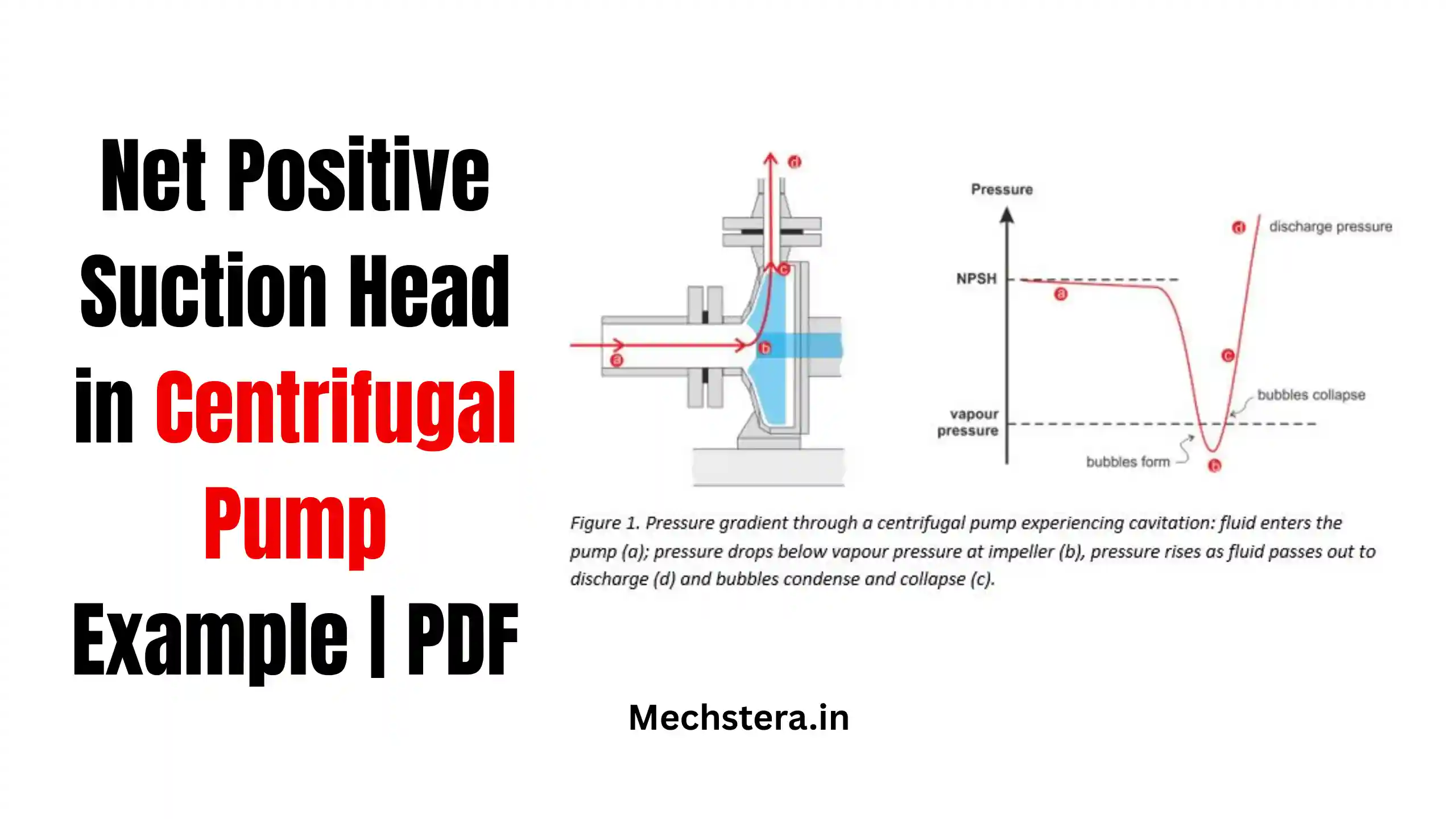
A centrifugal pump can look perfectly healthy from the outside while the conditions at its suction side are already creating trouble. A little noise, unusual vibration, fluctuating flow, or repeated seal and impeller damage may eventually lead engineers back to one hydraulic parameter: net positive suction head in centrifugal pump systems.
NPSH is not simply another value printed on a pump datasheet. It tells us whether the liquid reaching the pump has enough pressure to remain in the liquid state as it passes through the low pressure region near the impeller eye. If that pressure becomes too low, vapor bubbles can form and collapse inside the pump. That phenomenon is known as cavitation and can seriously affect pump reliability.
At Mechstera, we look at NPSH as a system problem rather than a pump-only problem. The pump manufacturer provides the required value, but the piping, tank, liquid temperature, elevation, pressure and operating flow determine what the system can actually provide.
What is net positive suction head in centrifugal pump?
The simplest way to understand net positive suction head is to think about the pressure available at the pump suction above the liquid’s vapor pressure, expressed as a head of liquid.
Inside a centrifugal pump, pressure is not constant. The liquid enters through the suction nozzle and moves toward the impeller eye, where the local pressure can fall significantly. If the pressure at the lowest pressure point drops below the liquid’s vapor pressure, the liquid can begin to vaporize. The resulting vapor bubbles may then collapse as they move into higher pressure regions.
This is why NPSH matters so much in practical pump operation.
There are two values engineers need to keep separate:
| Parameter | Meaning | Determined by |
|---|---|---|
| NPSHa | Net Positive Suction Head Available | System conditions |
| NPSHr | Net Positive Suction Head Required | Pump manufacturer |
| NPSH margin | Difference between available and required NPSH | System and pump selection |
NPSHa describes what the installation can provide at a particular operating condition. NPSHr describes what the selected pump needs at a particular flow rate. The available NPSH should remain above the required NPSH with an appropriate margin. Grundfos, for example, recommends an available NPSH greater than required NPSH by at least 0.5 m in its general guidance.
NPSHa vs NPSHr: what is the difference?
This is where many pump problems begin. Engineers sometimes see an NPSH number on a pump curve and assume that it represents the suction pressure available in the plant. It does not.
NPSHa is a property of the system. It depends on factors such as atmospheric or vessel pressure, liquid level, pump elevation, suction pipe losses, fittings and liquid vapor pressure.
NPSHr is a property of the pump at a specified operating condition. The manufacturer determines it through pump testing and provides the value on the pump performance documentation.
| NPSHa | NPSHr | Practical condition |
|---|---|---|
| 8 m | 5 m | Reasonable operating margin |
| 6 m | 5 m | Small margin, check operating variation |
| 5 m | 5 m | No practical margin |
| 4 m | 5 m | Cavitation risk |
| 3 m | 5 m | Serious suction problem |
The important relationship is:
NPSHa > NPSHr
But simply being a few centimeters above the required value is not a good design strategy. Flow changes, temperature changes, measurement uncertainty and suction-side fouling can reduce the actual margin during operation.
Net positive suction head in centrifugal pump formula
The net positive suction head in centrifugal pump formula depends on how the system is arranged. For a typical open tank installation, a useful form is:
NPSHa = Patm/ρg + Hs − Hf − Pv/ρg
Where:
- Patm/ρg = atmospheric pressure expressed as liquid head
- Hs = static liquid head relative to the pump reference point
- Hf = friction and minor losses in the suction line
- Pv/ρg = vapor pressure expressed as liquid head
For a pump installed above an open tank, the elevation term reduces available NPSH. For a pump below the liquid level, the static head contributes positively to NPSHa. Engineering ToolBox presents the same energy-balance approach and also accounts for suction-side velocity and elevation effects.
For a closed or pressurized vessel, atmospheric pressure should not simply be assumed. The absolute pressure at the liquid surface must be used instead.
That distinction matters in industrial systems. A process vessel operating under positive pressure can provide considerably more suction head than an open atmospheric tank.
How to calculate net positive suction head in centrifugal pump
When someone asks how to calculate net positive suction head in a centrifugal pump, the first step is to collect actual operating conditions instead of relying on ideal assumptions.
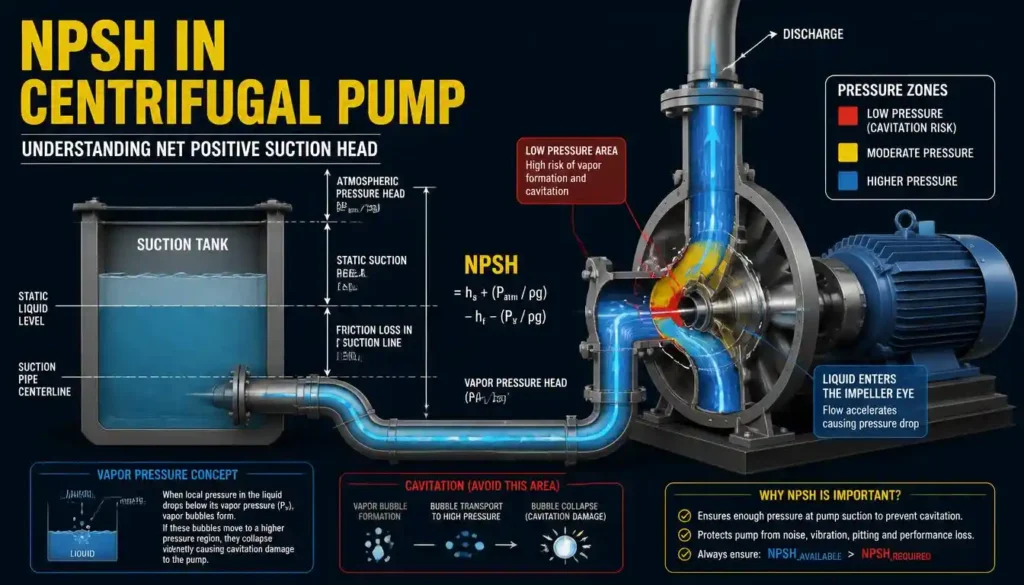
Consider an open tank containing a liquid. Suppose the pressure head equivalent at the liquid surface is 10 m, the liquid level provides 5 m of static head above the pump reference, vapor pressure corresponds to 2 m of liquid head, and suction-side losses equal 1 m.
Using the simplified equation:
NPSHa = Atmospheric pressure head + Static head − Vapor pressure head − Suction losses
Therefore:
NPSHa = 10 + 5 − 2 − 1
NPSHa = 12 m
So the system provides approximately 12 m of available NPSH under those assumed conditions.
Now imagine that the selected pump requires 8 m of NPSH at the same flow rate. The theoretical difference is:
NPSH margin = 12 − 8 = 4 m
That is a much more comfortable situation than a system where NPSHa is only 8.2 m against an NPSHr of 8 m.
The calculation should be repeated at the actual worst-case operating condition. A design that works with cold liquid and a full tank may behave very differently when the liquid becomes hotter or the tank level falls.
Net positive suction head in centrifugal pump example
Let’s take a more realistic engineering scenario.
Assume a centrifugal pump transfers water from an open tank. The pump is installed above the tank, so the liquid must travel upward through the suction line. The system has the following conditions:
| Parameter | Assumed value |
|---|---|
| Atmospheric pressure head | 10.3 m |
| Static suction lift | 3.0 m |
| Suction pipe and fitting losses | 1.0 m |
| Vapor pressure head | 0.3 m |
| NPSHr at operating flow | 4.0 m |
The available NPSH becomes:
NPSHa = 10.3 − 3.0 − 1.0 − 0.3
NPSHa = 6.0 m
The available margin is therefore:
NPSH margin = 6.0 − 4.0 = 2.0 m
At this operating condition, the system has a useful margin.
But now imagine that the water temperature rises. Vapor pressure increases as liquid temperature rises, which reduces available NPSH. If the suction strainer also becomes partially blocked, friction losses increase. Suddenly, the original calculation is no longer representative of the operating condition.
This is one reason I would never approve a pump installation based only on a single ideal NPSH calculation. The calculation needs to represent the conditions the pump will actually experience.
Meanwhile, you can also check out our Blog on : Positive Displacement Pump: How It Works & Its Types
Why vapor pressure matters in NPSH calculation
Temperature is one of the easiest NPSH variables to underestimate.
As the temperature of a liquid increases, its vapor pressure generally increases. That means the pressure required to keep the liquid from vaporizing also increases.
Water at moderate temperature may present relatively manageable vapor pressure, while hot water, hydrocarbons and other volatile liquids can become much more demanding from an NPSH perspective.
The result is straightforward: higher vapor pressure reduces NPSHa.
This becomes particularly important in boiler feed systems, hot-water circulation, chemical processing and other applications where the pumped liquid operates near its boiling or evaporation conditions.
Theoretical suction lift also has practical limitations. For water, atmospheric pressure corresponds to roughly 10.3 m of water head at sea-level conditions, but actual installations achieve less because of vapor pressure, friction losses and the pressure requirements inside the pump.
NPSH curve and flow rate
One detail that deserves more attention is the relationship between NPSH and flow.
NPSHr is generally not a fixed number for every operating point. The pump manufacturer provides an NPSH curve showing how the required value changes with flow. Grundfos explains that NPSH values depend on flow and generally increase as flow increases.
That means checking NPSHr only at the nominal flow can be misleading.
If a pump operates at a higher flow rate, the required NPSH may increase. A system that appears acceptable at one duty point can therefore move closer to cavitation when the operating point shifts.
This is also why the pump’s performance curve should be considered alongside the NPSH curve. Selecting a pump purely on discharge head and flow can create suction problems later.
What causes low NPSH in centrifugal pump systems?
In the field, low available NPSH usually comes from the interaction of several small problems rather than one dramatic design mistake. A long suction line, a dirty strainer and a lower tank level can combine to create a condition that was never present during commissioning.
Common causes include:
- Excessive suction pipe length or undersized suction piping
- High liquid temperature and increased vapor pressure
- Excessive suction lift
- Low pressure inside a closed supply vessel
- Partially blocked suction strainers
- Excessive elbows, valves and fittings on the suction side
- Poor tank and pump elevation arrangement
- Operation at a flow higher than the original design condition
- Air entering through leaks or poorly sealed suction connections
Suction piping deserves special attention because every fitting and restriction consumes pressure head. Engineering ToolBox’s energy equation approach explicitly accounts for major and minor losses between the liquid surface and pump suction.
A common mistake is to focus on discharge piping while treating the suction line as secondary. From an NPSH standpoint, that can be backwards.
Cavitation caused by insufficient NPSH
Cavitation is what happens when the local pressure inside the pump falls sufficiently for vapor bubbles to form and then collapse as pressure recovers.
The symptoms are often recognizable. Operators may hear a crackling or gravel-like sound from the pump. Vibration can increase. Flow and head can become unstable. Over time, repeated bubble collapse can damage hydraulic surfaces.
Grundfos describes cavitation as the formation and abrupt collapse of vapor-filled bubbles when pressure falls below the vapor pressure of the pumped medium.
| Cavitation symptom | Possible indication |
|---|---|
| Crackling or gravel-like noise | Vapor bubble formation and collapse |
| Increased vibration | Hydraulic instability |
| Reduced pump performance | Cavitation or poor operating condition |
| Impeller surface damage | Prolonged cavitation |
| Fluctuating flow | Unstable suction conditions |
| Premature component failure | Repeated hydraulic stress |
The damage can become expensive because cavitation does not always destroy a pump immediately. It can gradually erode hydraulic surfaces while operators continue running the equipment.
How to increase NPSH available
If a pump is experiencing an NPSH problem, the solution is not always to replace the pump. Often the system can be improved.
Start with the suction side. Reduce unnecessary pipe length, remove excessive restrictions and verify that the suction line is adequately sized. Check strainers and valves for blockage or incorrect positioning.
If possible, reducing the vertical distance between the liquid level and pump can improve the available suction condition. Installing the pump below the liquid level can provide positive static head rather than requiring the pump to lift the liquid.
Temperature also deserves attention. If the process allows it, reducing liquid temperature can lower vapor pressure and improve NPSHa.
Another approach is reducing the pump’s operating flow if the process permits. Since NPSHr commonly increases with flow, moving to a lower operating point can reduce the pump’s NPSH requirement. However, the pump must remain within its acceptable operating range.
Do not treat throttling as a universal cure. The pump still needs adequate cooling, lubrication and minimum flow.
NPSH safety margin for centrifugal pumps
There is no single margin that should blindly be applied to every pump and every liquid. The required margin depends on the pump, fluid, operating conditions, manufacturer guidance and consequences of cavitation.
As a practical starting point, the available NPSH should exceed the required value rather than merely equal it. Grundfos gives a general example of maintaining at least 0.5 m between NPSHa and NPSHr.
For critical services, engineers may choose a larger margin after considering temperature variation, flow variation, suction-line fouling, instrument accuracy and operating uncertainty.
The key is to calculate the margin at the worst credible operating condition, not just at the normal design point.
NPSH 3 percent meaning
You may also encounter the term NPSH3 or NPSH 3% in pump documentation.
It generally refers to the NPSH condition associated with a 3% reduction in pump head during standardized pump testing. It is commonly used as a reference for defining the pump’s required NPSH.
This is why an NPSHr value should not be interpreted as a magical point where the pump suddenly fails. It is a test-based performance criterion. Actual cavitation behavior and acceptable operating margin depend on the pump and application.
For process pumps, manufacturers may specify NPSH3 as part of the guaranteed operating data. KSB documentation, for example, uses NPSH3 together with system NPSHA when establishing permissible operating conditions.
NPSH vs suction lift
Suction lift and NPSH are related, but they are not interchangeable terms.
Suction lift describes a physical installation where the pump is positioned above the liquid surface. NPSH considers the complete pressure-energy condition at the pump suction, including atmospheric or vessel pressure, elevation, friction losses and vapor pressure.
A theoretical vacuum could lift water to a height of roughly 10.3 m under standard atmospheric conditions, but a real pump cannot simply use that entire theoretical value because vapor pressure and hydraulic losses consume part of the available head.
This distinction becomes especially useful during pump selection. Instead of asking only, “How much suction lift can this pump handle?” engineers should determine the NPSHa at the actual pump inlet and compare it with the manufacturer’s NPSHr.
Practical NPSH checklist for pump selection
Before approving a centrifugal pump for a new installation, I recommend checking the suction system as a complete hydraulic package rather than looking at the pump datasheet alone.
- Confirm liquid temperature and vapor pressure at the operating condition.
- Calculate NPSHa using actual tank pressure, elevation and suction-side losses.
- Obtain NPSHr from the manufacturer’s curve at the required operating flow.
- Check the lowest liquid level, highest temperature and maximum expected flow.
- Inspect suction piping, valves, strainers and fittings for unnecessary pressure losses.
- Maintain a suitable margin between NPSHa and NPSHr.
- Recheck the calculation if the process conditions, pump speed or piping arrangement changes.
These checks are simple, but they prevent a surprising number of suction-related problems.
NPSH calculation vs pump performance
NPSH should never be reviewed in isolation.
The pump’s flow, head, efficiency, power and NPSHr curves all describe different parts of the same operating condition. A pump may meet the required flow and head while still having inadequate NPSH.
That is why the final pump selection should consider the actual system curve and the pump performance curve together.
A pump with a slightly higher purchase price can be a better engineering choice if it provides a more suitable operating point and healthier suction margin. In my view, buyers chasing the lowest pump price usually regret it when the resulting installation requires repeated maintenance or modifications.
Final thoughts on net positive suction head in centrifugal pump
Understanding net positive suction head in centrifugal pump systems is ultimately about protecting the pump from poor suction conditions.
NPSHa tells you what the system can provide. NPSHr tells you what the pump needs. The difference between them gives you the operating margin.
A reliable NPSH assessment considers liquid temperature, vapor pressure, tank pressure, elevation, suction piping, friction losses and operating flow. It also considers the worst realistic condition rather than relying on a convenient nominal case.
For engineers, maintenance teams and plant operators, this approach turns NPSH from a number on a datasheet into a practical troubleshooting and design tool.
For additional technical background, Engineering ToolBox provides a useful reference on the energy balance and calculation of available NPSH. NPSH calculation reference
Frequently Asked Questions
What is NPSH in centrifugal pumps?
NPSH is a measure of the pressure head available above the vapor pressure of the pumped liquid at the relevant suction condition. It helps determine whether the pump has sufficient inlet pressure to avoid harmful cavitation.
What is the net positive suction head formula?
For a typical open tank system, a simplified form is NPSHa = atmospheric pressure head + static head − vapor pressure head − suction-side losses. The exact equation depends on the system configuration.
How to calculate net positive suction head in centrifugal pump?
Determine the absolute pressure or pressure head at the liquid source, account for elevation between the source and pump, subtract suction-line losses and subtract vapor pressure head. Then compare the resulting NPSHa with the pump’s NPSHr at the operating flow.
What is the difference between NPSHa and NPSHr?
NPSHa is supplied by the system, while NPSHr is the NPSH required by the pump. NPSHa must remain greater than NPSHr with an appropriate safety margin.
What does NPSH 3 percent mean?
NPSH3 generally refers to the NPSH condition associated with a 3% reduction in pump head during testing. It is commonly used as a reference value for the pump’s required NPSH.
How can NPSH available be increased?
NPSHa can often be improved by reducing suction-side losses, lowering the pump relative to the liquid source, reducing unnecessary suction restrictions, reducing liquid temperature where practical, or increasing pressure in a closed supply vessel.
Does increasing flow affect NPSH?
Yes. NPSHr generally changes with flow and commonly increases as flow increases. Therefore, NPSH should always be checked at the actual operating point and not treated as one constant pump value.







2 thoughts on “Net Positive Suction Head in Centrifugal Pump Example | PDF”