Maintenance is essential for keeping machines, equipment, systems, and industrial assets operating safely and efficiently. Whether it is a manufacturing plant, power station, oil and gas facility, processing plant, warehouse, or commercial building, equipment requires proper maintenance to perform its intended function.
Equipment naturally deteriorates over time. Bearings wear, lubricants degrade, electrical connections become loose, seals fail, components corrode, and machines can develop abnormal vibration or temperature. If these problems are not identified and managed properly, they can eventually result in equipment failure, production downtime, safety incidents, and expensive repairs.
Modern maintenance engineering therefore involves much more than simply fixing equipment after it breaks down. Organizations use different maintenance strategies depending on equipment criticality, failure behavior, operating conditions, safety requirements, and cost.
The four important maintenance strategies are corrective maintenance, preventive maintenance, predictive maintenance, and proactive maintenance.
Understanding how these four approaches differ can help maintenance engineers develop an effective maintenance program that improves reliability, reduces downtime, and controls maintenance costs.
What Are the Main Types of Maintenance?
The four major types of maintenance can be summarized as follows:
- Corrective Maintenance: Fixing a fault after it has been identified or after equipment has failed.
- Preventive Maintenance: Performing scheduled maintenance to reduce the likelihood of failure.
- Predictive Maintenance: Using equipment-condition data to determine when maintenance is required.
- Proactive Maintenance: Identifying and eliminating the root causes of equipment failures.
These strategies are not necessarily alternatives to one another. A well-designed maintenance program often combines all four approaches.
1. Corrective Maintenance
Corrective maintenance is maintenance performed to restore equipment after a defect, fault, or failure has been identified.
It can occur after a complete equipment breakdown or when an inspection identifies a problem that requires repair.
For example, if an industrial pump develops a leaking mechanical seal, the maintenance team may replace the seal and return the pump to normal operation.
Corrective maintenance can be divided into planned and unplanned corrective maintenance.
Planned Corrective Maintenance
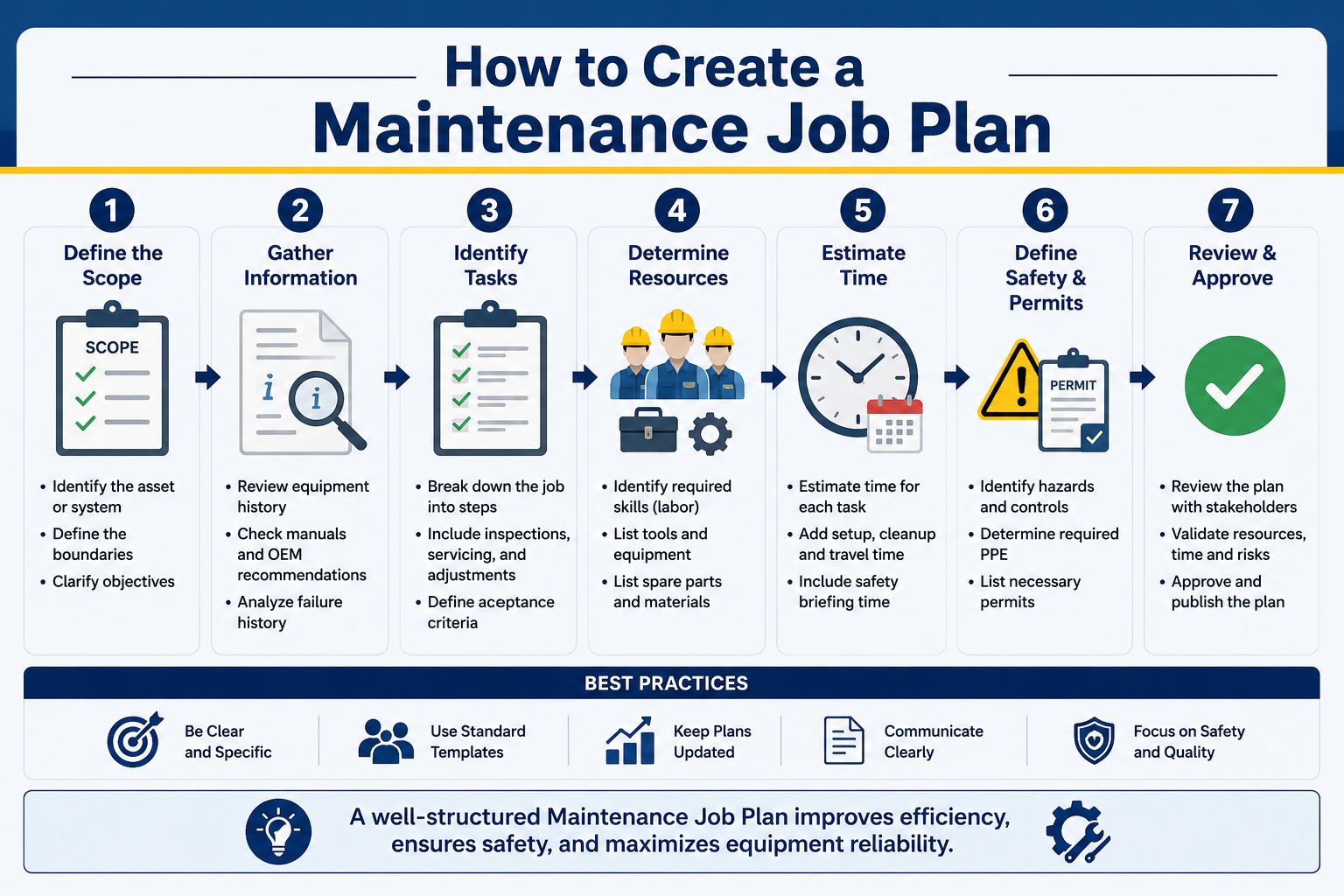
Planned corrective maintenance occurs when a problem has been identified but the equipment can continue operating safely until a suitable maintenance opportunity.
For example, an inspection may discover that a conveyor belt is beginning to wear. If the belt can continue operating safely, the replacement can be planned for the next scheduled shutdown.
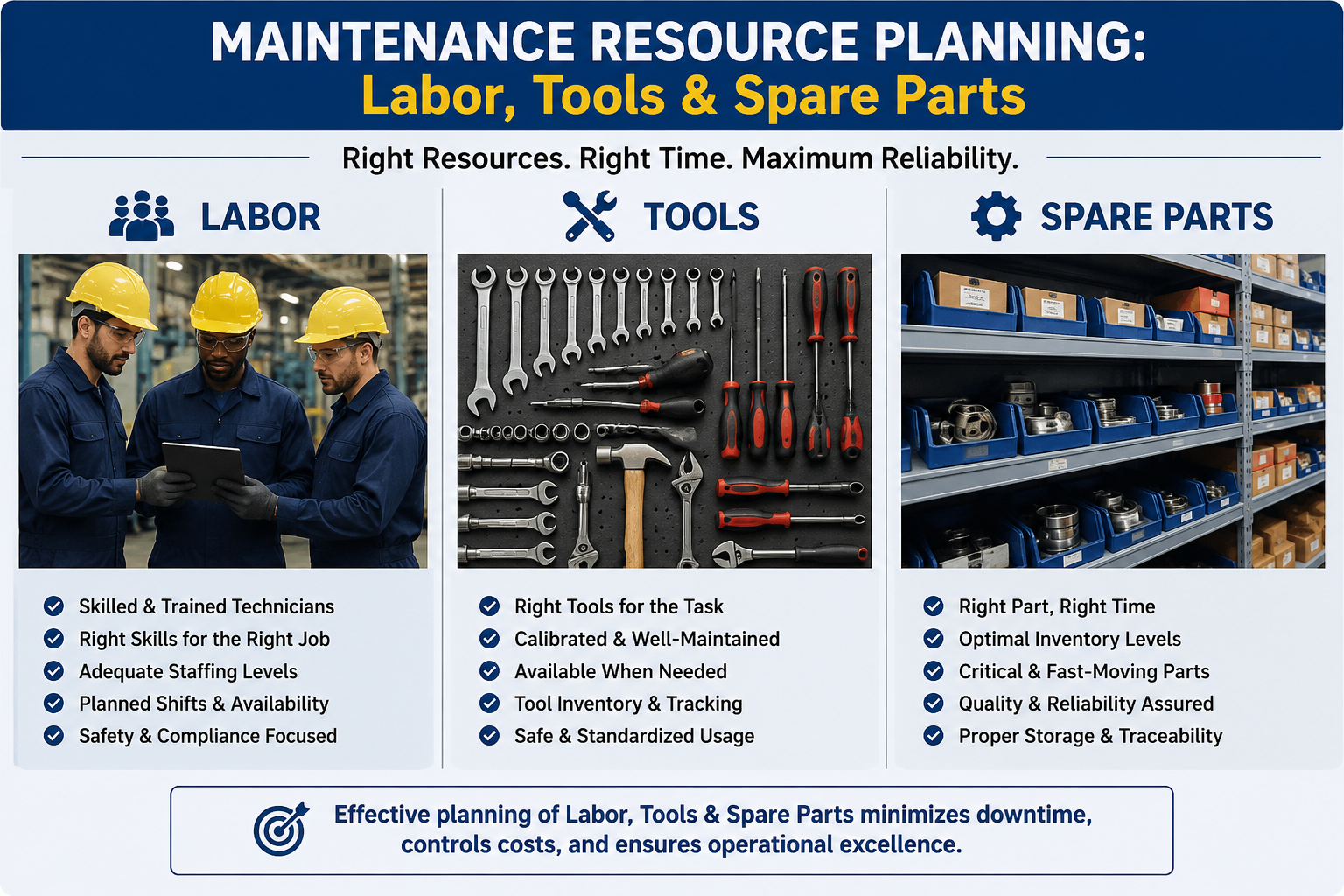
This approach allows maintenance teams to arrange:
- Labor
- Tools
- Spare parts
- Equipment isolation
- Work permits
- Maintenance procedures
Unplanned Corrective Maintenance
Unplanned corrective maintenance occurs when equipment fails unexpectedly and immediate repair is necessary.
Examples include:
- Electric motor failure
- Pump breakdown
- Gearbox failure
- Broken conveyor
- Hydraulic system failure
- Electrical component failure
Advantages of Corrective Maintenance
Corrective maintenance can be economical for equipment that is inexpensive, non-critical, or easy to replace.
Benefits include:
- Simple maintenance approach
- Lower routine maintenance requirements
- No unnecessary replacement of components
- Suitable for low-criticality assets
However, excessive reliance on corrective maintenance can result in unexpected downtime, emergency repair costs, production losses, and increased safety risks.
2. Preventive Maintenance
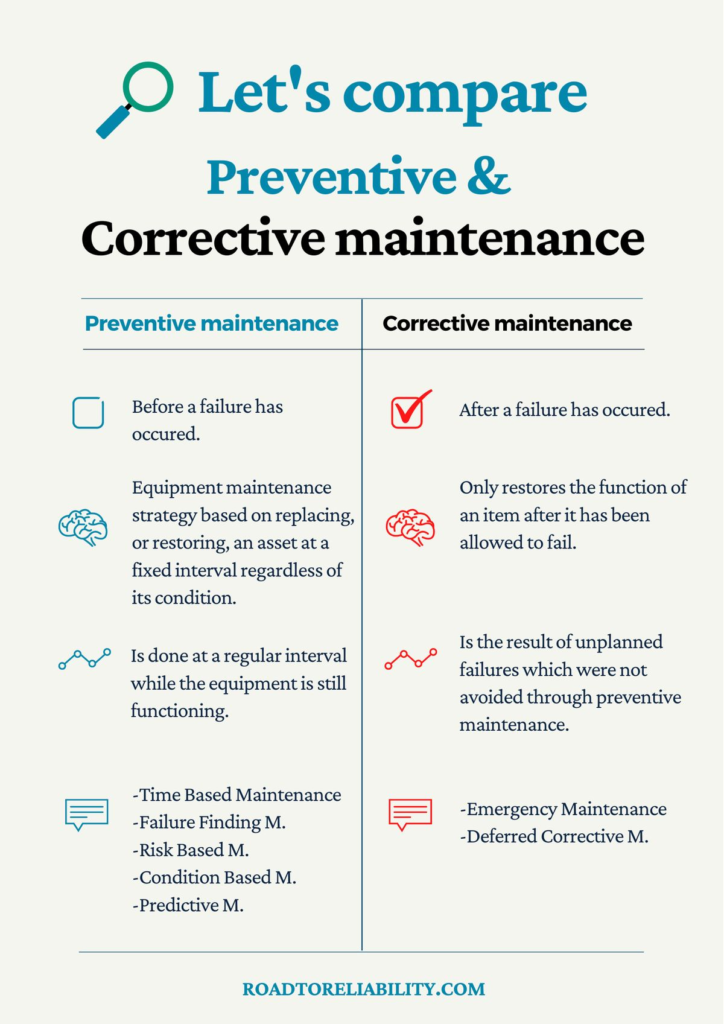
Preventive maintenance involves performing maintenance at predetermined intervals to reduce the probability of equipment failure.
Instead of waiting for equipment to fail, maintenance activities are scheduled based on time, operating hours, production cycles, mileage, or other usage criteria.
Typical preventive maintenance activities include:
- Lubrication
- Filter replacement
- Belt inspection
- Bearing inspection
- Cleaning
- Calibration
- Electrical testing
- Fastener tightening
- Component replacement
For example, a maintenance department may schedule an inspection of a compressor every three months or replace a filter after a specific number of operating hours.
Time-Based Preventive Maintenance
Time-based maintenance is performed according to a calendar schedule.
For example:
Inspect the pump every six months.
This approach is useful when equipment deterioration is reasonably associated with time.
Usage-Based Preventive Maintenance
Usage-based maintenance is triggered by how much an asset has operated.
For example:
Replace the component after 5,000 operating hours.
This can be more appropriate when component wear is directly related to equipment usage.
Advantages of Preventive Maintenance
Preventive maintenance provides several benefits:
- Reduces unexpected equipment failures
- Improves equipment reliability
- Allows maintenance work to be planned
- Improves spare-parts management
- Supports safer equipment operation
- Helps extend equipment life
- Reduces emergency maintenance
However, preventive maintenance must be properly optimized.
Performing maintenance too frequently can result in unnecessary labor, increased costs, additional downtime, and even maintenance-induced failures.
The objective should not be to perform as much maintenance as possible. The objective is to perform appropriate maintenance at the appropriate interval.
3. Predictive Maintenance
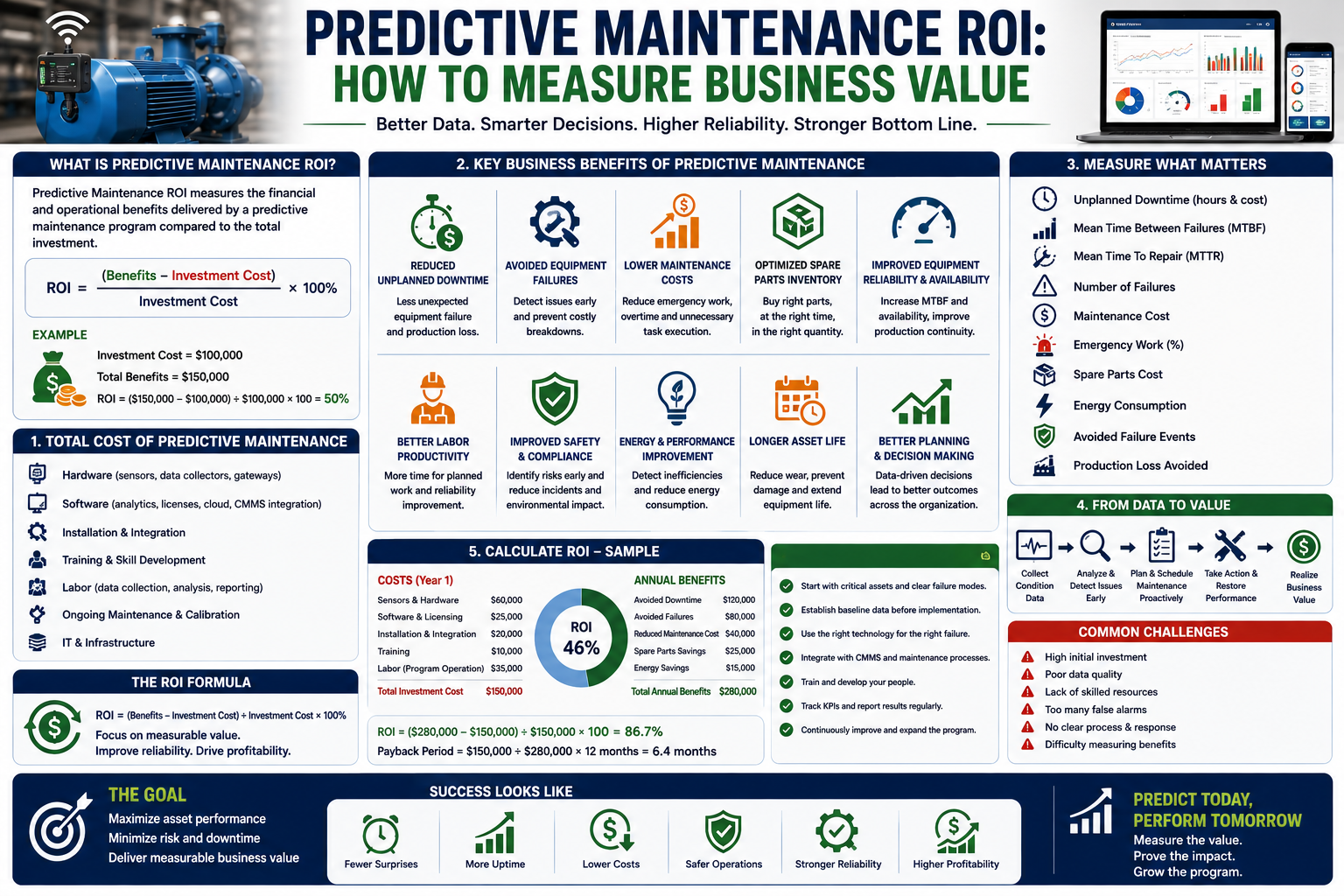
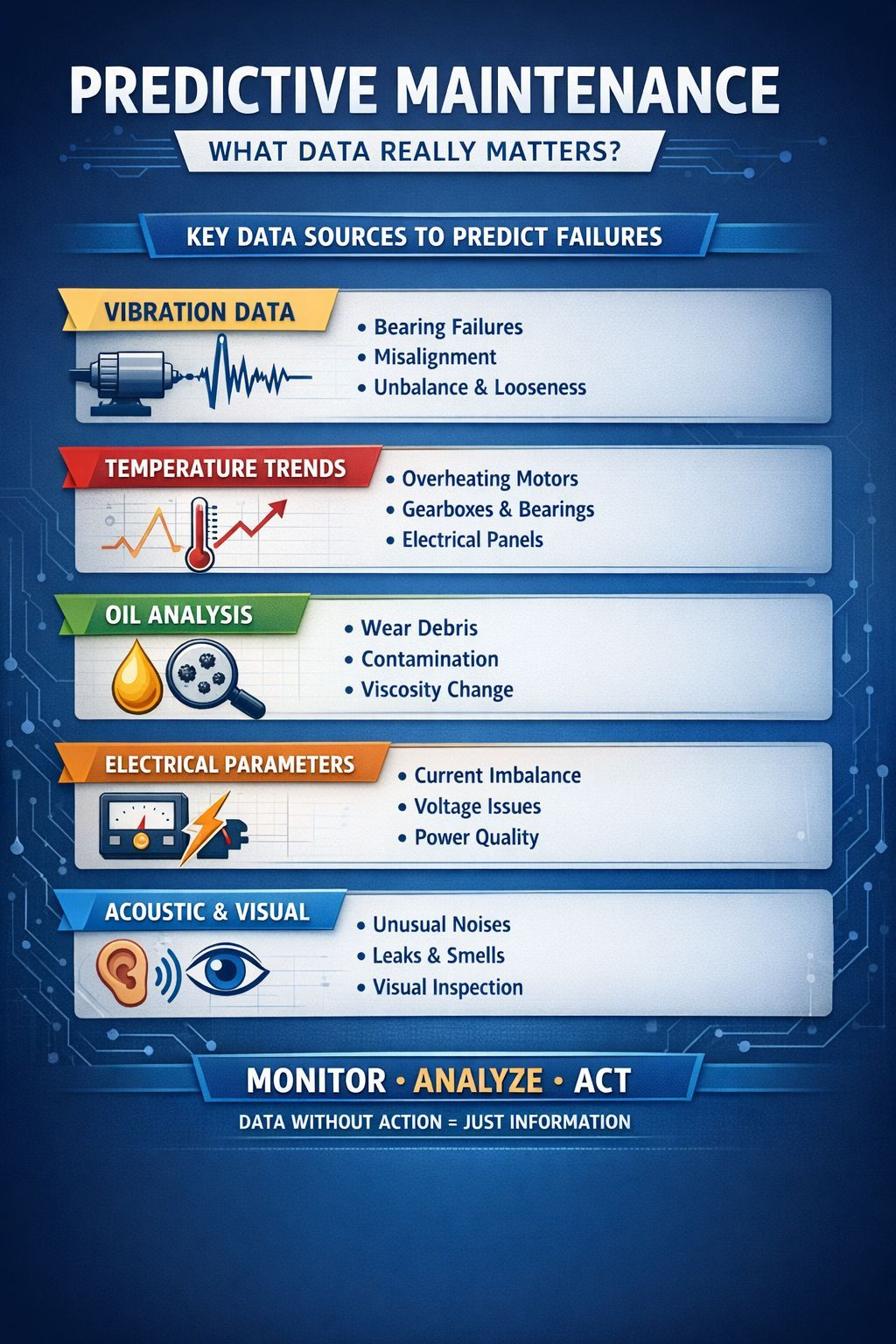
Predictive maintenance uses information about equipment condition to determine when maintenance should be performed.
Instead of relying only on fixed maintenance intervals, maintenance engineers monitor the actual condition of equipment.
Predictive maintenance is particularly useful for critical assets where unexpected failure can result in significant production losses or safety consequences.
Several technologies can be used for predictive maintenance.
Vibration Analysis
Vibration analysis is widely used for rotating machinery such as:
- Pumps
- Motors
- Compressors
- Fans
- Gearboxes
- Turbines
Changes in vibration patterns can indicate imbalance, misalignment, looseness, bearing deterioration, or gear problems.
Infrared Thermography
Infrared cameras can identify abnormal temperature patterns in electrical and mechanical equipment.
Thermal inspections can help identify:
- Overheated electrical connections
- Motor problems
- Bearing problems
- Electrical load abnormalities
- Insulation issues
Oil Analysis
Oil analysis provides information about lubricant condition and internal equipment wear.
It can help identify:
- Lubricant degradation
- Contamination
- Abnormal wear
- Internal component deterioration
Ultrasonic Inspection
Ultrasonic inspection can be used to detect compressed-air leaks, steam leaks, electrical discharge, and certain mechanical conditions.
Benefits of Predictive Maintenance
Predictive maintenance can:
- Detect problems at an early stage
- Reduce unplanned downtime
- Improve maintenance planning
- Reduce unnecessary component replacement
- Improve equipment reliability
- Support condition-based maintenance decisions
The main challenge is that predictive maintenance may require sensors, specialized equipment, software, trained personnel, and effective data management.
4. Proactive Maintenance
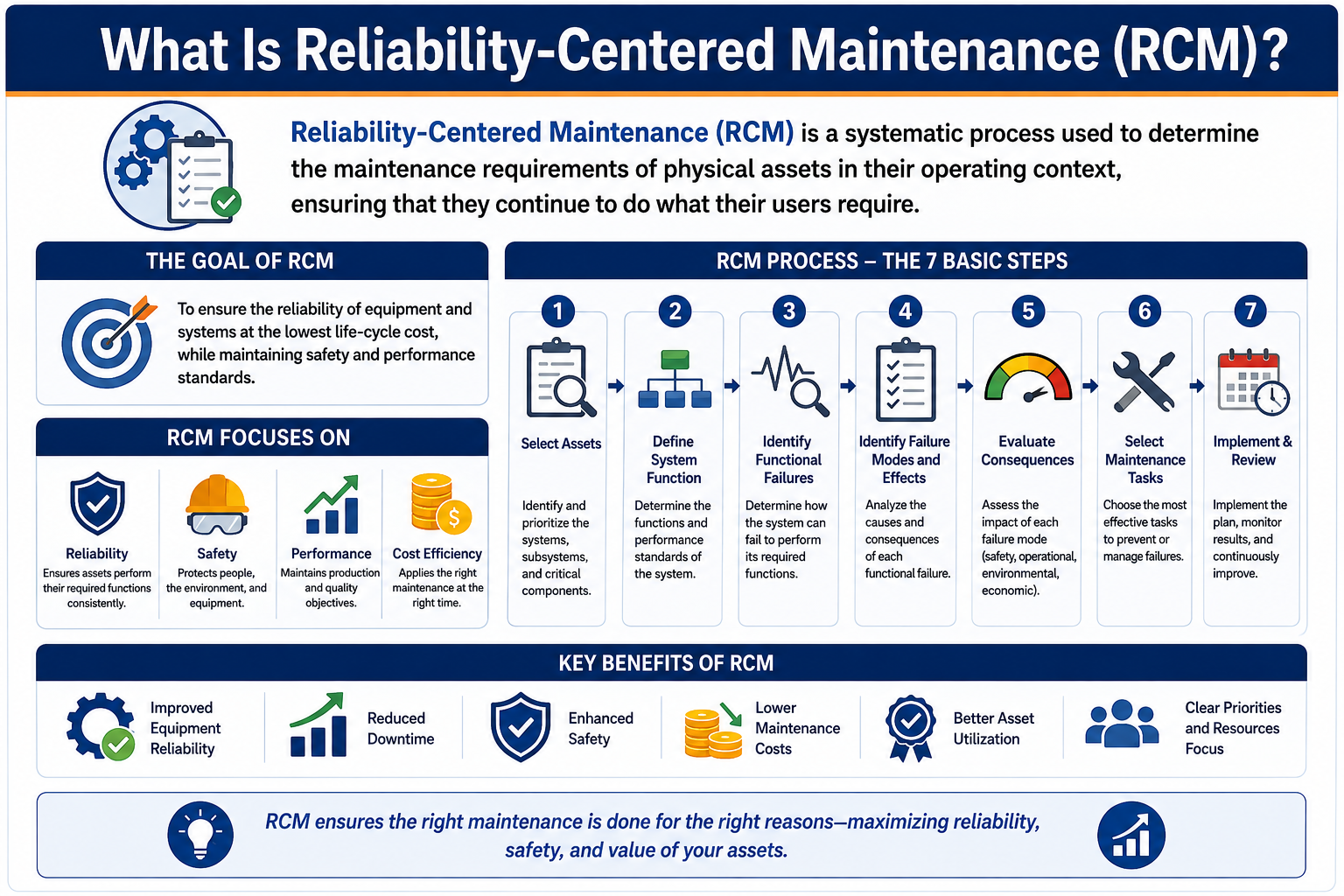
Proactive maintenance focuses on identifying and eliminating the underlying causes of equipment failure.
This approach asks a different question from traditional maintenance:
Why did the equipment fail, and what can we do to prevent the failure from happening again?
Consider an industrial pump that repeatedly experiences bearing failures.
Replacing the bearing after failure is corrective maintenance.
Monitoring vibration and replacing the bearing before failure is predictive maintenance.
Investigating why the bearing repeatedly fails and discovering that poor shaft alignment is causing excessive loading is proactive maintenance.
Correcting the alignment process addresses the underlying cause.
Common Proactive Maintenance Techniques
Proactive maintenance may involve:
- Root Cause Analysis (RCA)
- Failure Mode and Effects Analysis (FMEA)
- Reliability-Centered Maintenance (RCM)
- Precision alignment
- Precision balancing
- Lubrication optimization
- Contamination control
- Improved installation procedures
- Equipment modifications
- Operating-procedure improvements
The goal is to eliminate or control failure causes rather than repeatedly repairing the same problem.
Corrective vs Preventive vs Predictive vs Proactive Maintenance
| Maintenance Type | Primary Focus | Typical Trigger |
|---|---|---|
| Corrective | Restore equipment | Fault or failure |
| Preventive | Reduce failure probability | Time or usage |
| Predictive | Detect deterioration | Equipment condition |
| Proactive | Eliminate failure causes | Root-cause investigation |
Each strategy has an appropriate place in a modern maintenance program.
How to Choose the Right Maintenance Strategy
There is no single maintenance strategy that works for every asset.
Maintenance engineers should consider several factors when selecting an approach.
Equipment Criticality
Critical equipment that can cause major production losses or safety consequences may require preventive, predictive, or proactive maintenance.
Failure Consequences
If equipment failure has minimal consequences and the asset is inexpensive to replace, corrective maintenance may be acceptable.
Failure Behavior
Some components have predictable age-related deterioration and may benefit from preventive maintenance. Others provide warning signs that make predictive maintenance more appropriate.
Maintenance Cost
The cost of implementing a maintenance strategy should be compared with the cost and consequences of equipment failure.
Safety Requirements
Safety-critical equipment requires an appropriate maintenance strategy based on risk, engineering requirements, applicable standards, and operating conditions.
Can Different Maintenance Strategies Be Combined?
Yes. In fact, combining maintenance strategies is often the most effective approach.
For example, a manufacturing facility could use:
Corrective maintenance for low-criticality equipment.
Preventive maintenance for routine lubrication and inspections.
Predictive maintenance for critical motors, pumps, and gearboxes.
Proactive maintenance for assets experiencing repeated failures.
This allows maintenance resources to be concentrated on equipment where they provide the greatest operational value.
The Role of CMMS in Maintenance
A Computerized Maintenance Management System (CMMS) can help organizations manage all four maintenance strategies.
A CMMS can be used to:
- Schedule preventive maintenance
- Generate work orders
- Record equipment failures
- Track maintenance history
- Manage spare parts
- Monitor maintenance costs
- Track maintenance KPIs
- Identify recurring failures
Accurate maintenance records are particularly valuable for predictive and proactive maintenance because engineers need reliable historical data to understand equipment behavior and failure patterns.
Key Maintenance KPIs
Organizations should measure maintenance performance using appropriate Key Performance Indicators (KPIs).
Common maintenance KPIs include:
Mean Time Between Failures (MTBF)
MTBF measures the average operating time between failures of a repairable asset. Increasing MTBF generally indicates improved reliability.
Mean Time To Repair (MTTR)
MTTR measures the average time required to repair equipment and restore it to service. Reducing MTTR can improve equipment availability.
Equipment Availability
Availability measures the proportion of required operating time during which an asset is capable of performing its intended function.
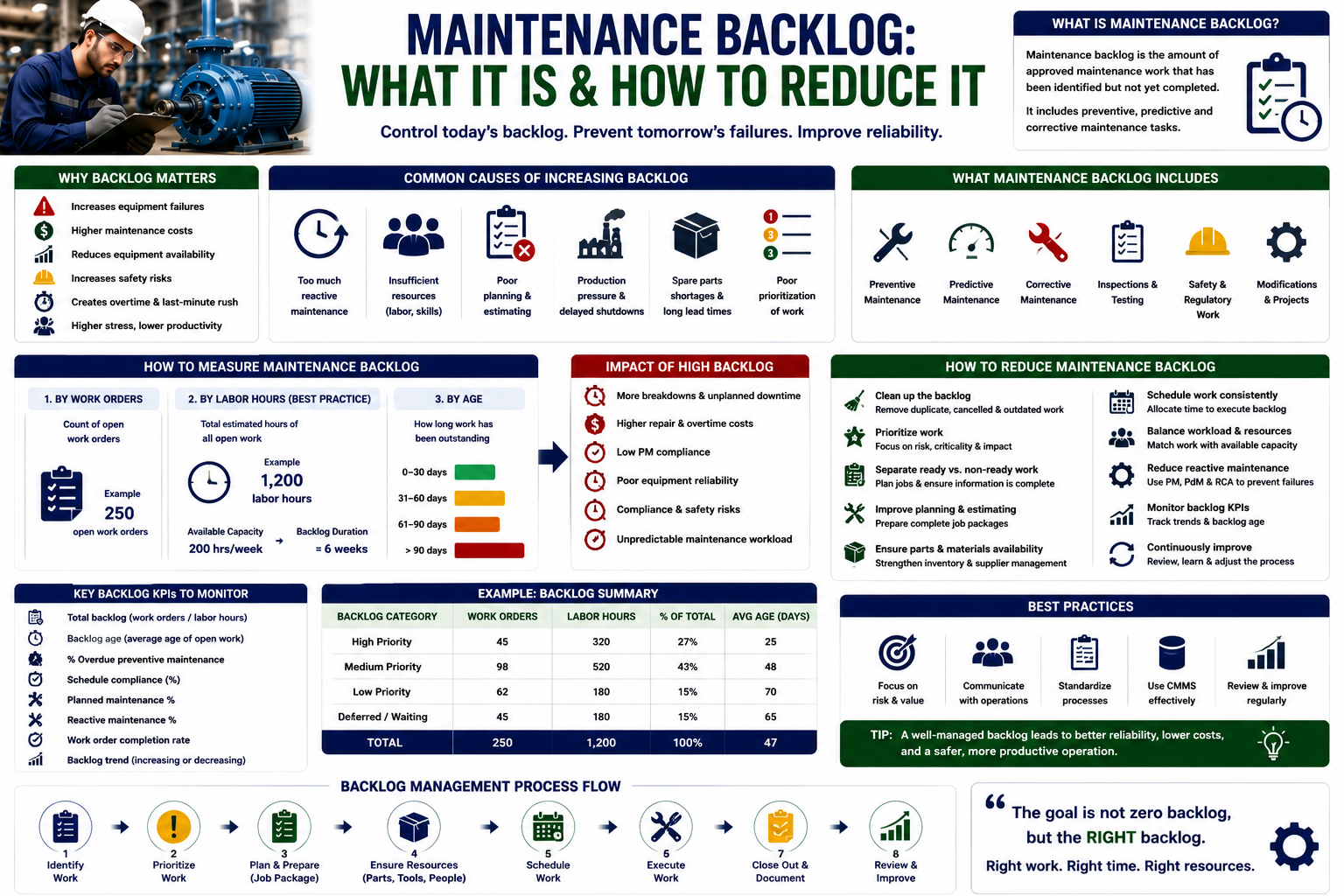
Other useful KPIs include preventive-maintenance compliance, maintenance backlog, schedule compliance, planned-to-unplanned work ratio, maintenance cost, and repeat-failure rate.