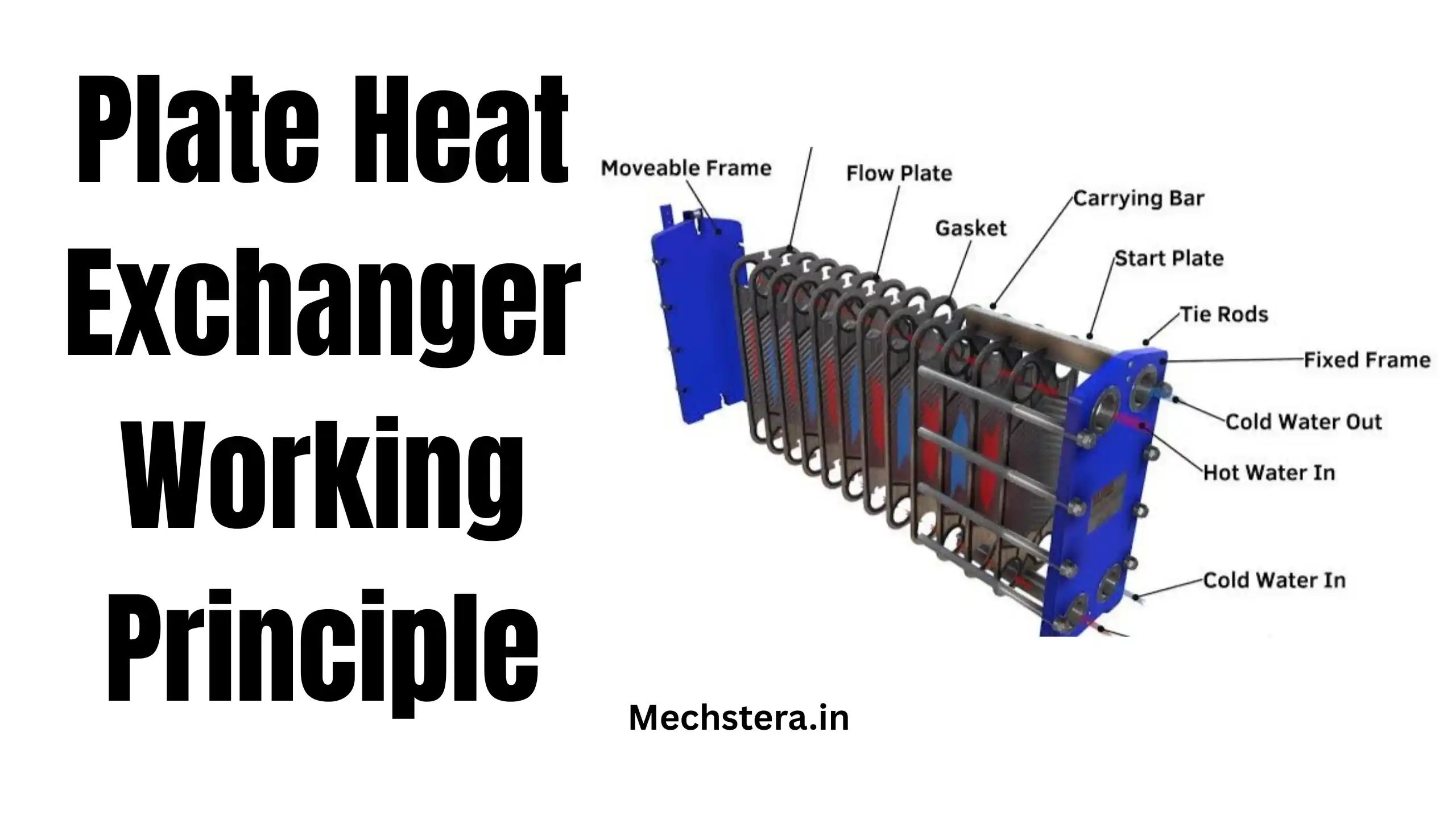
We’ve walked into plenty of utility rooms where someone points at a stack of thin metal plates bolted together and asks, “so how does this thing actually work?” It looks simple from the outside. Once you open one up, though, you start to appreciate how much thought went into every corrugation, every gasket, every millimeter of gap between plates. At Mechstera, we spend a good part of our week specifying, installing, and troubleshooting these units, so this isn’t theory pulled from a textbook. It’s what we see on site.
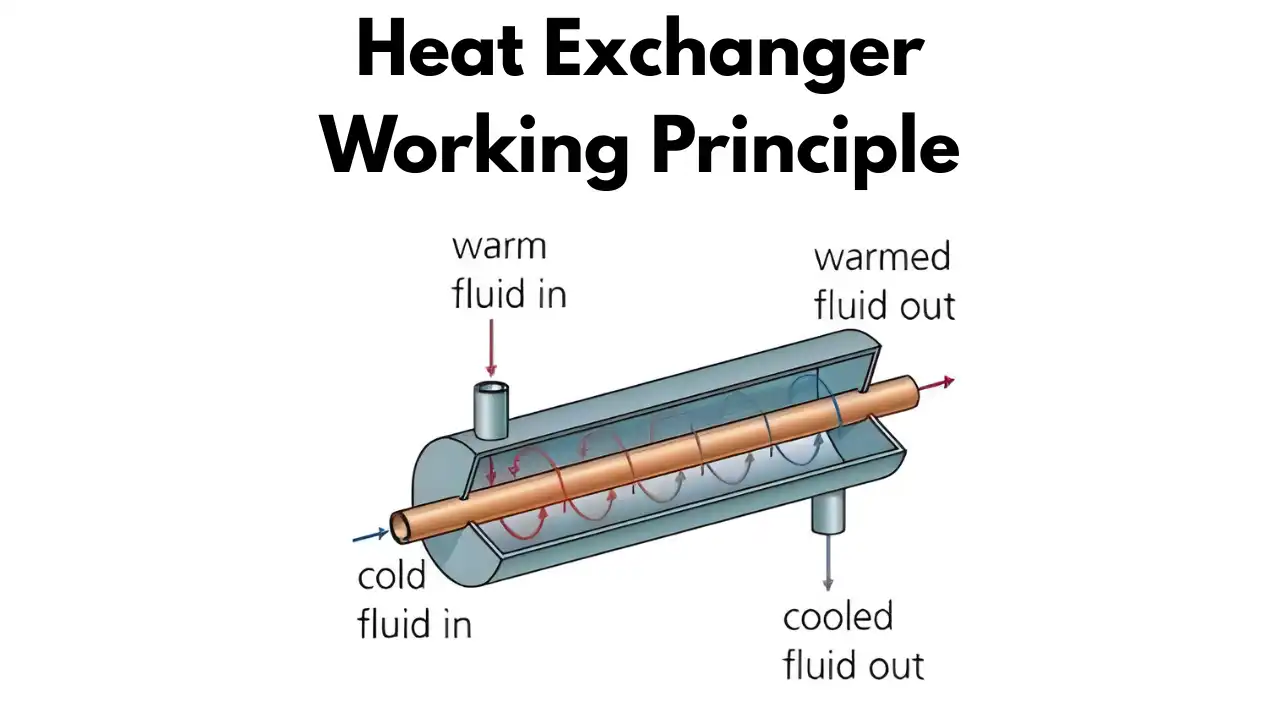
The short version of the plate heat exchanger working principle is this: two fluids, one hot and one cold, flow through alternating narrow channels formed between thin metal plates, and heat passes through the plate wall from the hot side to the cold side without the fluids ever touching. That’s it in one sentence. The interesting part, and the part that actually determines how well a unit performs, is everything happening inside those channels.
What Happens Inside a Plate Heat Exchanger
Picture a stack of rectangular plates, each pressed with a wavy or diamond shaped pattern, lined up one after another with a thin gap between each pair. Hot fluid enters through a corner port and gets directed into every other channel. Cold fluid enters through a different corner and fills the channels in between. So plate number two has hot fluid running along one face and cold fluid running along the other face, and that pattern repeats down the whole stack.
Because the plates are thin, usually somewhere between 0.3 mm and 1 mm of cold formed stainless steel, titanium, or aluminium, heat moves through them quickly. The corrugated surface also forces the fluid into a twisting, turbulent path rather than a smooth laminar flow, and that turbulence is honestly doing most of the heavy lifting. A flat, smooth channel would transfer far less heat for the same footprint. In practice, that’s why a plate unit the size of a filing cabinet can do the job of a shell and tube exchanger several times its size.
Plate Heat Exchanger Working Principle With Diagram: Reading the Flow Path
If you’ve ever looked up a plate heat exchanger working principle with diagram search result, you’ve probably seen the classic cutaway image showing red arrows for hot fluid and blue arrows for cold fluid weaving in opposite directions. That opposing arrangement is called countercurrent flow, and it’s used deliberately because it keeps the temperature difference between the two fluids more even across the whole plate, which means better overall heat transfer than fluids moving the same direction.
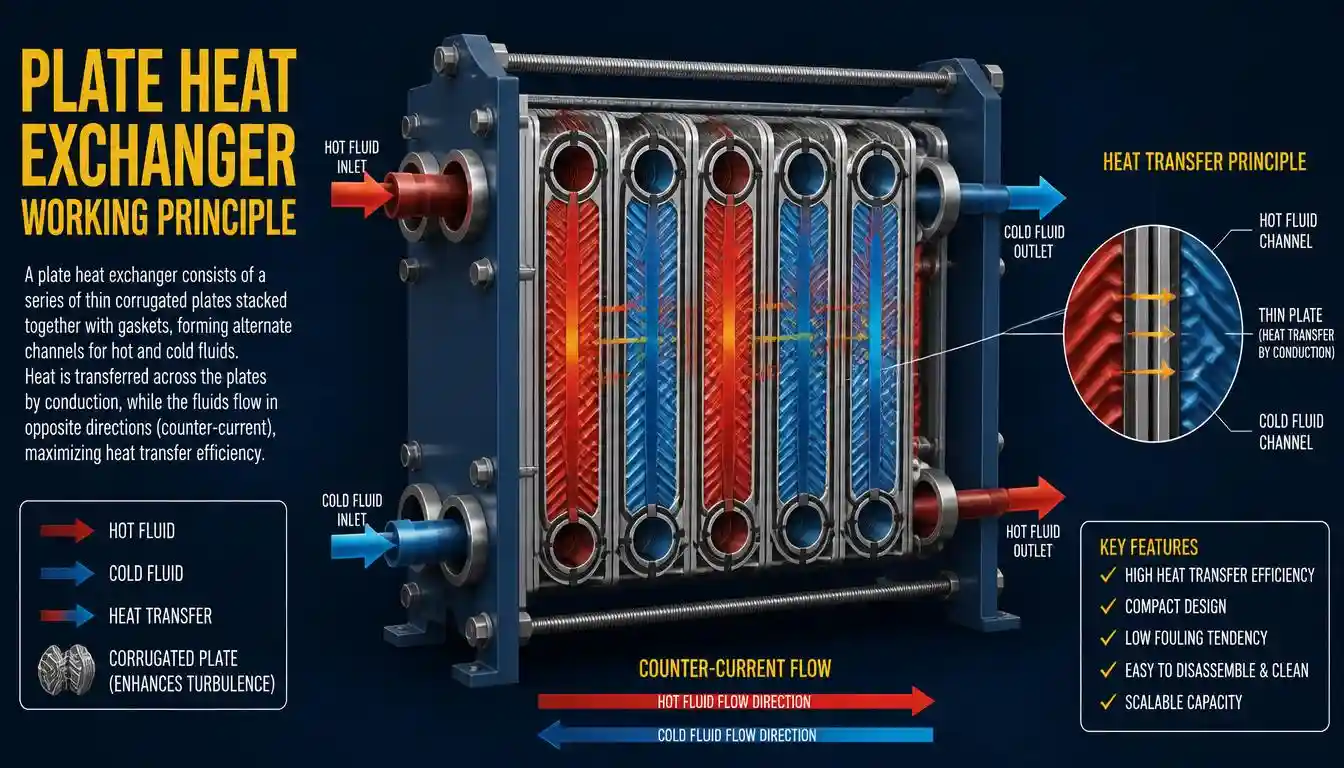
Most commercial units run in parallel countercurrent, meaning every channel carries fluid at roughly the same rate, moving in opposition to the neighboring channel. A less common setup runs the fluids in series, one channel after another rather than side by side. That configuration only makes sense when flow rates are small but the required temperature change is large, and even then it usually comes with a pressure drop penalty that buyers don’t always anticipate when they choose it purely to save on plate count.
Why Corrugation and Chevron Angle Matter
The wavy pattern pressed into each plate isn’t decorative. It sets the corrugation pitch, the corrugation depth, and the chevron angle relative to the direction of flow, and each of those numbers pushes performance in a different direction. A steep chevron angle above roughly 45 degrees produces strong turbulence and excellent heat transfer, but it also drives up pressure drop. A shallower angle calms the flow down, cuts pressure loss, but gives up some thermal performance in return. Good thermal design is really just finding the angle that fits the specific duty rather than grabbing whatever plate happens to be in stock.
The gap between plates, often called b, typically sits between 1 mm and 5 mm. Tighter gaps push fluid velocity up and improve heat transfer, but they also make the unit far more sensitive to particles and scale, so a slightly dirty water source can clog a tight gap plate in a way it never would in a wider one.
Gasketed PHE vs Brazed BPHE
People searching plate heat exchanger PDF datasheets usually land on one of two families: gasketed plate and frame units, and brazed plate units. They solve the same problem differently.
| Feature | Gasketed PHE | Brazed BPHE |
|---|---|---|
| Sealing method | Rubber gaskets between plates | Copper or nickel brazed joints, furnace bonded |
| Maintainability | Can be opened, cleaned, replated | Sealed for life, no disassembly |
| Compactness | Bulkier due to frame and tie bars | Smaller footprint, lighter |
| Operating limits | Roughly 80°C to 200°C, up to 25 bar | Higher pressure and temperature tolerance |
| Best fit | Applications needing frequent cleaning | Refrigerants, closed loops, tight equipment rooms |
| Typical cost driver | Press tooling and gasket replacement | One time furnace brazing, no replacement gaskets |
Neither option is universally better. We tend to steer clients toward gasketed units when the fluid is prone to fouling, food processing lines and untreated water loops are a good example, because you genuinely need to pull the plates apart and scrub them. For sealed refrigerant circuits or compact HVAC skids, brazed units usually win on space and long term leak resistance.
Pros and Cons of Plate Heat Exchangers
| Pros | Cons |
|---|---|
| Very high heat transfer area for the physical size | Narrow channels are prone to fouling with dirty fluids |
| Easy to expand gasketed units by adding plates | Gaskets limit maximum pressure and temperature |
| Countercurrent flow gives close temperature approach | Brazed units cannot be cleaned or reconfigured |
| Lower refrigerant or water charge than shell and tube designs | Uneven flow distribution across many plates hurts performance |
| Compact footprint saves valuable plant room space | Upfront tooling and gasket costs can be significant |
That last con in the performance column deserves a mention because it catches people off guard. As you add more plates to a gasketed unit, the fluid naturally favors the first few channels it reaches rather than spreading evenly, since it’s simply following the path of least resistance. Add too many plates chasing a bigger surface area and you can actually end up with worse real world performance than a smaller, well balanced unit. We’ve seen this trip up buyers who assume more plates always means more capacity. It doesn’t, not once distribution starts breaking down.
Materials and Configurations Worth Knowing
A short list is genuinely the clearest way to cover this, so here it is:
- Stainless steel, usually AISI 304 or 316, for general water and process duties
- Titanium for seawater, brine, or chloride heavy fluids where corrosion resistance matters
- Aluminium for lightweight, lower pressure applications
- Butyl or silicone rubber gaskets, chosen based on chemical compatibility and temperature range
Plate size itself ranges enormously, from small units around 100 mm by 300 mm up to large industrial plates around 1000 mm by 2500 mm, with anywhere from ten plates to several hundred stacked into a single frame.
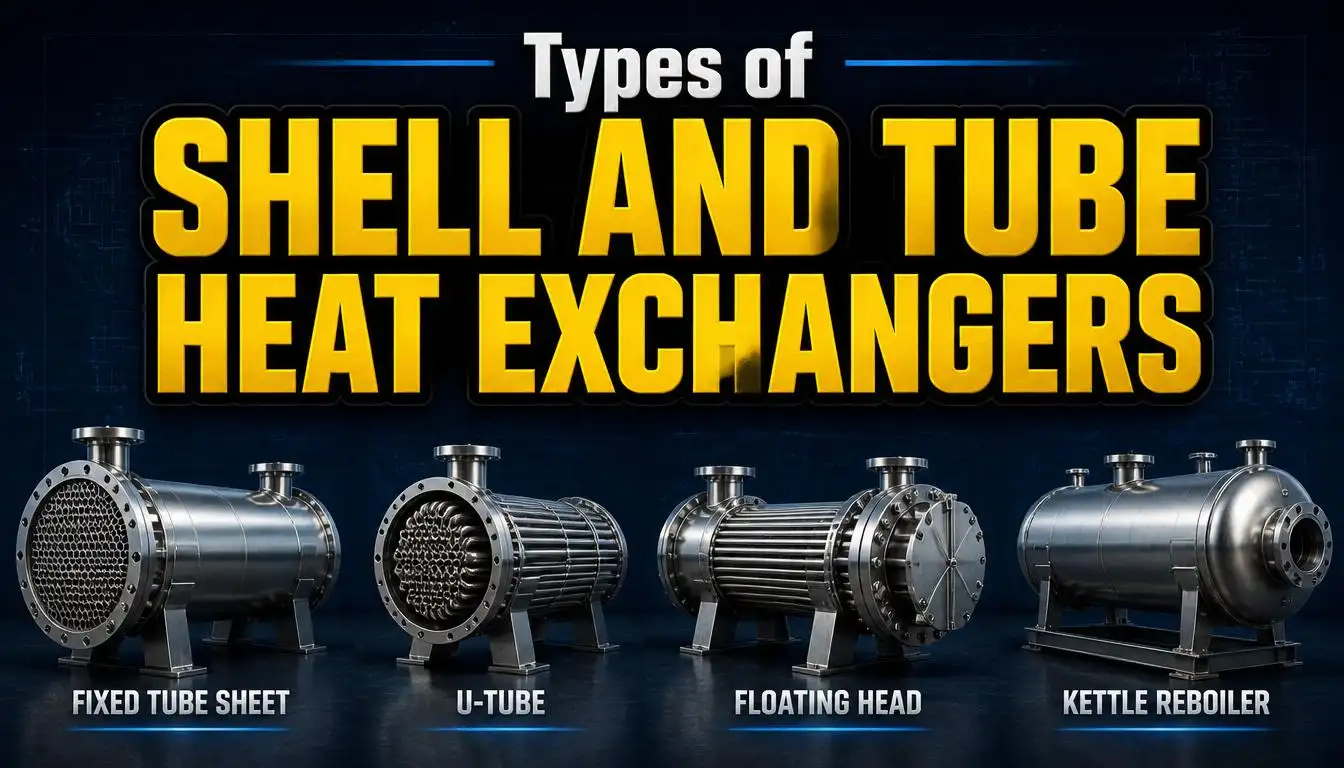
Meanwhile, you can also check out our guide on : Shell and Tube Heat Exchanger: Working, Diagram, Types & Uses
Plate Heat Exchanger Working Principle PDF and Animation: When to Use Which
Manufacturer PDFs are useful once you already understand the basics, since they’re built for spec sheets and pressure drop tables rather than teaching the concept. If you’re trying to explain the flow path to a colleague or a client who has never seen one opened up, an animation does that job far better, since watching the alternating hot and cold streams move through the plate stack in real time makes the countercurrent pattern obvious in a way a static diagram struggles to. We usually pull up a short animation clip in early client meetings before ever opening a PDF datasheet, and it saves a lot of back and forth.
Where Mechstera Fits In
Most of the plate heat exchanger questions that land on our desk at Mechstera aren’t about the working principle itself, they’re about sizing a replacement, diagnosing a drop in output, or deciding between gasketed and brazed for a retrofit. Understanding the fluid dynamics inside the plates is what lets us catch problems like flow maldistribution or the wrong chevron angle for the duty before they turn into a failed unit on site. That practical grounding is really the whole point of writing this up in plain terms rather than repeating a textbook definition.
FAQs
How does a plate heat exchanger transfer heat without mixing fluids?
Each fluid stays confined to its own set of channels, sealed by gaskets or brazed joints, while heat conducts through the thin metal plate separating the hot and cold sides.
What is the ideal chevron angle for a plate heat exchanger?
There isn’t one universal answer. Angles above 45 degrees favor heat transfer at the cost of pressure drop, while shallower angles reduce pressure loss but transfer less heat, so the right angle depends on the specific duty.
Can a brazed plate heat exchanger be cleaned or repaired?
No. Brazed units are sealed permanently during manufacturing, so they cannot be opened, replated, or mechanically cleaned the way gasketed units can.
Why does adding more plates sometimes reduce performance?
Flow distribution becomes uneven as plate count rises, with fluid favoring the first channels over the last, so beyond a certain point extra plates add cost without adding usable capacity.
What materials are plate heat exchanger plates typically made from?
Stainless steel grades 304 and 316 cover most general duties, titanium handles corrosive or seawater applications, and aluminium is used for lighter, lower pressure needs.
For a deeper technical breakdown of flow paths and thermal design, Alfa Laval’s plate heat exchanger explainer is a solid reference worth reading alongside this guide.